BLUF (Bottom Line Up Front)
The NREMT cognitive exam is a computerized adaptive test. It does not ask a fixed number of questions at a fixed difficulty level. It adapts to your performance in real time. Understanding how the CAT algorithm works — and what it is actually measuring — changes how you should prepare.
What Makes a CAT Different
A standard multiple-choice exam asks every candidate the same questions in the same order. Your score is determined by how many questions you answer correctly. The exam is the same for everyone.
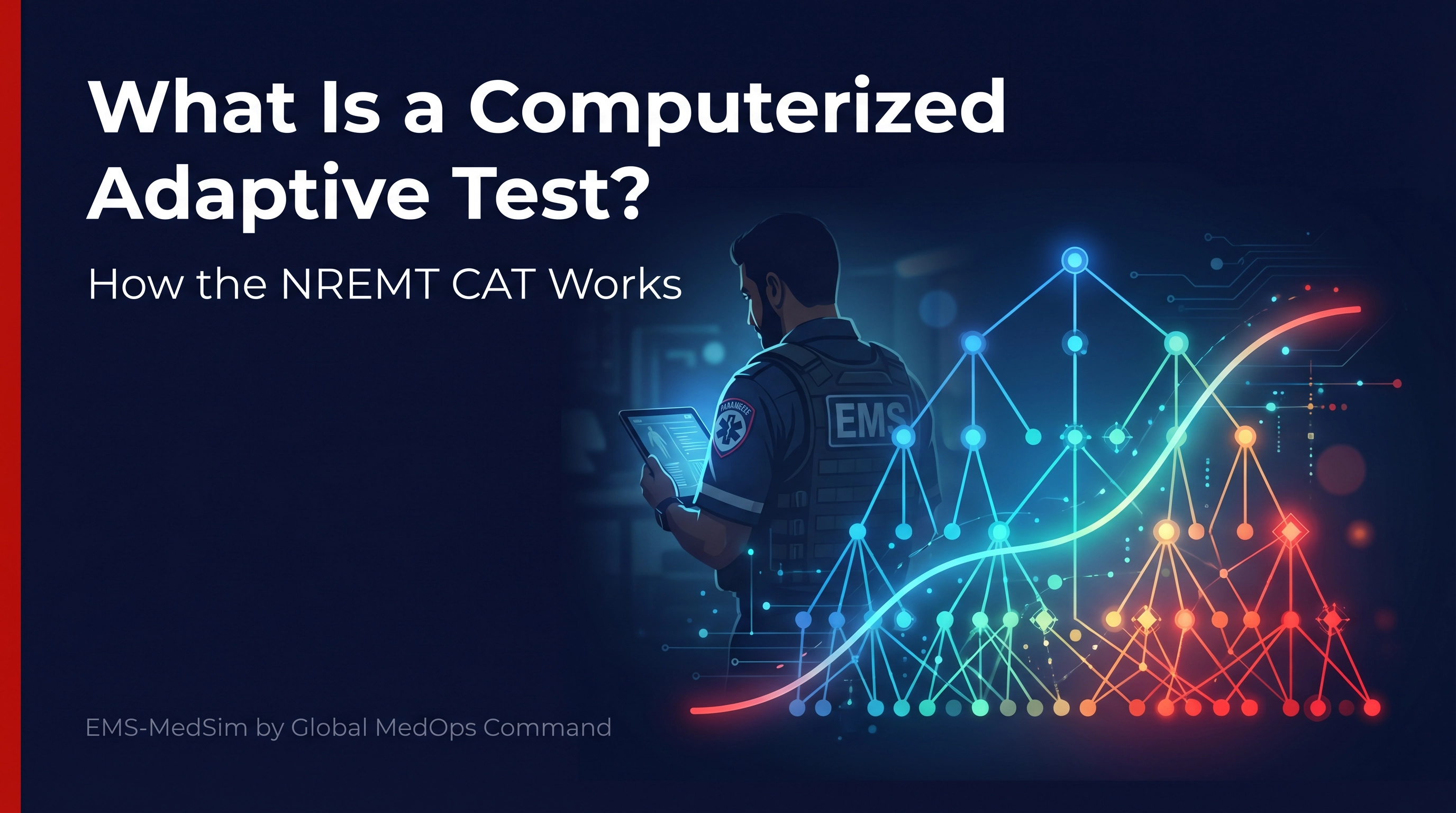
A computerized adaptive test works differently. The algorithm starts with a question at a moderate difficulty level. If you answer correctly, the next question is harder. If you answer incorrectly, the next question is easier. The algorithm is continuously updating its estimate of your ability level based on every answer you give.
The exam ends when the algorithm has enough information to make a pass/fail decision with statistical confidence — or when you reach the maximum question limit.
This has several important implications for how you experience the exam:
The number of questions varies. The NREMT EMT exam can end anywhere between 70 and 120 questions. The paramedic exam can end between 80 and 150 questions. Getting more questions does not mean you are doing better or worse — it means the algorithm needs more data to make a confident decision.
The difficulty of questions varies. If you are performing well, you will see harder questions. This can feel disorienting — the exam seems to get harder as you go. That is by design. The algorithm is trying to find the ceiling of your competency.
You cannot skip questions or go back. Each answer updates the algorithm's estimate of your ability. Skipping or changing answers would corrupt the adaptive process.
What the Algorithm Is Measuring
The CAT algorithm is not measuring how many questions you get right. It is measuring your ability level — specifically, whether your ability level is above or below the minimum competency standard for entry-level practice.
The algorithm maintains a running estimate of your ability level and the confidence interval around that estimate. The exam ends when the confidence interval is narrow enough to make a pass/fail decision with statistical certainty — or when you hit the question limit.
This means that a candidate who answers 70 questions and passes has demonstrated competency just as clearly as a candidate who answers 120 questions and passes. The difference is how quickly the algorithm reached statistical confidence.
It also means that the exam is not graded on a curve. You are not competing against other candidates. You are being measured against a fixed competency standard.
Why This Changes How You Should Prepare
Most candidates prepare for the NREMT as if it were a standard multiple-choice exam. They focus on memorizing protocols, drug doses, and normal values. They run through practice questions until they can answer quickly and accurately.
This preparation is not wrong — it builds the baseline knowledge you need. But it is not sufficient for the CAT.
The CAT is testing clinical judgment, not knowledge recall. It is asking whether you can apply what you know when the situation is ambiguous, when the presentation is atypical, or when your first intervention does not work.
Practice questions build pattern recognition. When you have seen enough questions about tension pneumothorax, you recognize the presentation quickly. But the CAT will present tension pneumothorax in a way you have not seen before — with an atypical presentation, a complicating factor, or a patient who deteriorates after your initial intervention.
Simulation-based training builds the judgment the CAT is actually measuring. When you have worked through a scenario where the patient deteriorated because you delayed needle decompression, you do not just know the right answer. You understand the clinical stakes and the decision-making process.
The Practical Implications
Do not try to game the question count. Candidates sometimes try to answer questions slowly to avoid reaching the maximum question limit, or quickly to end the exam sooner. Neither strategy works. The algorithm is measuring your ability level, not your pacing.
Do not interpret question difficulty as a sign of failure. If the questions are getting harder, it means you are performing well. The algorithm is trying to find the ceiling of your competency.
Do not panic if the exam does not end at 70 questions. Getting more questions means the algorithm needs more data — not that you are failing.
Focus your preparation on clinical judgment, not recall. The CAT will find the limits of your pattern recognition. Simulation training builds the judgment that performs well when pattern recognition is not enough.
Summary
The NREMT CAT adapts question difficulty based on your performance and ends when the algorithm has statistical confidence in a pass/fail decision. It measures clinical judgment, not knowledge recall. Preparing for the CAT requires both practice questions (for baseline knowledge) and simulation (for the judgment the algorithm is actually testing). Do not try to game the question count or interpret difficulty as failure — focus on building the clinical judgment that performs consistently across all difficulty levels.