BLUF (Bottom Line Up Front)
Flight paramedics face a fundamental training paradox: the calls that require the most clinical skill occur least frequently. A flight program that runs 1,500 transports per year may see only a handful of neonatal transports, LVAD complications, or post-cardiac surgery patients with tamponade. Maintaining competency in these presentations requires a deliberate training strategy that goes beyond waiting for the next call.
Why Do Flight Paramedics Struggle to Maintain Skills Between High-Acuity Calls?
In ground EMS, the calls that require the most skill — cardiac arrests, major trauma, respiratory failure — occur frequently enough that providers maintain competency through regular exposure. A busy ground paramedic may run a cardiac arrest every few weeks. The pattern recognition stays sharp.
In critical care transport, the highest-acuity presentations occur much less frequently. A flight program that runs 1,500 transports per year may see 10-15 neonatal transports, 5-10 LVAD complications, and 20-30 post-cardiac surgery patients. Spread across a team of 10-15 providers, each individual provider may see these presentations only a few times per year.
The problem is not that providers do not know what to do. They do — they learned it in their critical care transport training. The problem is that the pattern recognition that allows them to manage these presentations automatically, under pressure, without having to consciously recall the protocol, degrades between exposures.
This is not a failure of training. It is a neurological reality. Skills that are not practiced regularly require conscious effort to execute. Conscious effort is slower and more error-prone than automatic execution.
What Does Skill Degradation Actually Look Like for Critical Care Transport Providers?
Skill degradation in critical care transport does not usually look like a provider forgetting what to do. It looks like a provider who knows what to do but takes longer to recognize the situation, longer to make the decision, and longer to execute the intervention.
In a stable patient with time to spare, this is acceptable. In a patient who is deteriorating at altitude with limited options, the extra time matters.
The presentations where skill degradation is most dangerous are the ones where the recognition is the hard part. Tension pneumothorax in a ventilated patient. Cardiogenic shock in a patient who was hemodynamically stable at the time of transfer. LVAD pump failure in a patient who was transferred for a non-cardiac reason.
These are the presentations where the experienced provider recognizes the situation immediately and acts. The provider whose pattern recognition has degraded between exposures may recognize the situation — but later, and with more cognitive effort.
What Is the Best Training Strategy for Maintaining Critical Care Transport Competency?
Maintaining competency between high-acuity calls requires a deliberate training strategy with three components:
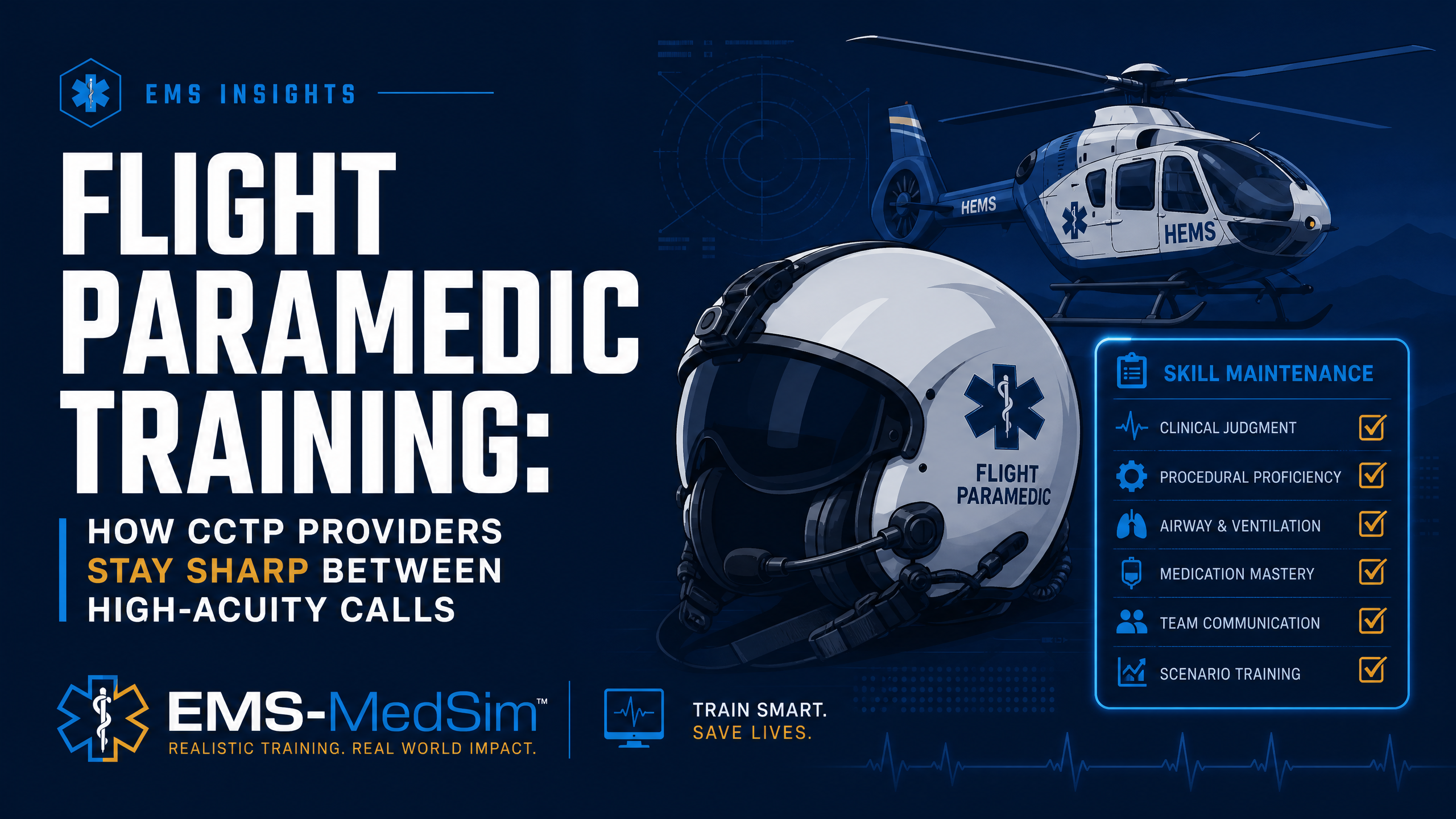
Regular simulation in low-frequency presentations. Work through at least one scenario per week in the presentations that define critical care transport. The goal is not to learn new material — it is to maintain the pattern recognition that allows automatic execution.
Structured debriefs after every transport. Every transport is a learning opportunity, regardless of acuity. After each transport, spend five minutes reviewing the decisions you made and why. What was your initial assessment? What was your differential? What interventions did you perform and in what order? What would you do differently?
Peer review of high-acuity transports. High-acuity transports should be reviewed by the team, not just the crew that ran the call. Peer review surfaces the decision-making process and allows the team to learn from each other's experience.
How Does Simulation Help Flight Paramedics Stay Sharp?
Simulation is the most effective tool for maintaining competency in low-frequency presentations. It provides repeated exposure to the presentations that matter most, with immediate feedback on performance.
The key is specificity. Generic EMS simulation is not sufficient for critical care transport skill maintenance. The scenarios need to replicate the clinical complexity of critical care transport patients — with the comorbidities, the active interventions, and the physiologic instability that characterize these patients.
EMS-MedSim includes scenarios specifically designed for critical care transport providers. These scenarios are built by a board-certified emergency physician who works in critical care transport and are reviewed against current evidence and guidelines.
The scenarios are branching — patient outcomes change based on your decisions. This is critical for skill maintenance because it builds the decision-making habits, not just the pattern recognition. When you have worked through a scenario where the patient deteriorated because you misidentified cardiogenic shock as distributive shock, you build the habit of checking for the distinguishing features before committing to a treatment approach.
How Should a Flight Program Build a Team-Based Training Program?
Individual simulation practice is valuable. Team-based simulation is more valuable for critical care transport, because critical care transport is a team activity.
A team training program has three components:
Individual simulation practice. Each provider maintains their individual competency through regular simulation in low-frequency presentations.
Team simulation exercises. The crew trains together on high-acuity scenarios, practicing the communication and coordination that is as important as the clinical skills.
Program-level case review. The program reviews high-acuity transports as a team, using the cases to identify training needs and update protocols.
The combination of individual practice, team exercises, and program-level review creates a learning culture that maintains competency across the team — not just in the most experienced providers.
Summary
Flight paramedics face a fundamental training paradox: the highest-acuity presentations occur least frequently, and the pattern recognition that allows automatic execution degrades between exposures. Maintaining competency requires a deliberate training strategy: regular simulation in low-frequency presentations, structured debriefs after every transport, and peer review of high-acuity calls. Simulation is most effective when it replicates the clinical complexity of critical care transport patients and uses branching scenarios that build decision-making habits, not just pattern recognition.