BLUF (Bottom Line Up Front)
Lectures teach declarative knowledge: facts, protocols, drug doses. Simulation trains procedural knowledge: the ability to apply that knowledge under pressure, when the presentation is atypical and the stakes are real. The difference is not just pedagogical. It is neurological. Clinical judgment is a skill, and skills are built through deliberate practice with feedback, not passive learning. This article explains why, then gives you a five-step framework for turning scenario practice into field-ready automaticity.
The Neuroscience of Clinical Judgment
Clinical judgment is not a knowledge problem. It is a pattern recognition and decision-making problem.
When an experienced paramedic walks into a room and immediately knows the patient is sick, before a single vital sign is taken, they are not applying a protocol. They are pattern-matching against thousands of previous encounters. The recognition is automatic, fast, and largely unconscious.
That kind of automatic recognition is built through exposure with feedback. Not through lectures. Not through practice questions. Through repeated contact with real or simulated patient presentations, followed by a clear signal about whether the read was right.
Lectures can teach you the signs of tension pneumothorax. They cannot build the recognition that fires when you walk in and see a patient who is not moving air on one side.
What Deliberate Practice Looks Like in EMS
Deliberate practice is not the same as experience. Experience is doing the job. Deliberate practice is doing the job with specific attention to the skill you are trying to develop, with immediate feedback on performance.
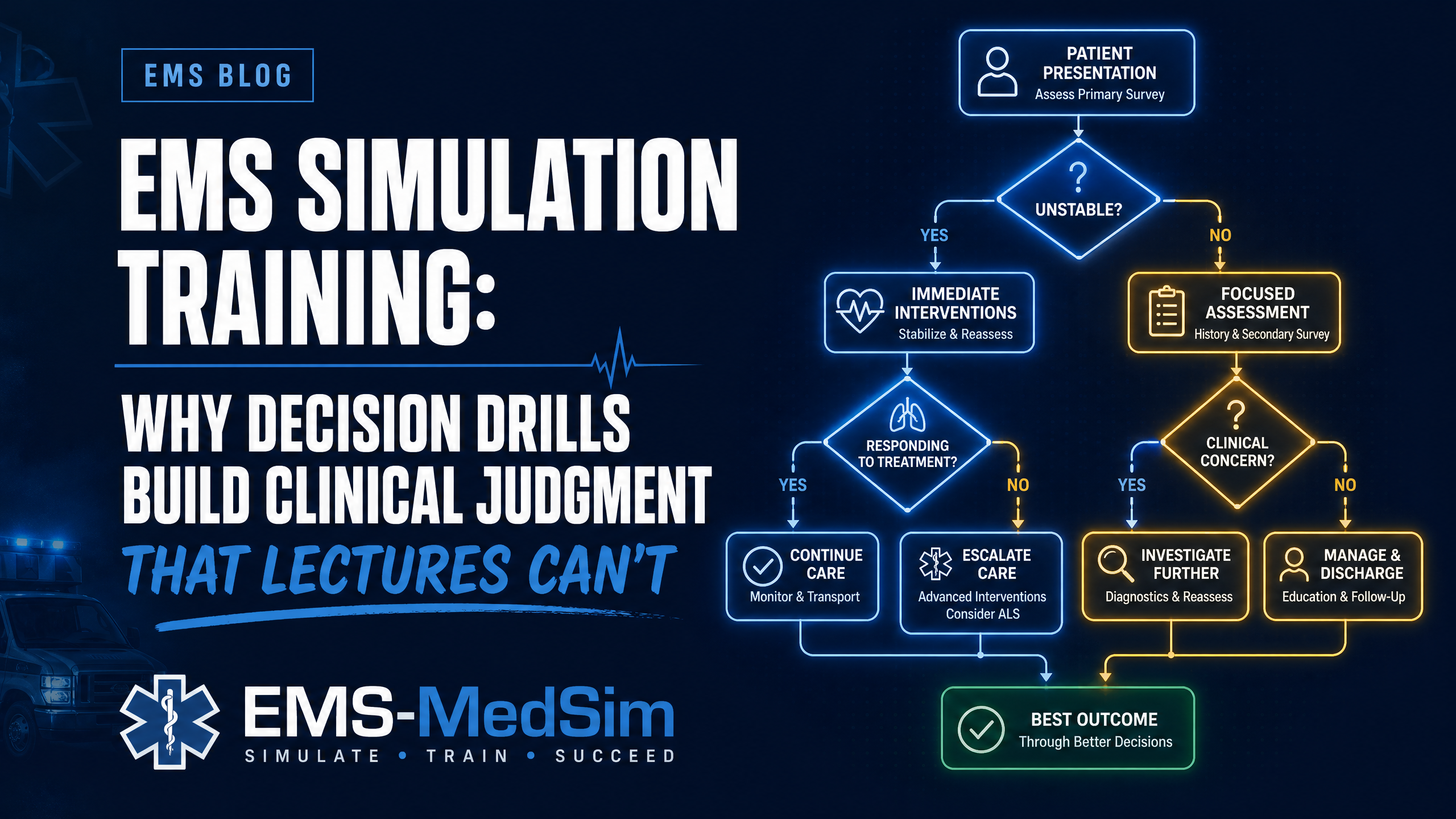
In EMS it looks like this: you work a scenario. You make a decision. The scenario shows you the consequence. You get specific feedback on why the decision was right or wrong. You run it again with a different decision.
The feedback loop is the critical element. Without feedback, experience builds habits, some good and some bad. With feedback, experience builds judgment. That is why simulation outperforms field experience alone: the field provides exposure, simulation provides exposure plus feedback, and the combination is what builds judgment.
The evidence is not subtle. A meta-analysis comparing simulation-based education with deliberate practice against traditional clinical education found a large advantage for simulation in skill acquisition, with an overall effect size of 0.71 (McGaghie et al., Acad Med 2011). A larger review of 609 studies and 35,226 trainees found technology-enhanced simulation produced large gains in knowledge, skills, and behaviors and moderate gains in direct patient outcomes compared with no intervention (Cook et al., JAMA 2011).
The Limitations of Lectures
Lectures are efficient for transmitting declarative knowledge. A good lecture can teach you the ACLS algorithm in 45 minutes, and that is genuinely useful.
But lectures cannot train procedural knowledge. You cannot learn to drive by listening to a lecture about driving. You cannot learn to run a cardiac arrest by listening to a lecture about ACLS.
Most EMS education is still lecture-heavy. Students learn the protocols, pass the written exams, and graduate with excellent declarative knowledge and limited procedural knowledge. Then they reach the field, and the protocols do not tell them what to do when the patient does not look like the textbook.
Why Branching Scenarios Beat Linear Ones
Not all simulation is equal. Linear scenarios, where the patient follows a predetermined path no matter what you do, build pattern recognition but not decision-making.
Branching scenarios, where the patient's condition changes based on your choices, build both. When the patient deteriorates because you delayed a critical intervention, you learn not just what the right intervention was, but why it mattered and what happens when you get it wrong. The feedback is immediate and specific. You do not wait until the debrief to find out.
In some ways this is better than the field. In the field, patients sometimes survive suboptimal decisions. In simulation, consequences are consistent and educational.
A Five-Step Framework for Building Automaticity
Automaticity is the ability to perform complex clinical tasks, airway management, rhythm interpretation, drug dosing, without conscious deliberation. It frees cognitive bandwidth for situational awareness when it matters most. Here is how to build it with scenario practice.
Step 1: Set up for immersion
Simulation only produces durable competency when the provider is fully present and treating the scenario as a real call. That means a quiet, distraction-free environment, a stable connection if the platform is online, and baseline protocol knowledge in place before you launch. Simulation sharpens execution. It does not replace learning the foundation.
Step 2: Select high-acuity, branching scenarios
Prioritize low-frequency, high-stakes presentations: pediatric respiratory distress, tension pneumothorax, multi-system trauma, the inferior STEMI with right ventricular involvement. These are the calls where hesitation costs lives and where repetition pays the highest return. Verify the scenario truly branches. And let your agency's QA/QI data drive the queue: if the last run review flagged delays in pediatric airway management, that is the next scenario, not an arbitrary topic rotation.
Step 3: Engage the feedback, and repeat at the failure point
On EMS-MedSim, the Virtual FTO (AI Decision Coach) asks Socratic questions after each decision: "You've given the first dose. What does the SpO₂ trend tell you, and how does that change your next priority?" Answer them honestly. When you make an incorrect intervention, do not run the case to the end and move on. Reset that decision point and repeat it until the correct pathway is automatic. Drill the segment that broke, not the entire case.
Step 4: Analyze the debrief and name the bias
The scenario ends; the learning does not. Read the feedback line by line and connect each intervention to its clinical rationale. Then name the cognitive error. Did anchoring lock you onto an early impression? Did premature closure cut the assessment short? Did you defer the 12-lead past the ten-minute window because the patient "didn't look cardiac"? Naming the bias is the first step toward correcting it, and the agency QA/QI dashboard will show you whether it is yours alone or a crew-wide pattern.
Step 5: Iterate until the coach goes quiet
One run builds awareness. Repetition builds automaticity. Return to the same scenario until you can execute a clean run without a single prompt. When the Virtual FTO has nothing to say because you anticipated every branch, that is the signal that field-ready competency has taken hold. Skill decay is real and fast, so schedule a return visit to each high-stakes scenario at roughly 30-day intervals.
How to Build a Simulation Practice
A simulation practice is not something you do once before a certification exam. It is an ongoing habit with three components.
Regular volume. Two to three scenarios per week builds the pattern library that comes from repeated exposure to a wide range of presentations.
Deliberate focus. Identify your weakest areas and spend your simulation time there. If you are least confident in pediatric emergencies, work pediatric scenarios until your performance is consistent.
Active debrief. Spend a few minutes after each scenario reviewing your decisions and the feedback. The debrief is where the learning happens. Do not skip it.
For Agencies: Close the Loop with QA/QI
Individual gains compound only when the agency treats simulation as an operational tool rather than a one-off training event.
Controlled deployment. Assign scenario sets by certification level, schedule iteration windows, and require completion before field rotations.
Data integration. Decision-point accuracy, intervention timing, and protocol deviation rates should feed directly into the QA/QI process, giving the medical director a structured evidence base rather than anecdote. EMS-MedSim's agency dashboards surface which providers have reached automaticity and which still need targeted repetition at specific failure points.
Workflow alignment. When simulation scores inform preceptor pairings and remediation triggers, the platform shifts from a training tool to a performance management system, and providers engage because their data matters.
The Role of AI in EMS Simulation
AI-powered simulation has one specific advantage over traditional simulation: personalized, adaptive feedback at scale.
Traditional simulation needs an instructor to design scenarios, observe performance, and provide feedback. That is resource-intensive and inconsistent; the quality of the feedback depends on the instructor. AI-powered simulation can deliver consistent, evidence-based feedback on every decision, at any hour, specific to the clinical reasoning behind the choice.
EMS-MedSim uses AI this way across 50 branching scenarios, every one of them built and reviewed by a board-certified emergency physician and calibrated to the cognitive level of the NREMT. The AI coaches. It does not write the medicine.
Dr. Chet's Take
I have run a lot of debriefs, in simulation labs and after real calls, and the thing that separates the medics who get better from the ones who plateau is not talent and it is not years on the truck. It is whether they close the loop. The medic who runs a scenario, gets told the epinephrine was late, shrugs, and clicks into the next case will be late on the next real anaphylaxis too. The medic who stops, resets that decision point, and runs it three more times until the hand reaches for the drug box before the brain finishes the sentence has built something that will survive a 0300 call. That is automaticity, and there is no shortcut to it.
The agency side is where I see the most waste. Departments buy a simulation platform, announce it in a memo, and then measure nothing. Six months later the medical director cannot tell you which crews are drilling and which are not, and the QA/QI committee is still working off chart review alone. If you are going to spend the money, spend it on a loop: assign the scenarios, pull the decision-point data, put it next to your run review, and let it change who precepts whom. The data will embarrass you a little the first quarter. That is the point.
One honest caveat. Simulation builds judgment; it does not build hands. A medic who can run a perfect pediatric respiratory scenario on a screen still needs to have bagged a real child and felt the compliance change. Use the screen for the decisions, the lab for the hands, and the street for both. None of the three replaces the others.
Key Takeaways
- Clinical judgment is a pattern-recognition skill built through deliberate practice with feedback, not through lectures.
- Branching scenarios build both recognition and decision-making because the consequence of each choice is immediate and specific.
- Automaticity comes from repeating the failure point, not the whole case, until the correct pathway no longer requires conscious thought.
- Name the cognitive bias in every debrief; it is the only way to correct it.
- Return to high-stakes scenarios at roughly 30-day intervals, because skill decay is fast.
- Agencies get the return only when simulation data feeds QA/QI and changes assignments, preceptor pairings, and remediation.
Frequently Asked Questions
Why is EMS simulation training more effective than lectures?
Simulation forces active decision-making in realistic scenarios, which builds clinical judgment more effectively than passive lecture-based learning. Decision drills create automatic responses to protocols and expose gaps in reasoning that lectures cannot reveal.
What types of scenarios are used in EMS simulation training?
Cardiac arrest, respiratory failure, trauma assessment, stroke recognition, obstetric emergencies, and pediatric calls, among others. Branching decision trees let learners experience the consequences of both correct and incorrect choices.
How does simulation training improve clinical judgment in EMS?
Repeated exposure to high-acuity scenarios trains pattern recognition and decision-making under pressure. Immediate feedback after each choice reinforces correct protocols and builds the judgment providers need on real calls.
Sources
- McGaghie WC, Issenberg SB, Cohen ER, Barsuk JH, Wayne DB. Does simulation-based medical education with deliberate practice yield better results than traditional clinical education? A meta-analytic comparative review of the evidence. Acad Med. 2011;86(6):706-711. https://doi.org/10.1097/ACM.0b013e318217e119
- Cook DA, Hatala R, Brydges R, et al. Technology-enhanced simulation for health professions education: a systematic review and meta-analysis. JAMA. 2011;306(9):978-988. https://doi.org/10.1001/jama.2011.1234