BLUF (Bottom Line Up Front)
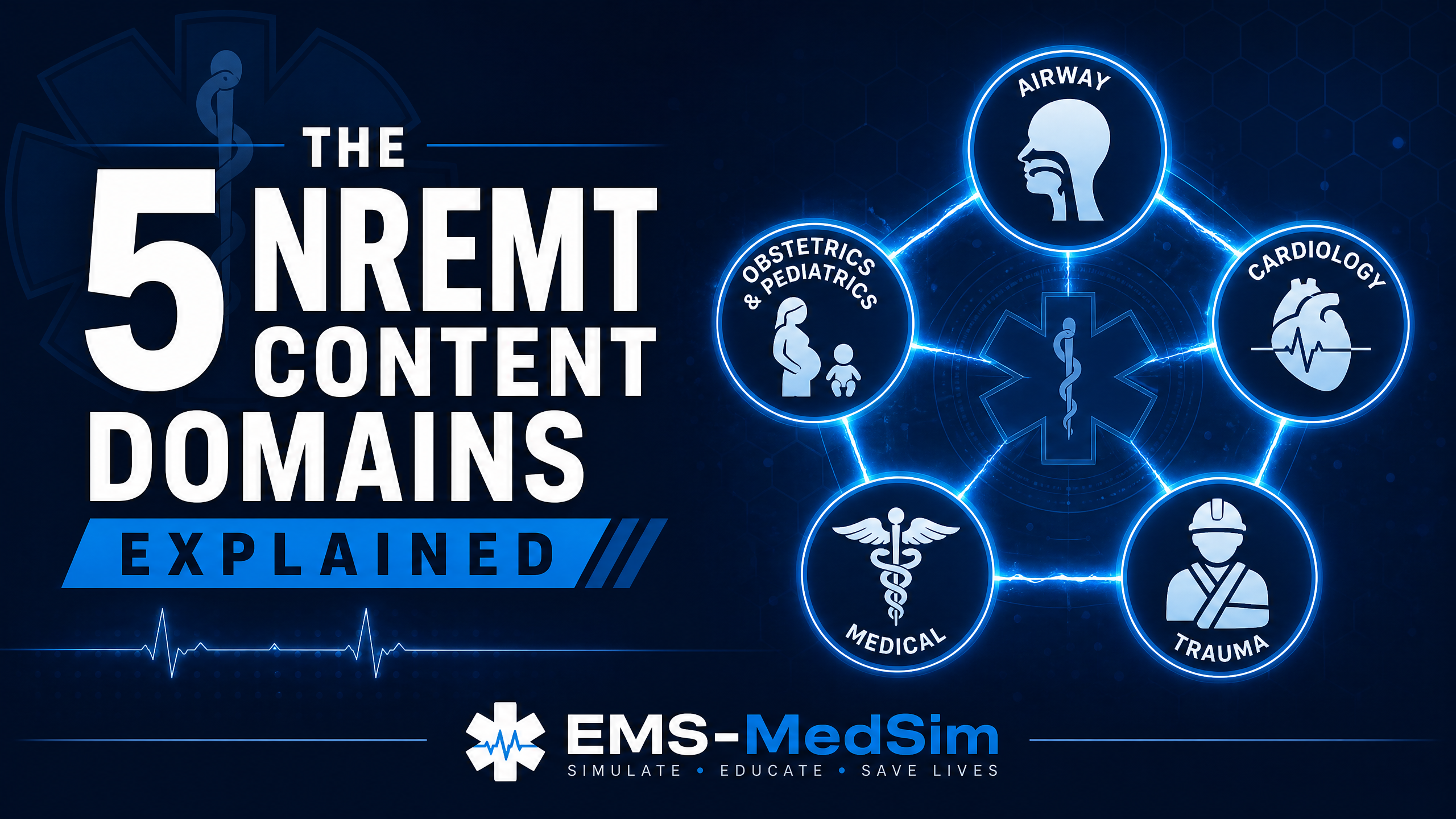
The NREMT cognitive exam is organized into five content domains. Most candidates study all five equally, which is the wrong approach. Understanding what each domain actually measures — and where the CAT algorithm weights its difficulty — changes how you allocate your preparation time.
The Five Domains
The NREMT cognitive exam tests five content domains across both EMT and paramedic levels. The domains and their approximate weighting are:
- Airway, Respiration, and Ventilation — approximately 18–22% of questions
- Cardiology and Resuscitation — approximately 20–24% of questions
- Trauma — approximately 14–18% of questions
- Medical/Obstetrics/Gynecology — approximately 27–31% of questions
- EMS Operations — approximately 10–14% of questions
These percentages are approximate and vary by certification level. The CAT algorithm adjusts question difficulty within each domain based on your performance, so a strong performance in one domain does not compensate for weakness in another.
Domain 1: Airway, Respiration, and Ventilation
This domain tests your ability to recognize and manage airway compromise and respiratory failure across the full spectrum of presentations — from the patient who is breathing adequately to the patient who is not breathing at all.
What the exam is actually testing: Can you recognize when a patient's airway is failing before they stop breathing? Can you select and execute the appropriate intervention under time pressure? Can you reassess and adjust when your initial intervention is not working?
High-yield topics: Recognition of respiratory failure versus respiratory distress, indications for BVM versus supraglottic airway versus endotracheal intubation (at paramedic level), management of tension pneumothorax, recognition and management of anaphylaxis with airway involvement, pediatric airway differences.
Preparation strategy: This domain rewards simulation over practice questions. The critical skill is recognizing deterioration early and acting before the patient crashes. Work through scenarios where the patient's respiratory status changes based on your decisions. Practice recognizing the difference between a patient who is working hard to breathe and one who is about to stop.
Domain 2: Cardiology and Resuscitation
This domain tests your ability to recognize and manage cardiac emergencies, including dysrhythmias, acute coronary syndromes, and cardiac arrest. At the paramedic level, this domain is heavily weighted toward 12-lead interpretation and ACLS application.
What the exam is actually testing: Can you recognize a STEMI equivalent when the presentation is atypical? Can you manage a wide-complex tachycardia when the patient is unstable? Can you apply ACLS algorithms when the patient does not respond the way the textbook says they should?
High-yield topics: STEMI equivalents (posterior MI, right ventricular infarction, Wellens syndrome), wide-complex tachycardias (VT versus SVT with aberrancy), ACLS algorithms with complications, post-ROSC management, cardiogenic shock.
Preparation strategy: This domain requires both knowledge and application. You need to know the algorithms cold before you can apply them under pressure. Use practice questions to build baseline knowledge of dysrhythmia recognition and ACLS algorithms, then use simulation to stress-test your application when the presentation is atypical or the patient deteriorates.
Domain 3: Trauma
This domain tests your ability to recognize and manage traumatic injuries across the full spectrum — from isolated extremity trauma to multi-system trauma with competing priorities.
What the exam is actually testing: Can you prioritize interventions when multiple systems are compromised simultaneously? Can you recognize life threats that are not immediately obvious? Can you manage hemorrhagic shock while also managing a compromised airway?
High-yield topics: Hemorrhage control and tourniquet application, tension pneumothorax recognition and management, traumatic brain injury management (hypotension and hypoxia avoidance), penetrating versus blunt trauma differences, spinal motion restriction indications.
Preparation strategy: Trauma scenarios with competing priorities are the highest-yield simulation training for this domain. Work through scenarios where the patient has both a compromised airway and hemorrhagic shock, and practice making the prioritization decision under time pressure.
Domain 4: Medical/Obstetrics/Gynecology
This is the largest domain by question volume. It covers a wide range of medical emergencies and is the domain where most candidates have the most gaps.
What the exam is actually testing: Can you differentiate between presentations that look similar but require different interventions? Can you manage a patient whose presentation crosses multiple categories? Can you recognize time-critical conditions that require rapid intervention?
High-yield topics: Altered mental status differential (hypoglycemia, stroke, seizure, overdose, sepsis), anaphylaxis management, obstetric emergencies (eclampsia, placental abruption, umbilical cord prolapse), toxicological emergencies, behavioral emergencies.
Preparation strategy: This domain benefits most from systematic review. The breadth of topics means that gaps are common. Use practice questions to identify your weakest areas, then use targeted simulation to build application skills in those areas.
Domain 5: EMS Operations
This domain tests your knowledge of EMS system operations, including scene safety, mass casualty incidents, hazmat operations, and documentation.
What the exam is actually testing: Can you make sound operational decisions when the situation is ambiguous? Can you apply START triage correctly under time pressure? Can you recognize when a scene is unsafe and take appropriate action?
High-yield topics: START triage algorithm, hazmat operations and PPE, scene safety and situational awareness, mass casualty incident management, documentation requirements.
Preparation strategy: This domain is primarily knowledge-based and responds well to practice questions. The START triage algorithm and hazmat operations are the highest-yield topics. Make sure you can apply START triage quickly and accurately — the CAT algorithm tests this at a higher cognitive level than simple recall.
How to Allocate Your Preparation Time
The most common mistake is spending equal time on all five domains. A better approach is to allocate time based on two factors: domain weighting and your personal performance gaps.
Start by taking a diagnostic practice exam that covers all five domains. Identify your weakest domains — the ones where you are consistently getting questions wrong or where you feel least confident.
Prioritize Cardiology and Medical/OB/GYN because they carry the most questions. A strong performance in these two domains significantly improves your overall pass probability.
Do not neglect Airway — it is the domain where the CAT algorithm is most likely to ask high-difficulty questions, because airway management is considered a core competency.
Use simulation for the domains where you need to build application skills (Airway, Cardiology, Trauma). Use practice questions for the domains where you need to build knowledge breadth (Medical/OB/GYN, Operations).
Summary
The NREMT cognitive exam tests five content domains with different weightings and different cognitive demands. Cardiology and Medical/OB/GYN carry the most questions. Airway carries the highest-difficulty questions. Trauma and Operations respond best to different preparation strategies. Allocate your time based on domain weighting and your personal gaps, not equally across all five. Use simulation for application-heavy domains and practice questions for knowledge-heavy domains.