BLUF (Bottom Line Up Front)
The NREMT cognitive exam fails candidates who study the right material the wrong way. It is a computerized adaptive test built to measure clinical decision-making under pressure — not protocol memorization. Practice questions develop pattern recognition. Simulation-based training develops the judgment the exam actually measures. Use both, but know which one does the heavier work.
The Exam You Think You Are Taking Is Not the Exam You Are Taking
Most EMT and paramedic candidates walk into the NREMT cognitive exam believing it rewards preparation. They spent weeks on flashcards, ran through hundreds of practice questions, and reviewed every drug dose and protocol in their textbook. They are prepared. And a significant number of them still fail.
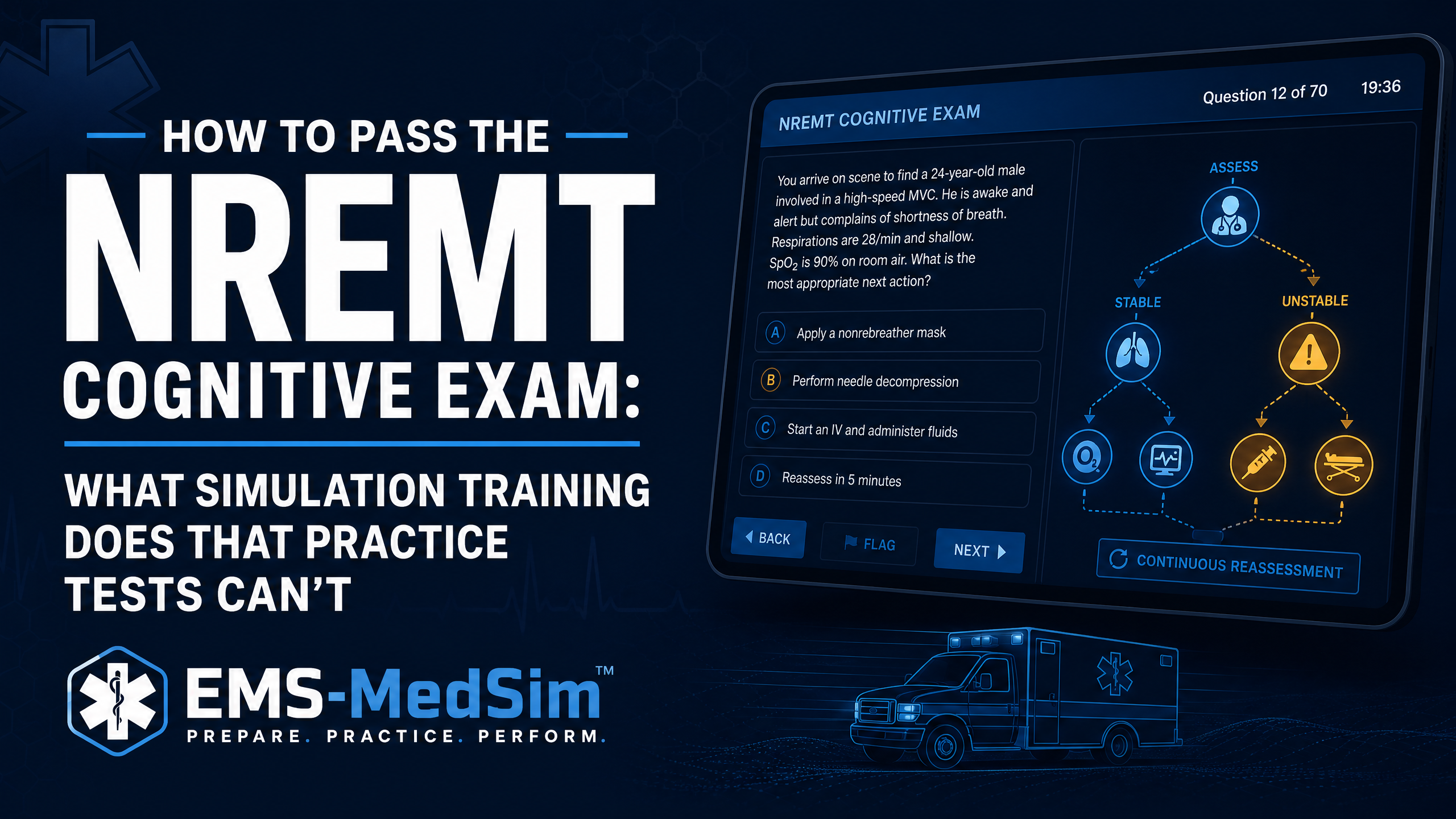
The NREMT is a computerized adaptive test — a CAT. It does not ask a fixed number of questions at a fixed difficulty level. It adapts. Every answer you give determines the next question. The algorithm is continuously re-evaluating one thing: have you demonstrated entry-level clinical competency, or not?
That distinction matters. The exam is not measuring what you know. It is measuring what you do with what you know when the situation changes.
National Registry of Emergency Medical Technicians — EMT Candidate Handbook
Why Practice Questions Are Not Enough
Practice questions build pattern recognition. That is genuinely useful. When you have seen enough questions about tension pneumothorax, you start to recognize the presentation quickly. You know the answer before you finish reading the stem.
But the NREMT CAT is not testing whether you recognize the pattern. It is testing whether you can manage the patient when the pattern is incomplete, when the presentation is atypical, or when your first intervention does not work.
That is a different cognitive skill. And it is one that practice questions do not develop.
Simulation-based training — specifically branching scenario training where your decisions change the patient's trajectory — builds the judgment the CAT is actually measuring. When you have worked through a tension pneumothorax scenario where the patient deteriorated because you delayed needle decompression, you do not just know the right answer. You understand why it is right and what happens when you get it wrong.
What the NREMT Is Actually Testing
The NREMT cognitive exam is built around five content domains. Understanding what each domain is actually measuring changes how you should prepare.
Airway, Respiration, and Ventilation is not asking whether you know the steps for RSI. It is asking whether you can recognize when a patient's airway is failing and make the right decision under time pressure.
Cardiology and Resuscitation is not asking whether you know the ACLS algorithms. It is asking whether you can apply them when the patient does not present the way the textbook says they will.
Trauma is not asking whether you know the steps of a trauma assessment. It is asking whether you can prioritize interventions when multiple systems are compromised simultaneously.
Medical/Obstetrics/Gynecology is not asking whether you know the signs of preeclampsia. It is asking whether you can manage a patient whose presentation crosses multiple categories.
EMS Operations is not asking whether you know your protocols. It is asking whether you can make sound operational decisions when the situation is ambiguous.
Every one of these domains is testing clinical judgment under pressure. That is what simulation builds.
How to Use Simulation Training for NREMT Prep
The most effective approach combines practice questions with simulation in a specific sequence.
Start with practice questions to build baseline pattern recognition. You need to know the material before you can apply it under pressure. Use NREMT-style questions that match the cognitive level of the actual exam — not recall questions, but application and analysis questions.
Then use simulation to stress-test your knowledge. Work through branching scenarios in your weakest content domains. Pay attention to what happens when you make the wrong decision. The feedback loop is the point — understanding why an intervention failed is more valuable than getting the right answer.
Return to practice questions to identify gaps that simulation exposed. If you consistently struggle with a particular presentation in simulation, targeted practice questions can help you fill in the knowledge gaps.
Repeat the cycle until your performance in simulation is consistent across all five content domains.
The Specific Scenarios That Matter Most
Not all simulation scenarios are equally useful for NREMT prep. The scenarios that most directly map to what the CAT tests are the ones where the presentation is atypical, where the patient deteriorates if you delay, and where the correct intervention requires integrating information from multiple systems.
High-yield scenario categories for NREMT prep include:
Respiratory emergencies with deteriorating patients — tension pneumothorax, severe asthma with impending respiratory failure, anaphylaxis with airway involvement. These scenarios test whether you can recognize deterioration and act before the patient crashes.
Cardiac emergencies with atypical presentations — STEMI equivalents, right ventricular infarction, wide-complex tachycardias. These scenarios test whether you can apply cardiology knowledge when the presentation does not match the classic picture.
Trauma with competing priorities — penetrating trauma with tension pneumothorax and hemorrhagic shock, TBI with hypotension. These scenarios test whether you can prioritize interventions when multiple systems are compromised.
Pediatric emergencies — the NREMT consistently tests pediatric presentations because they are high-stakes and candidates are often less comfortable with them. Pediatric respiratory failure, pediatric shock, and pediatric seizures are high-yield.
Obstetric emergencies — eclampsia, placental abruption, shoulder dystocia. These are tested because they are time-critical and require specific interventions.
What EMS-MedSim Builds That Practice Tests Cannot
EMS-MedSim scenarios are built by a board-certified emergency physician and reviewed against current AHA, NREMT, and NAEMSP guidelines. They are designed specifically to develop the clinical judgment the NREMT CAT measures.
Each scenario branches based on your decisions. If you choose the wrong intervention, the patient deteriorates in a clinically realistic way. If you delay a critical intervention, the window closes. The feedback is immediate and specific — not just "incorrect," but an explanation of what happened and why.
The scenarios cover all five NREMT content domains and are calibrated to the cognitive level of the actual exam. They are not recall exercises. They are judgment exercises.
If you are preparing for the NREMT cognitive exam, simulation is not a supplement to practice questions. It is the training method that most directly develops the skill the exam measures. Use both — but understand which one is doing the heavier work.
Summary
The NREMT cognitive exam measures clinical judgment under pressure, not protocol memorization. Practice questions build pattern recognition. Simulation builds the judgment the exam actually tests. Use both in sequence: practice questions to build baseline knowledge, simulation to stress-test application, practice questions to fill gaps that simulation exposes. Focus simulation training on the scenario types that most directly map to the five NREMT content domains. EMS-MedSim scenarios are built specifically for this purpose — branching, physician-reviewed, and calibrated to NREMT cognitive level.