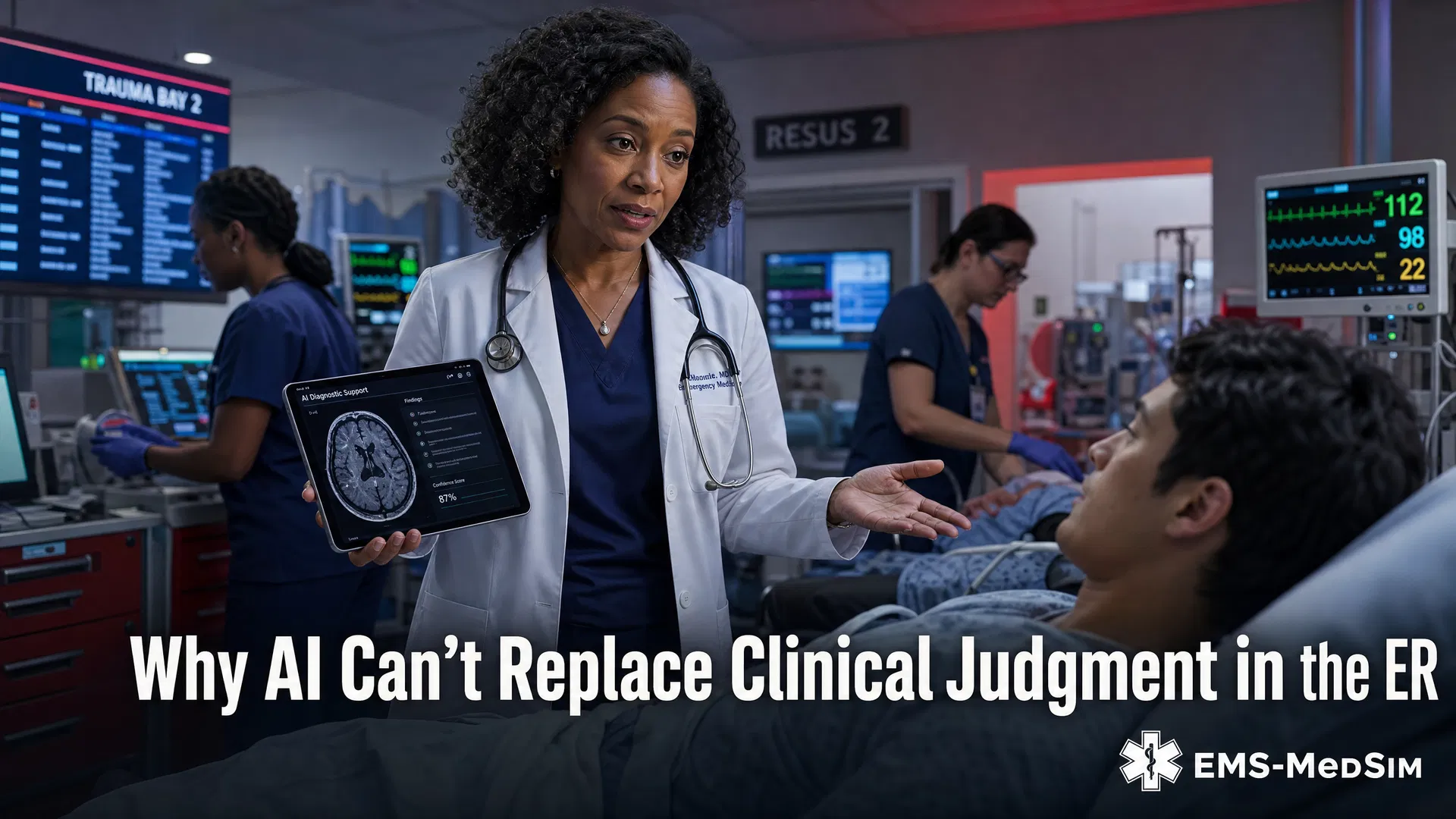
Editor's Note — October 2026: This article discusses AI decision-support tools in prehospital and emergency care from a clinical framework perspective. It does not evaluate, endorse, or critique any specific commercial product. EMS-MedSim is a human-designed simulation platform; AI is used solely to generate adaptive feedback, not to replace clinical decision-making. — Chester Shermer, MD, FACEP, Founder & Medical Director, Global MedOps Command
The 0300 Call No Algorithm Was Built For
A 68-year-old "not feeling well" in a second-floor bedroom. Family says she was fine yesterday. Heart rate 108, pressure 104/62, temperature not yet taken, skin warm. Your monitor's rhythm interpretation says sinus tachycardia. Your agency's new decision-support tool, if you have one, says nothing useful, because it was trained on emergency department data from patients who had already been triaged, roomed, and drawn.
That gap between what a model learned and what the back of an ambulance looks like at 0300 is the central unsolved problem of AI in prehospital care. Models that post impressive numbers on curated datasets underperform in the environment that defines EMS: incomplete history, no labs, one set of vitals, a moving vehicle, and a decision that has to be made before the next exit.
Emergency physicians and paramedics are, by training and temperament, skeptical of black-box output. That skepticism is a safety feature. It is not a strategy. The crews who will do well over the next decade are the ones who learn exactly what these tools are good at, exactly where they fail, and how to keep their own judgment in command when the two disagree.
Clinical Judgment Is Not What the Algorithm Replaces
Augmented clinical judgment is not deference to a screen. It is a hybrid process in which algorithmic output gets stress-tested by a trained human who is physically present with the patient.
The threat is automation bias: the tendency to over-rely on automated output and stop checking it. A systematic review of 74 studies on clinical decision support found that automation bias rises with trust in the system, with workload and time pressure, and with task complexity, and that the mitigators are training, emphasized user accountability, and systems that present information rather than issue recommendations (Goddard et al., JAMIA 2012). Every one of those risk factors describes a busy EMS shift.
A tool that flags sepsis correctly 94% of the time is wrong 6% of the time. That 6% is the atypical presentation, the beta-blocked patient whose heart rate never climbs, the elderly patient whose only sign is new confusion. The pattern recognition that catches those patients, the felt sense that something is off before the numbers confirm it, does not live in a training set. It lives in the medic who has seen a thousand sick people and knows what sick looks like. Protect it.
Where AI Already Touches the Prehospital Chain
The evidence base for prehospital AI is thin compared with the hospital literature, and what exists is instructive precisely because it is mixed.
Dispatch. The best prehospital trial to date is a double-masked randomized study of 169,049 emergency calls in Copenhagen. A machine-learning model listened to calls and alerted dispatchers when it suspected out-of-hospital cardiac arrest. The model alone was more sensitive than the dispatchers (85.0% vs 77.5%), yet dispatchers who received the alert recognized arrest no more often than those who did not (93.1% vs 90.5%, not significant), and the alert's positive predictive value was 17.8% (Blomberg et al., JAMA Network Open 2021). A better detector did not produce a better outcome, because the humans in the loop had learned to discount a tool that cried wolf four times out of five. That is automation bias running in reverse, and it is the most important prehospital AI lesson published so far.
The 12-lead. This is where the field case is strongest. Standard STEMI criteria miss a large share of acute coronary occlusions. In a Swedish cohort of 24,511 emergency department chest-pain patients, an AI ECG model detected occlusion MI with 52% sensitivity against 23% for STEMI criteria, at the same specificity (Lindow et al., JACEP Open 2026). In the hardest subset, cath lab activations cancelled because the ECG "did not meet criteria," the AI read was 94% sensitive for a true occlusion against 47% for the criteria (Friedman et al., J Electrocardiol 2026). For EMS, that is a tool that can earn its place in the transmit-and-activate decision, provided the medic still knows the patterns the model is looking for (the STEMI equivalents every paramedic should recognize).
Triage and acuity prediction. Systematic reviews of machine-learning triage find most studies hospital-based; one 2024 review of 17 studies counted only two in the prehospital setting (Almulihi et al., Med Arch 2024). The models outperform fixed acuity scores on retrospective data. Almost none have been tested prospectively in a moving ambulance with field-grade data.
Every one of these applications has a hard ceiling, and the ceiling is the provider holding the monitor.
Train for the Moment the Tool Is Wrong
Knowing how a tool works is not the skill. The skill is recognizing, in real time, when its output does not match the patient in front of you, and acting on your own read without hesitating.
A lecture on AI-assisted ECG interpretation teaches you how the model performs under ideal conditions. It does not prepare you for the night it flags two false positives in a row and then reads a subtle posterior occlusion as "no acute changes" on the third. Scenario-based simulation is the only honest preparation available: put the medic inside a high-acuity decision where the algorithm is present, wrong, or suddenly absent, and make the override a practiced reflex rather than a first-time improvisation.
What gets tested is not familiarity with a dashboard. It is the underlying judgment the machine cannot supply: recognizing drift, overriding gracefully, and holding decision quality when the tablet dies. That last piece, graceful degradation, matters most at a mass casualty incident, where connectivity fails and paper triage tags come back out of the bag. Why EMS AI training has to move beyond the algorithm covers the training design in detail; the case for decision drills over lectures covers why it works.
A Playbook for EMS Medical Directors
Successful integration starts with a physician-led framework, not a vendor demonstration.
Select for workflow fit, not benchmark accuracy. A model with excellent retrospective numbers is worthless if it adds forty seconds to a 12-lead workflow or generates alerts that crews learn to swipe away. Evaluate it against your actual call mix, scene times, and documentation burden.
Put field providers on the oversight committee with real authority. Administrators and data scientists bring value. The paramedics running the calls are the ones who will notice first when the tool starts drifting. Give them a vote, not a seat.
Monitor for drift on a schedule. Patient populations shift. Seasonal illness patterns change. A model that performed well in January can quietly degrade by fall. Review performance quarterly, and break it out by age, sex, and the presentations your QA/QI program already tracks.
Write the override into protocol. The medic's documented clinical judgment supersedes the tool's output, and the protocol says so in plain words. A crew that has to wonder whether disagreeing with the software is a deviation will stop disagreeing.
Dr. Chet's Take
I sign the protocols for a HEMS and critical care ground service, and I have sat through more vendor pitches than I care to count. Every one of them opens with a sensitivity number and none of them opens with the Copenhagen trial. That study should be required reading for every medical director before the first purchase order. The machine beat the humans at hearing a cardiac arrest, and the humans with the machine did no better than the humans without it, because a tool that is wrong four times out of five gets ignored the fifth time. Nobody in that dispatch center was negligent. They were behaving exactly the way people behave around unreliable alarms, which is the same way your crews will behave.
The ECG work is different, and I want to be fair to it. The occlusion MI data are real, the criteria we were all trained on miss a lot of true occlusions, and an AI read that flags a subtle posterior pattern a tired medic would miss at 0300 is a patient who gets a cath lab instead of a serial troponin. I would adopt that tool tomorrow, with two conditions. My medics still learn the patterns, because the tool will go down and the patient will not wait. And the protocol says in writing that the paramedic's read wins a disagreement, because the day it does not, I have a crew that stops reading ECGs.
That is the whole framework, and it is not complicated. Buy tools that present information instead of issuing orders. Train your people on the failure modes before the successes. Make it safe, in writing, to overrule the screen. Then drill the overrule in simulation until it is boring. The algorithm will keep getting better. So should the medic standing next to it.
Key Takeaways
- AI augments the prehospital provider; it does not replace the judgment, context, or accountability that stay with the person on scene.
- Automation bias is the primary safety threat, and its drivers, high workload, time pressure, and trust, describe every EMS shift.
- The best prehospital trial so far showed a more sensitive AI alert that did not improve dispatcher recognition of cardiac arrest, because low positive predictive value taught humans to ignore it.
- AI ECG interpretation for occlusion MI is the strongest field use case, and it still requires a medic who knows the patterns.
- Simulation that deliberately introduces algorithmic failure is the only training that builds a reliable override reflex.
- Medical directors must select for workflow fit, monitor for drift, and write the clinical override into protocol.
Frequently Asked Questions
Will AI replace paramedics or emergency physicians?
No. The framework here is augmented practice: AI handles bounded, data-heavy tasks faster and more consistently, while scene assessment, judgment, and accountability remain with the clinician. Every published prehospital study still depends on a human acting on the output.
How should EMS crews train for AI failure?
By running scenarios in which the tool is confidently wrong or unavailable, so that overriding it with clinical judgment is a practiced skill. Lectures explain how a tool works under ideal conditions; simulation builds the reflex for the night it does not.
What is automation bias?
The tendency to over-rely on an automated system and stop checking its output. It increases with trust, workload, and time pressure, and it is reduced by training, clear personal accountability, and tools that present information rather than issue recommendations.
Sources
- Goddard K, Roudsari A, Wyatt JC. Automation bias: a systematic review of frequency, effect mediators, and mitigators. J Am Med Inform Assoc. 2012;19(1):121-127. https://doi.org/10.1136/amiajnl-2011-000089
- Blomberg SN, Christensen HC, Lippert F, et al. Effect of machine learning on dispatcher recognition of out-of-hospital cardiac arrest during calls to emergency medical services: a randomized clinical trial. JAMA Netw Open. 2021;4(1):e2032320. https://doi.org/10.1001/jamanetworkopen.2020.32320
- Lindow T, Nyström A, Forberg JL, et al. Improved detection of acute coronary occlusion myocardial infarction by an artificial intelligence electrocardiogram model in Swedish emergency departments. J Am Coll Emerg Physicians Open. 2026;7(5):100473. https://doi.org/10.1016/j.acepjo.2026.100473
- Friedman BS, Malloy-Post R, Smith SW, Meyers HP. Can an artificial intelligence electrocardiogram algorithm improve diagnostic accuracy for acute coronary occlusion in the difficult subset of canceled catheterization lab activations? J Electrocardiol. 2026;97:154255. https://doi.org/10.1016/j.jelectrocard.2026.154255
- Almulihi QA, Alquraini AA, Almulihi FAA, et al. Applications of artificial intelligence and machine learning in emergency medicine triage: a systematic review. Med Arch. 2024;78(3):198-206. https://doi.org/10.5455/medarh.2024.78.198-206