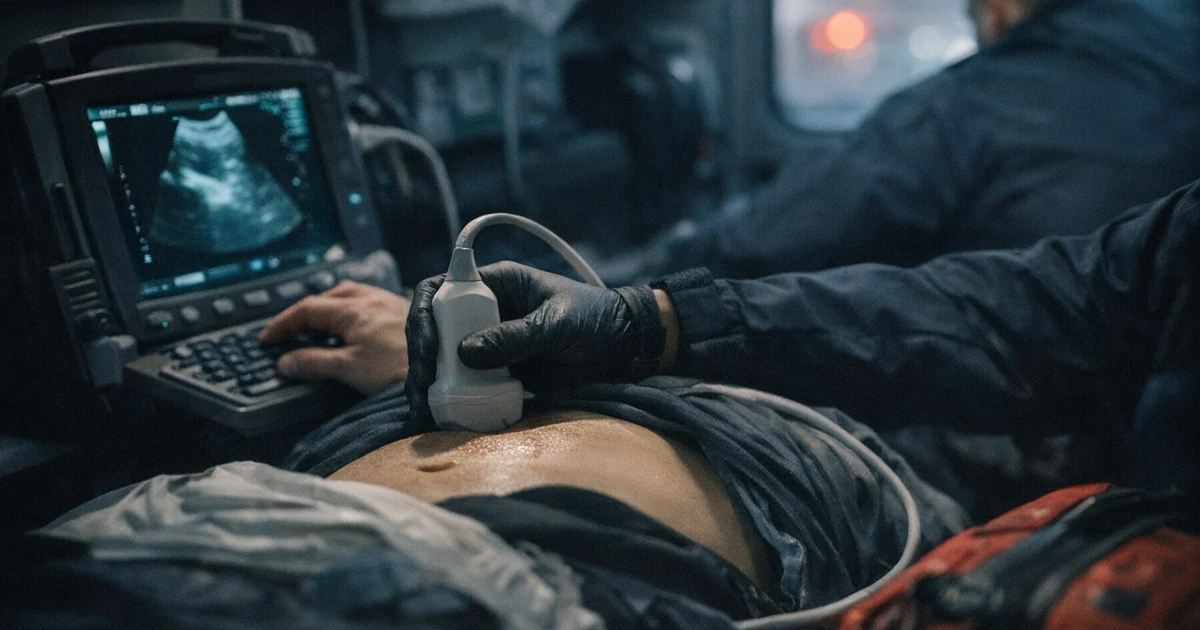
The patient is breathing fast in the back of the ambulance. One medic reaches for the ultrasound probe. The other is already preparing the next intervention. The right question is not, “Can we get a picture?” It is, “What will this picture change before we reach the hospital?”
Prehospital point-of-care ultrasound (POCUS) can add useful information during trauma, respiratory distress, shock, and cardiac arrest. A 2025 review describes its use on scene and during ground or air transport, while also calling for larger clinical trials and formal education to maintain the skill. That evidence review supports a practical position for EMS: scan when the result can change a decision, and stop when it cannot.
A probe can create false confidence or extend scene time. POCUS is a clinical workflow, not a device purchase.
The useful question: what decision will it change?
Start with the decision, not the machine. A limited exam can help answer a narrow question: Is there cardiac motion? Is there lung sliding at the location that matters? Is free fluid plausible in a patient with trauma and shock? Are B-lines part of a broader picture of pulmonary edema? The 2025 review of current US EMS protocols found that the most common protocol indications were cardiac arrest, trauma, procedural guidance, and dyspnea. Those are reasonable targets because each can connect an image to triage, treatment, destination, or reassessment.
In a prospective HEMS cohort of 209 patients, POCUS changed management in 40.7% of cases, including 75.7% of patients undergoing CPR, and changed destination in 6.9% of trauma patients. The study does not prove a survival benefit, but it shows that a trained team can use a focused scan to change a critical decision.
State the action before scanning: “If I see X, I will do Y. If the image is poor, I will return to the exam and protocol.” This keeps the scan from competing with airway care, hemorrhage control, ventilation, or transport.
What the current evidence supports
POCUS is an adjunct. It does not replace the history, physical exam, vital signs, ECG, capnography, or response to treatment. The NAEMSP traumatic pneumothorax position statement says EMS identification of tension pneumothorax should use a combination of risk factors and physical findings, with diagnostic technologies as an aid. It also states that a POCUS finding of pneumothorax alone does not mean pleural decompression is required.
That distinction matters because POCUS can be sensitive to small findings that do not explain the patient’s instability. In the evidence summarized by NAEMSP, EMS POCUS for pneumothorax had reported specificity of 99% and sensitivity of 61%, compared with 99% specificity and 85% sensitivity for ED POCUS. The position statement also emphasizes that operator skill and experience affect detection. A negative or positive image must fit the whole call.
In cardiac arrest, timing is the safety issue. The joint NAEMSP, ACEP, and ACS-COT trauma arrest statement places monitors and POCUS after indicated life-saving interventions. A scan that interrupts compressions or delays defibrillation is a bad scan, even if the image is beautiful. If a team uses ultrasound during a rhythm check, the task should be assigned, the view should be limited, and the pause should stay within the team’s resuscitation standard.
A finding can be wrong or non-actionable; when uncertain, follow local protocol.
Guardrails: time, interpretation, and training
The 2025 protocol review found that only 90 of 514 reviewed US EMS protocols, or 17.5%, included prehospital ultrasound and specific indications. None specified training requirements; interpretation responsibility was missing from 76, and only three described 100% image review. The report shows that an indication list is not a complete program.
A usable program needs a credentialing path, a small initial exam set, supervised practice, a way to store images, and regular review by someone who can judge both image quality and clinical use. The 2025 Faculty of Pre-Hospital Care consensus statement addresses indications, competency, equipment, infection control, and governance. It also states that POCUS should not delay interventions or transport to definitive care.
Tele-ultrasound may help a developing program, but remote support does not remove the need for local competency. A scoping review identified training difficulty, uninterpretable images, connection problems, equipment failure, and patient acuity as barriers. The review describes the model as promising, not sufficient by itself.
Document the indication, exam, key finding, image quality, interpreter, action taken, and whether the clip was stored. “Ultrasound used” is not enough for call review or learning.
Build a field habit, not a gadget habit
Use a short verbal loop: question, window, finding, action. For example: “Shock after blunt trauma. RUQ and cardiac views. Limited view, no clear free fluid, cardiac motion present. Continue hemorrhage control and rapid transport.” The words keep the scan attached to patient care.
Practice the handoff. The receiving team needs to know why the scan was done, what was seen, how confident the operator was, and what was done next. Teams that use EM-Sim can rehearse this kind of ED handoff without waiting for a rare field case. A crew that also works in austere or flight settings can carry the same decision-first habit into MilMedSim, where equipment limits and transport choices change the problem.
Track process measures before promising outcome gains: time added, interpretable clips, protocol adherence, later agreement when available, management changes, and confusion or delay. The 2024 systematic review of evidence-based prehospital guidelines found that guideline applicability is often the weakest reporting area. Local audit must show whether a protocol fits staffing, geography, and transport times.
The Global MedOps Command approach is useful here: protect judgment, define failure, and train the fallback. POCUS earns a place in the rig when the team can state its question, limit, and next action.
Dr. Chet's Take
I have watched HEMS crews use ultrasound to answer a focused question while the rest of the team kept the patient moving. I have also seen technology become a delay dressed up as thoroughness. This article gets the central point right: POCUS is useful when it changes a decision, not when it merely produces an image. The best scan is short, documented, and connected to the next action.
That being said, I do not want a new device to become a new badge of expertise. A clean clip can still be the wrong view. A real finding can still be irrelevant to the patient in front of you. The honest answer is that prehospital outcome evidence remains thinner than the enthusiasm around the technology. Medical directors should demand image review, feedback, and a stop rule before they call a program mature.
If you are running this call, say the question before touching the probe. Assign one person to scan and one to protect the primary survey. If the exam is not interpretable, name that limitation and move. Your patient needs a decision, not a sonogram souvenir.
Key Takeaways
- Use POCUS to answer a narrow question tied to treatment, triage, destination, or reassessment.
- Keep the history, physical exam, vital signs, ECG, capnography, and treatment response in charge of the interpretation.
- Do not delay life-saving interventions, compressions, defibrillation, or transport for a scan.
- Build competency, image review, documentation, infection-control, and medical-director oversight into the program before field use.
- Track time, interpretability, management changes, and delays so the agency can improve the workflow.
If you're a EMT, paramedic, flight medic, CCTP, or EMS medical director trying to understand how AI will actually impact your clinical practice — not just the hype — I put together a free practical guide. You can download it here: AI in EM Survival Guide.
FAQ
When should EMS use prehospital POCUS?
Use it when a focused answer can change treatment, triage, destination, or reassessment without delaying higher-priority care. Current US protocol data show that an indication list alone does not define a complete program.
Can EMS use POCUS to diagnose a tension pneumothorax?
POCUS can add information, but EMS should interpret it with risk factors, physical findings, hemodynamics, and the patient’s response to care. A pneumothorax finding by itself does not establish that pleural decompression is required. Follow the current local protocol and the NAEMSP traumatic pneumothorax statement.
Does POCUS replace a physical exam in the field?
No. POCUS is an adjunct to the history, physical exam, vital signs, ECG, capnography, and treatment response. A poor-quality or discordant image should lower confidence, not overrule the rest of the assessment. The 2025 prehospital ultrasound review describes POCUS as a tool to support decisions, not a replacement for clinical assessment.
How should an EMS agency train paramedics in POCUS?
Define a limited exam set, teach image acquisition and interpretation, require supervised practice, store clips for review, and audit both technical quality and clinical impact. Include infection control, equipment readiness, documentation, medical direction, and a stop rule for situations where scanning would delay care. The 2025 prehospital consensus statement identifies competency and governance as core parts of safe use.
Sources
- Evolving role of point-of-care ultrasound in prehospital emergency care: a narrative review
- Current Practices in Prehospital Ultrasound: A Systematic Evaluation of Prehospital Protocols Within the United States
- Impact of Point-of-Care Ultrasound on Prehospital Decision Making by HEMS Physicians
- Prehospital Trauma Compendium: Traumatic Pneumothorax Care
- Prehospital Management of Adults with Traumatic Out-of-Hospital Circulatory Arrest
- Pre Hospital Ultrasound Consensus Statement
- Paramedic-Performed Prehospital Tele-Ultrasound: A Scoping Review
- 2024 Systematic Review of Evidence-Based Guidelines for Prehospital Care
- Books by Dr. Shermer: Books by Dr. Shermer