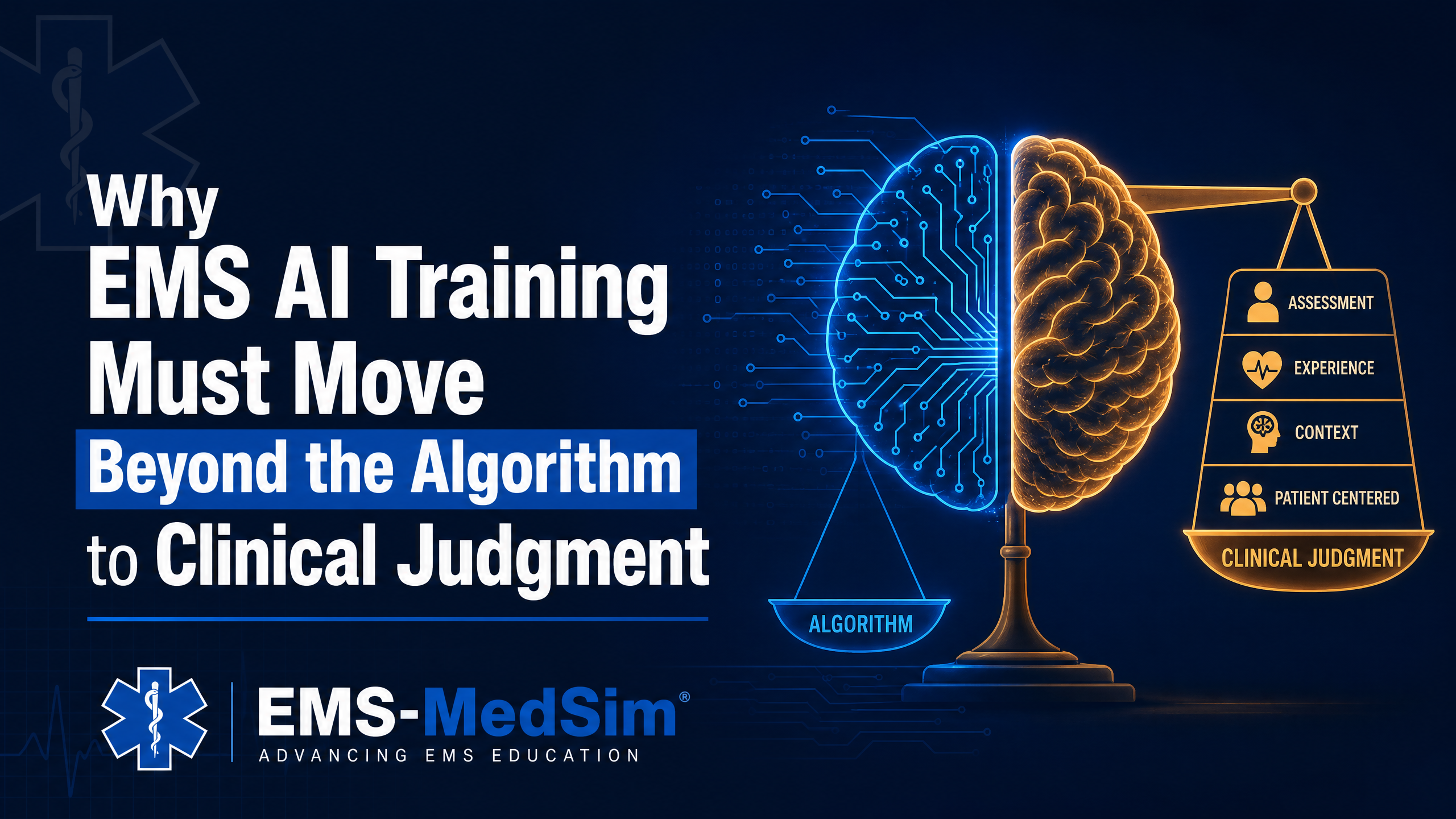
The Reality of AI in the Prehospital Environment
AI is no longer arriving in EMS — it's already on scene, and most providers aren't trained to work with it safely.
Picture this: your unit is dispatched on an AI-prioritized cardiac call, routed by an algorithm that analyzed caller speech patterns, historical incident data, and real-time unit positioning. You arrive, you assess, and the clinical picture doesn't match the dispatch priority. Now what?
That gap — between what the algorithm predicted and what your patient actually needs — is where clinical judgment lives. And right now, that gap is widening.
Automation vs. clinical decision support is a distinction that matters enormously in the prehospital environment. Automation executes tasks. Clinical decision support, or CDS, gives the provider better information at the point of care so they can make a better decision. According to research on AI adoption in emergency settings, these tools are designed to augment, not replace, the diagnostic reasoning of the paramedic.
EMS providers are uniquely positioned to benefit from real-time data analysis — they're gathering unfiltered, high-acuity information the moment they step through the door. That data is extraordinarily valuable. The danger is trusting a black-box algorithm to interpret it without understanding what's happening inside that model or how to override it when the clinical picture demands it.
That's the concept behind Medceptor — the human-in-the-loop oversight of AI outputs. Understanding why physician-led AI training matters starts with recognizing why generic tech training almost always falls short.
Why Generic Tech Training Fails EMS Providers
Knowing how to click through a software interface is not the same as knowing when to override what it tells you.
Most EMS technology onboarding follows a familiar pattern: a vendor rep walks through the dashboard, providers get a certificate, and everyone moves on. That's IT training. It's not clinical education. And when the tool in question is one of the many clinical decision support tools now embedded in prehospital workflows, that gap becomes a patient safety issue.
Medceptor — Human-in-the-loop oversight of AI outputs, where a clinically trained provider actively evaluates, validates, and when necessary, overrides an algorithm's recommendation before it influences patient care.
The Medceptor concept exists because AI doesn't carry a license. The provider does. Research confirms that clinical AI adoption fails most often not from bad technology, but from untrained human oversight. That's a training problem, not a tech problem.
The data quality issue compounds this. Prehospital environments generate noisy, incomplete, and often inconsistent data. Garbage in, garbage out — an algorithm fed a mis-cuffed blood pressure or an incomplete scene assessment will produce a confident-looking recommendation built on a flawed foundation. Providers need physician-led education to recognize these failure modes, not a tutorial that assumes the inputs are clean.
The answer isn't skepticism of AI. It's building the kind of structured clinical judgment that makes you a better partner for it. That process starts long before any real call — which is exactly where scenario-based decision training enters the picture.
Simulation-Based Training: The Gold Standard for AI Adoption
Reading about AI decision support is not the same as performing under it — and that gap is exactly where providers get into trouble.
Clinical skills are built through repetition under pressure, not passive exposure. The same principle applies to AI integration. Simulation-based training gives EMS providers a controlled environment to make real decisions alongside real tools — without a real patient paying the price for the learning curve. Scenario-driven platforms like EMS-MedSim are specifically designed to place providers inside AI-assisted workflows, where they can evaluate algorithm outputs, weigh them against clinical findings, and practice the deliberate act of agreeing — or disagreeing — with what the machine says. That friction is where the learning happens.
EMS-MedSim takes this further by stress-testing those interactions under time pressure and competing clinical variables. When a provider has already navigated a deteriorating airway while an AI flags a rhythm abnormality in simulation, the response in the field becomes faster and more deliberate. It's muscle memory for the digital environment — the same way intubation drills build procedural confidence, AI scenario repetition builds cognitive confidence. You can explore how triage is already changing with AI tools, and the providers adapting fastest are the ones who've rehearsed these moments.
That being said, simulation only works when it mirrors the actual tools in use. Generic medical scenarios won't build AI-specific judgment. The design of the simulation environment matters as much as the clinical content itself.
Maintaining Clinical Oversight in an Automated Workflow
The clinician's hand stays on the wheel — even when the algorithm is driving.
Simulation builds the skill. That being said, skill without clear rules of engagement becomes hesitation under pressure. Every EMS provider working with AI-assisted tools needs a governing framework for how to interact with that technology in the field — not just how to operate it.
Rules of Engagement for AI Oversight:
- Trust but verify. Accept AI-generated ECG interpretations and vitals analysis as a data point, not a diagnosis. Confirm with your own assessment before acting.
- Own the decision. Legally and ethically, you sign the care record. The algorithm doesn't. Following AI output without clinical corroboration exposes you directly.
- Recognize algorithmic bias. AI tools trained on narrow patient populations can underperform in edge cases. Evidence-based education equips providers to identify when a recommendation doesn't fit the patient in front of them.
- Know your override threshold. Operational readiness means deciding in advance — not in the moment — when you'll act against the machine's recommendation.
This isn't about distrust of technology. As systems thinking research from EMS1 confirms, providers who understand why an AI flags something make better decisions than those who simply react to what it flags.
Operationalizing AI Strategy for EMS Leadership
EMS leadership that treats AI as a technology purchase rather than a training obligation will see no meaningful return on either investment.
Operational Readiness begins at the organizational level. Platforms like EMS-MedSim are built specifically to align with civilian and operational medicine readiness standards — meaning the scenarios your providers train through aren't hypothetical classroom exercises. They reflect real-world mission parameters.
The ROI case for simulation-based, evidence-based education is straightforward: reduced clinical errors and measurably improved provider confidence under pressure. That confidence doesn't come from watching a webinar about AI tools. It comes from repeated, deliberate practice inside scenarios that mirror field conditions.
For agencies looking to scale this without rebuilding their CE calendar from scratch, the practical path is integration, not addition. Embed AI-focused simulation modules into existing continuing education cycles. Your providers are already recertifying. Use that time to build the judgment layer, not just the technical one. For high-acuity teams operating without physician backup, prehospital critical care training frameworks offer a proven structural model.
Select platforms with physician-designed curricula. That's non-negotiable.
The Bottom Line: Key Takeaways for AI Training
Successful prehospital AI adoption doesn't fail at the technology layer — it fails at the training layer.
- AI is a clinical decision support tool. The algorithm surfaces data. The paramedic makes the call.
- Simulation-based training is the only effective method. Scenario repetition prepares providers to challenge AI outputs under pressure.
- Physician-led curriculum is non-negotiable. Medical accuracy in AI training requires physician oversight at the design level.
- The Medceptor role defines the next generation of EMS professionals. This isn't a job title. It's a clinical identity built on judgment, situational awareness, and the ability to own a decision when the algorithm gets it wrong.
Preparing for the Next Generation of Emergency Medicine
A sound EMS AI strategy doesn't start with the device in the rig — it starts with the clinician behind the decision.
The transition from traditional EMS to AI-augmented emergency care is already underway. What separates the agencies that will lead from those that will lag isn't budget or hardware — it's the deliberate investment in training that builds clinical judgment alongside technological fluency.
The mission at Global MedOps Command is exactly that — bridging the gap between emerging technology and frontline medical reality. If that work resonates with where your agency is headed, the path forward is clear.
Prioritize education. Build judgment. Start the conversation today.
Frequently Asked Questions
Why isn't generic technology training enough for EMS AI tools?
Button-level training teaches operation, not judgment. Providers need practice recognizing when an algorithm's output is wrong for the patient in front of them — which is what simulation-based training builds.
Who is responsible when AI is part of the workflow?
The clinician, always. AI output is decision support; the provider keeps clinical oversight and accountability — the article's rules of engagement start there.