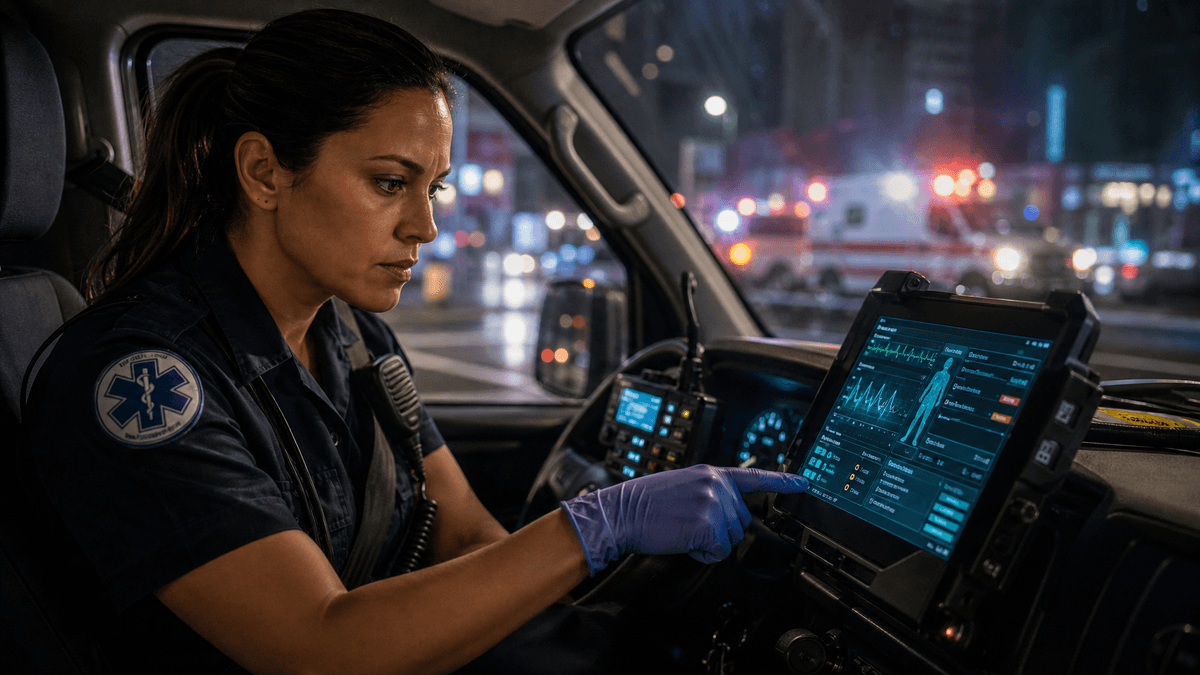
BLUF (Bottom Line Up Front)
AI-based decision support tools are entering the prehospital environment faster than the training infrastructure needed to use them safely. EMS providers need exposure to AI-assisted clinical decision-making in simulation before they encounter it on a real call — because how you use the tool, and when you override it, matters as much as knowing it exists.
The ambulance is not a passive transport vehicle. It is a rolling clinical environment where time-sensitive decisions are made under conditions that hospital providers rarely experience: limited resources, incomplete information, physical constraints, and a patient whose condition is often actively changing. Any technology that enters that environment has to work under those conditions. Most AI decision support tools were not designed with those conditions in mind.
I wrote about this problem in depth on Medium — the gap between what EMS crews actually need from decision support and what AI companies are currently selling them. The article is worth reading before you evaluate any prehospital AI tool. You can find it at medium.com/@chet.shermer. The core issue is that prehospital decision support requires contextual awareness that current AI systems handle inconsistently — and in a moving ambulance, inconsistency costs time you don't have.
That being said, the technology is improving. And regardless of the current limitations, prehospital AI is arriving. The question for EMS agencies and medical directors is not whether to engage with it — it's how to prepare providers to use it effectively and safely.
What AI Decision Support in EMS Actually Looks Like
The current generation of prehospital AI tools covers several functional categories. Protocol decision support tools surface relevant protocol recommendations based on patient presentation data — vital signs, chief complaint, mechanism. Some are integrated into electronic patient care reporting (ePCR) systems and trigger alerts based on specific data inputs. Others are standalone applications that providers query actively.
Predictive tools — systems that estimate time-critical diagnoses like STEMI, stroke, or sepsis based on prehospital data — are the most clinically significant category. Several of these have demonstrated genuine utility in research settings. The translation to day-to-day prehospital operations is less consistent, largely because data input quality in the prehospital environment varies significantly from what research protocols control for.
Dispatch decision support is a separate layer, already well-established in many systems, that uses historical call data and real-time resource information to route units and anticipate call volume. This category has the longest track record and the most reliable performance data.
Why Does the Override Problem Matter in Prehospital AI?
Every AI decision support system has a failure mode: it recommends something wrong. The clinical question that prehospital providers have to answer in real time is whether the AI recommendation reflects a genuine clinical picture they haven't fully assessed, or whether the algorithm is missing something they can see that the sensors can't.
That judgment — when to follow the tool and when to override it — is not instinctive. It's learned. It requires providers who understand both the clinical content behind the recommendation and the operational limitations of the algorithm generating it. A provider who blindly follows an AI recommendation in a case where their clinical assessment contradicts it has been harmed by the technology, not helped. A provider who reflexively ignores AI recommendations because they distrust the tool entirely is not using a resource that might have caught something.
The appropriate relationship with decision support is calibrated trust. That calibration has to be built through experience with the tool in a training environment before a provider encounters it for the first time on a real call.
Why Does Training With AI Tools Matter as Much as Clinical Skills Training?
EMS-MedSim's AI Tutor provides real-time feedback on clinical decision-making within scenarios — not just outcome feedback, but reasoning feedback. That type of interaction is the closest available analog to working with an AI decision support tool in a controlled environment. It builds the habit of evaluating AI-generated clinical guidance critically rather than accepting or rejecting it reflexively.
As prehospital AI tools become more common, agencies will need to address AI competency as a training domain — not just clinical skill competency and protocol knowledge. The providers who perform best with decision support tools will be those who have practiced using them in scenarios that include both cases where the AI is right and cases where it's wrong.
Medical directors evaluating prehospital AI tools should read the NAEMSP guidance on technology integration, review validation data specific to prehospital environments (not just hospital settings), and include decision support tool training in their agency's simulation curriculum before deployment — not after.
Dr. Chet's Take
I have been thinking about AI in emergency medicine for long enough to have watched the hype cycle go through several full rotations. The prehospital space is now receiving the same attention the ED received two years ago — vendors with strong pitch decks and variable evidence bases, promising tools that will transform how providers make decisions in the field.
Some of those tools will deliver. Some will create new failure modes that the agencies using them won't immediately recognize. The difference between those outcomes won't be the AI. It will be whether the providers using the tools have the training to use them critically.
Simulation is where that training happens. Not in a vendor webinar.