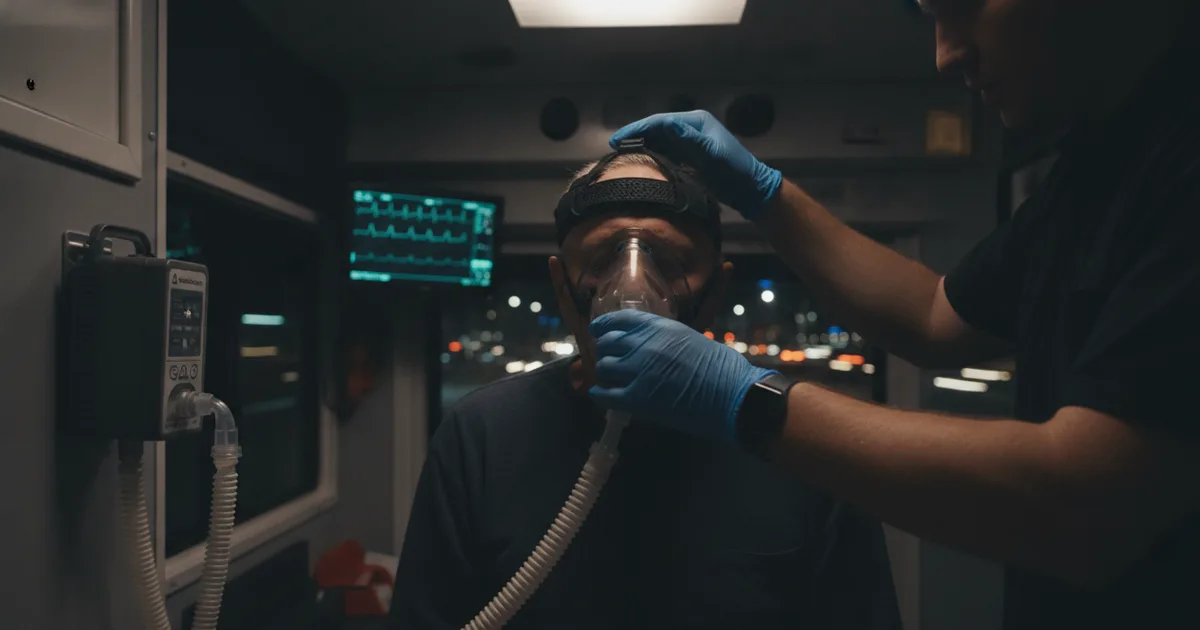
Dispatch sends you to a second-floor apartment for a 71-year-old retiree who lives alone and woke up unable to breathe. She is sitting bolt upright on the edge of the bed, hands braced on her knees, speaking two words at a time. Her skin is cool and wet. You hear crackles to the apices, and the first blood pressure is 224/118. The pulse oximeter waveform keeps dropping out.
Bottom line: this is an afterload crisis, so treat it on two tracks at once. Put her on CPAP for the work of breathing, and give sublingual nitroglycerin per protocol to bring the pressure down, after you have screened for the drugs and the infarct pattern that make nitrates dangerous.
What SCAPE is, and why the fluid is in the wrong place
Sympathetic crashing acute pulmonary edema (SCAPE) is a subset of acute heart failure: sudden, severe pulmonary edema with hypertension, respiratory distress, and hypoxemia [1]. The driver is a marked rise in afterload, with fluid shifted into the lungs rather than added to the body [1]. Many of these patients are not volume overloaded. A 2025 emergency medicine review advises against routine diuretics in SCAPE unless the patient shows signs of systemic volume overload, and it names respiratory support and vasodilators as the core of treatment [1].
The two things on your truck, CPAP and nitroglycerin, are the two first-line arms.
The physiology explains why CPAP helps the heart as well as the lungs. A patient fighting to breathe pulls large negative swings in intrathoracic pressure. Those swings increase venous return and make it harder for the left ventricle to eject. CPAP reverses them, which is the rationale for using it immediately in cardiogenic pulmonary edema [2]. The same mechanism is why positive pressure can drop the blood pressure in a patient who is short on preload [2].
What the evidence says about CPAP in cardiogenic pulmonary edema
The 2019 Cochrane review pooled 24 randomized trials with 2,664 adults treated in emergency departments and intensive care units [3]. Compared with standard care alone, CPAP or bilevel ventilation reduced hospital mortality (risk ratio 0.65, 95% CI 0.51 to 0.82; low-quality evidence; number needed to treat 17) and endotracheal intubation (risk ratio 0.49, 95% CI 0.38 to 0.62; moderate-quality evidence; number needed to treat 13) [3]. Myocardial infarction rates did not differ [3].
The largest single trial is more sober. 3CPO randomized 1,069 patients with acute cardiogenic pulmonary edema to standard oxygen, CPAP at 5 to 15 cm H2O, or bilevel ventilation [4]. Seven-day mortality was 9.8% with oxygen and 9.5% with noninvasive ventilation, with no significant difference. At one hour, noninvasive ventilation produced greater improvement in dyspnea, heart rate, acidosis, and hypercapnia, with no treatment-related adverse events [4].
A 2014 meta-analysis of 7 randomized trials (632 adults with severe respiratory distress of mixed causes) found that out-of-hospital noninvasive ventilation reduced in-hospital mortality (risk ratio 0.58, 95% CI 0.35 to 0.95) and the need for invasive ventilation (risk ratio 0.37, 95% CI 0.24 to 0.58), without a difference in length of stay [5]. In a Western Australian trial of 708 adults aged 40 or older with severe non-traumatic respiratory distress that had not responded to initial paramedic treatment, CPAP improved dyspnea scores and respiratory rate at emergency department arrival but did not change hospital length of stay [7]. Neither was limited to SCAPE.
The specific uncertainty is mortality. CPAP reliably speeds relief and probably reduces intubation. Whether it lowers death is not settled.
Who gets CPAP, and who does not
The 2022 NAEMSP position statement recommends noninvasive ventilation for prehospital respiratory failure, including pulmonary edema, calls it safe for use by EMTs, and makes medical directors responsible for training in patient selection, adjunctive medications, and assessment of response [6].
The trigger is the work of breathing: accessory muscle use, tripod posture, crackles, speech in fragments, and a patient tiring in front of you. A poor waveform on a cold, wet finger is not a number to wait for.
Most protocols hold CPAP, and move to the airway plan, when any of these are present:
- Apnea or failing spontaneous breathing. CPAP supplies pressure. It does not breathe for the patient.
- Reduced consciousness or inability to protect the airway. The patient has to manage her own secretions against the pressure.
- Active vomiting or aspiration. This is a real contraindication. A sealed mask over a vomiting patient is an aspiration.
- Suspected pneumothorax. Positive pressure can make it worse.
- Hypotension, using your protocol's threshold. Positive pressure lowers venous return, and a patient short on preload can drop her pressure further [2].
- Facial trauma or no achievable seal. Without a seal there is no pressure.
Settings, seal, and oxygen
Many protocols start near 5 cm H2O and titrate toward a ceiling that is commonly 10 cm H2O, guided by work of breathing and tolerance. Trials have used other ranges; 3CPO allowed 5 to 15 [4]. The number belongs to your protocol and your device.
Coach the mask on. Hold it to the face before you strap it, tell the patient what the pressure will feel like, and breathe with them for the first few cycles.
Then titrate oxygen to your protocol's saturation target. In the IOTA meta-analysis of 25 trials and 16,037 acutely ill adults, liberal oxygen increased in-hospital mortality (relative risk 1.21, 95% CI 1.03 to 1.43), and the authors suggested harm begins above an SpO2 of 94% to 96% [8].
Nitroglycerin, the other half of the treatment
CPAP buys time. The afterload still has to come down.
Sublingual nitroglycerin, repeated at your protocol's interval with a blood pressure check before every dose, is the field entry point. Authors of a prehospital study noted that field treatment is usually restricted to sublingual doses that often do not affect afterload [11].
Emergency departments use higher doses by vein. In a single-center retrospective study of 441 SCAPE patients, an initial infusion of 100 mcg/min or more was associated with faster oxygen weaning (median 2.7 vs 3.3 hours) and more frequent attainment of the blood pressure target, without more hypotension [12]. A 2019 review found the high-dose evidence promising but limited and heterogeneous [13]. One Texas EMS system gave a 1 mg IV nitroglycerin bolus to 48 hypertensive pulmonary edema patients, with one transient episode of hypotension [11]. High-dose and IV nitroglycerin belong to physician-directed or critical care transport protocols, under explicit medical direction.
Stop and screen before the first dose:
- Phosphodiesterase-5 inhibitors. The interaction with nitroglycerin is gone by 24 hours for sildenafil and vardenafil, and by 48 hours for tadalafil [9]. Ask directly, and ask the family if the patient cannot answer. The same drugs are prescribed for pulmonary hypertension, so ask women too.
- Hypotension, or a pressure falling fast.
- Inferior STEMI with possible right ventricular involvement. In one series, 15 of 20 inferior MI patients with marked hypotension after nitrates had right ventricular involvement [10]. Read why nitroglycerin can kill in right ventricular infarction before you treat an inferior pattern.
Recognizing CPAP failure
Failure is a trend. Watch for:
- Falling mental status. Agitation that turns to sleepiness is not relaxation.
- A slowing respiratory rate in a patient who has not improved. That is exhaustion.
- Saturation falling despite a good seal and correct settings.
- New hypotension, vomiting, or a patient who cannot keep the mask on.
If your setup samples capnography under the mask, trend it. Successful noninvasive ventilation lowered carbon dioxide in 3CPO [4], so a rising value in a tiring patient means ventilation is failing.
Fix the seal, oxygen supply, circuit, and pressure setting first. If the patient still declines, the review guidance is intubation [1]. Move to assisted ventilation and the airway plan your system trains, call medical direction, and give the receiving team early notice with the blood pressure trend. For a reassessment loop to run after every CPAP start, see Prehospital CPAP: relief is not the same as resolution.
Key Takeaways
- Start CPAP on work of breathing, at about 5 cm H2O, and titrate to your protocol ceiling (commonly 10 cm H2O).
- Give sublingual nitroglycerin per protocol after a PDE-5 screen (24 hours sildenafil or vardenafil, 48 hours tadalafil) and a right-sided look at any inferior STEMI.
- Hold CPAP for reduced consciousness, active vomiting, suspected pneumothorax, hypotension, or no seal.
- Titrate oxygen to your protocol target; in IOTA, liberal oxygen raised in-hospital mortality by about a fifth.
FAQ
What is SCAPE in EMS?
SCAPE stands for sympathetic crashing acute pulmonary edema. It is sudden, severe pulmonary edema with hypertension, driven by high afterload rather than total-body fluid overload [1]. Field treatment is CPAP plus nitroglycerin under protocol.
Can you give nitroglycerin to a patient on CPAP?
Yes, if the patient meets your protocol's blood pressure criteria and has no contraindication. Both treatments lower preload, so recheck the pressure before every dose. Screen for PDE-5 inhibitor use and right ventricular involvement first [9, 10].
How do paramedics tell SCAPE from a COPD exacerbation?
SCAPE is usually abrupt and hypertensive, with crackles and diaphoresis [1]. COPD usually brings a known lung history, wheeze, and prolonged expiration. Paramedic lung ultrasound had 73.8% sensitivity and 91.0% specificity for pulmonary edema in one program [14]; see scanning with a decision in mind. CPAP helps both, so the distinction matters most for the nitroglycerin decision [6].
Dr. Chet's Take
I have been an ED attending and a HEMS and critical care transport medical director long enough to know that SCAPE is one of the few calls where a crew can turn a patient around before the doors open. This piece gets the order of operations right. Two tracks, at the same time. My addition is about the first five minutes on scene. Keep the patient sitting up. Get the mask on and the first nitroglycerin in before you think about moving her. A patient in flash pulmonary edema who gets laid flat on a stretcher, or carried down a flight of stairs half-reclined, uses up reserve she does not have. Treat in place, then move. The stairs will still be there in five minutes.
That being said, the evidence for sublingual nitroglycerin alone in SCAPE is thinner than most protocols admit. The honest answer is that we do not know how much afterload a field dose takes off, and I suspect it is less than crews assume. So give it, repeat it when the pressure allows, and read the blood pressure trend as the result. I also want morphine out of this patient's care plan. It has no job here, and a sedated patient on a mask is a patient who stops protecting her own airway. The patient who is still hypertensive and still drowning after two doses is telling you she needs more than the truck carries. That is the moment to call medical direction, not the moment to wait for the third tablet to dissolve. Ask for the order your system allows, or ask for the intercept.
If you are running this call, ask the PDE-5 question out loud, get a 12-lead before the first dose, and call the receiving hospital early with the pressure trend. Tell them what she looked like when you walked in and what she looks like now. That comparison is the most useful thing you will hand over. If you are flying, have the critical care team's nitroglycerin plan agreed before you land on scene, because that is the gap this patient falls into. If you are the medical director, write a repeat-dose pathway for hypertensive pulmonary edema and track time from patient contact to CPAP. Put that number on the QA report every month, next to the crews' intubation rate for the same diagnosis. Seal the mask, drop the afterload, and move the patient only after she is breathing easier.
— Chester Shermer, MD, FACEP | Emergency Medicine, 25+ Years Clinical Experience | State Surgeon
Continue Your Training
If you're an EMT, paramedic, flight medic, or CCTP (or any clinician treating patients daily) trying to understand how AI will actually impact your clinical practice — not just the hype — I put together a free practical guide. You can download the AI in EM Survival Guide here.
Browse All Courses at Global MedOps Command
Relevant Reading on Global MedOps Command:
How to Avoid Becoming an AI Casualty — Dr. Shermer's guide to navigating AI tools in clinical and operational settings without compromising judgment or patient outcomes.
Emergency Department Efficiency Playbook — Practical systems for throughput, triage optimization, and operational efficiency.
Read more from Dr. Shermer on Medium
Connect with Dr. Shermer: LinkedIn — Chester "Chet" Shermer, MD, FACEP.
References
- Long B, Brady WJ, Gottlieb M. Emergency medicine updates: Sympathetic crashing acute pulmonary edema. Am J Emerg Med. 2025;90:35-40. PubMed
- Alvarado AC, Pinsky MR. Cardiopulmonary interactions in left heart failure. Front Physiol. 2023;14:1237741. PubMed
- Berbenetz N, Wang Y, Brown J, et al. Non-invasive positive pressure ventilation (CPAP or bilevel NPPV) for cardiogenic pulmonary oedema. Cochrane Database Syst Rev. 2019;4(4):CD005351. PubMed
- Gray A, Goodacre S, Newby DE, et al. Noninvasive ventilation in acute cardiogenic pulmonary edema. N Engl J Med. 2008;359(2):142-151. PubMed
- Mal S, McLeod S, Iansavichene A, et al. Effect of out-of-hospital noninvasive positive-pressure support ventilation in adult patients with severe respiratory distress: a systematic review and meta-analysis. Ann Emerg Med. 2014;63(5):600-607.e1. PubMed
- McCoy AM, Morris D, Tanaka K, et al. Prehospital Noninvasive Ventilation: An NAEMSP Position Statement and Resource Document. Prehosp Emerg Care. 2022;26(sup1):80-87. PubMed
- Finn JC, Brink D, Mckenzie N, et al. Prehospital continuous positive airway pressure (CPAP) for acute respiratory distress: a randomised controlled trial. Emerg Med J. 2022;39(1):37-44. PubMed
- Chu DK, Kim LH, Young PJ, et al. Mortality and morbidity in acutely ill adults treated with liberal versus conservative oxygen therapy (IOTA): a systematic review and meta-analysis. Lancet. 2018;391(10131):1693-1705. PubMed
- Kloner RA. Pharmacology and drug interaction effects of the phosphodiesterase 5 inhibitors: focus on alpha-blocker interactions. Am J Cardiol. 2005;96(12B):42M-46M. PubMed
- Ferguson JJ, Diver DJ, Boldt M, et al. Significance of nitroglycerin-induced hypotension with inferior wall acute myocardial infarction. Am J Cardiol. 1989;64(5):311-314. PubMed
- Patrick C, Ward B, Anderson J, et al. Feasibility, Effectiveness and Safety of Prehospital Intravenous Bolus Dose Nitroglycerin in Patients with Acute Pulmonary Edema. Prehosp Emerg Care. 2020;24(6):844-850. PubMed
- Henry K, Pelsue B, Hartman H, et al. Low versus high dosing strategies of intravenous nitroglycerin for the management of sympathetic crashing acute pulmonary edema. Am J Emerg Med. 2025;98:41-45. PubMed
- Wang K, Samai K. Role of high-dose intravenous nitrates in hypertensive acute heart failure. Am J Emerg Med. 2020;38(1):132-137. PubMed
- Russell FM, Supples M, Tamhankar O, et al. Evaluating the Impact That a Lung Ultrasound Training Program to Detect Acute Heart Failure Has on Paramedic Behavior. Air Med J. 2025;44(4):314-317. PubMed
Related simulation training: EMS-MedSim · Run a free EMS-MedSim scenario · EM-Sim · Books by Dr. Shermer