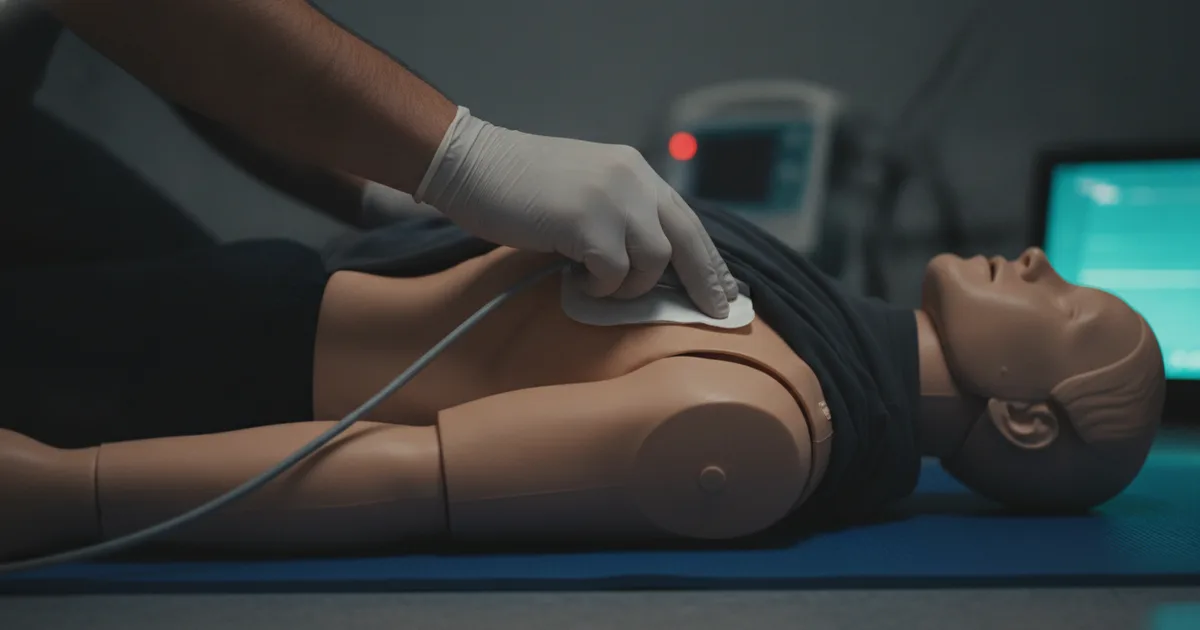
A 54-year-old woman collapses in the checkout line of a farm-supply store. A stock clerk starts compressions through her sweater. A sheriff's deputy arrives first with an AED and kneels beside her, the pads still sealed in their package. Your crew walks in at minute eight. Your partner cuts the sweater, pushes the bra off the left side of her chest, and seats the lateral pad under the breast at the mid-axillary line. The monitor shows ventricular fibrillation.
Bottom line: women in cardiac arrest are less likely than men to have an AED placed before EMS arrives, by bystanders or by police, and in one U.S. system EMS crews took longer to deliver their first shock. Pads go on bare skin with the lateral pad beside or under the breast, the bra gets moved rather than debated, and your QA report should split time to first shock by sex.
How Big the Gap Is
The bystander CPR gap depends on where the arrest happens. In the Resuscitation Outcomes Consortium registry (seven U.S. sites, 2011 to 2015, 19,331 arrests), 39% of women and 45% of men who collapsed in public got bystander CPR [1]. In private settings, mostly homes, the rates were 35% and 36%, with no significant difference [1]. In the national CARES registry (2013 to 2019, 309,662 arrests), women who arrested in public had 14% lower odds of bystander CPR (odds ratio 0.86) [2].
In the Texas CARES registry (2013 to 2023, 50,484 arrests), bystander CPR in public was 50.7% for women and 51.2% for men, with no significant difference [3]. Bystander AED placement was 5.2% for women and 6.7% for men (adjusted odds ratio 0.76) [3]. A Resuscitation Outcomes Consortium analysis of 61,473 arrests found the same AED pattern: in public arrests, women had lower odds of public-access AED application (adjusted odds ratio 0.76) [4].
Why Rescuers Hesitate
A national survey of 548 U.S. adults asked why women receive less bystander CPR than men [5]. Three themes came back: the sexualization of women's bodies, including fear of inappropriate touching or an accusation of sexual assault; a belief that women are frail and easy to injure; and misperceptions about women in acute medical distress [5]. These are perceptions. The survey did not measure what bystanders did.
The Texas data complicate this. The AED gap sat with women outside reproductive age, 4.8% against 7.4% for men (adjusted odds ratio 0.62), and AED placement for women aged 15 to 49 was similar to men's [3]. In that registry, the woman most likely to wait for pads was over 50, not the young woman at the gym.
Of 20 adult CPR manikins on the global market, 15 were labeled male or had no sex label, all 15 had flat torsos, and one of them offered a breast overlay [6]. In a 2026 randomized crossover trial, 52 internal medicine residents ran VF scenarios on a male-bodied and a female-bodied manikin [7]. When the female manikin came first, pads went on 15 seconds later and the first shock came 28 seconds later than on the male manikin [7]. When the male manikin came first, the gap disappeared [7]. The authors caution that a crossover design cannot fully separate practice effects from manikin effects, and the participants were hospital residents [7].
The Gap Continues After Police and EMS Arrive
The Portland Cardiac Arrest Epidemiologic Registry looked at 3,049 adult arrests from 2018 to 2021 that EMS did not witness [8]. Men had higher odds than women of any AED placement before EMS arrived (adjusted odds ratio 1.40) [8]. The difference held for law enforcement (adjusted odds ratio 1.89) but not for lay bystanders (1.19, not significant) [8]. In patients still in arrest on EMS arrival, with a shockable first rhythm and no AED already on, time from EMS arrival to the first shock was 0.81 minute longer for women (95% CI 0.22 to 1.41) [8].
Portland is one system, but a larger registry points the same way. In Resuscitation Outcomes Consortium Epistry data (2011 to 2015, 65,241 EMS-treated arrests), men had higher odds of EMS defibrillation (odds ratio 1.36) and epinephrine (odds ratio 1.22) after adjustment for age, bystander CPR, witness status, location, and initial rhythm [9].
Survival is where registries disagree. Adjusted survival to discharge favored men in that analysis (odds ratio 1.12) [9]. In CARES (2013 to 2019, 326,138 arrests), women less often had a shockable first rhythm (14.7% against 25.1%), and unadjusted survival to discharge was similar (8.6% for women against 10.5% for men), but after adjustment men had lower odds of survival to discharge (adjusted odds ratio 0.83) [10]. No protocol should rest on a settled survival gap. When the pads go on and when the first shock lands are the parts a crew controls.
Pads on a Woman: Placement and the Bra
The lateral pad belongs on the chest wall at the mid-axillary line, beside or under the breast. In a study of 25 women and 2 men, transthoracic impedance with the apex electrode on the breast averaged 95 ohms, against 84 ohms under the breast and 83 ohms lateral to it [11]. In women with a bra size of 40 or larger, the figures were 112, 94, and 98 ohms; in smaller sizes, 81, 77, and 71 ohms [11]. Higher impedance means less current for the same energy, and the authors recommended the lateral or under-breast position [11]. The study measured impedance rather than shock success, and it dates from 1996. Moving the pad off the breast still costs nothing.
The 2025 AHA adult basic life support guideline keeps pads on the exposed chest and added this: "When placing pads for defibrillation for an adult in cardiac arrest, it might be reasonable to adjust the position of a bra instead of removing it" (Class 2b, Level of Evidence C-EO) [12]. The writing group tied it to lower public-access defibrillation rates in women [12]. The evidence is thin. A 2025 scoping review found three studies, one in pigs and two on manikins, and none with patient outcomes [13]. In the pig model, pads touching a bra underwire caused no adverse events, and in simulation, removing the bra did not change time to pad placement or shock [13].
On scene, cut or move clothing, clear the bra from both pad sites, lift the breast if you need to reach the skin under it, and place the pads while compressions continue. Pause only to analyze and shock, as in any high-performance CPR sequence. Drape the patient once the rhythm check is done.
What Dispatch and the Agency Can Change
In a Korean registry of 15,840 public arrests (2013 to 2017), bystanders coached by a dispatcher started CPR on 84.4% of women and 86.9% of men; after adjustment, the difference was not significant (adjusted odds ratio 0.83, 95% CI 0.68 to 1.01) [14]. Without coaching, the rates were 40.5% and 47.3%, and women had lower odds of bystander CPR (adjusted odds ratio 0.79) [14]. It is observational and Korean, so treat the effect size as a signal.
Three changes an agency can make now:
- Measure it. Add pre-EMS AED placement and time from arrival to first shock, split by sex, to your cardiac arrest review. The QA data you already collect carries both timestamps.
- Train on the right chest. Use female-bodied manikins or breast overlays for crews and for the police AED program, early in the course, and practice the bra adjustment in every cardiac arrest simulation.
- Script it. Have dispatchers tell callers to put the pads on bare skin and move the bra out of the way.
Key Takeaways
- In Texas CARES (2013 to 2023), bystander CPR was equal by sex but bystander AED placement was not, 5.2% for women against 6.7% for men. Report the two as separate measures.
- In Portland, police applied AEDs to men more often (adjusted odds ratio 1.89), and EMS took 0.81 minute longer to deliver a first shock to women in a shockable rhythm.
- Electrodes on breast tissue raised impedance from about 84 to 95 ohms. Put the lateral pad at the mid-axillary line, beside or under the breast.
- The 2025 AHA guideline rates adjusting a bra instead of removing it as "might be reasonable" (Class 2b, C-EO), on one animal study and two manikin studies.
FAQ
Do you have to remove a bra to use an AED?
No. The 2025 AHA adult basic life support guideline says it might be reasonable to adjust the position of a bra instead of removing it when placing defibrillation pads (Class 2b, Level of Evidence C-EO, expert opinion) [12]. The pads still go on the exposed chest. If the bra still covers a pad site, move it further until both pads sit on bare skin; adjusting is preferred to cutting.
Where do AED pads go on a woman?
The upper pad goes in the usual spot below the right collarbone. The lateral pad goes on the left chest wall at the mid-axillary line, lateral to or under the breast, directly on skin. In a 1996 study, electrodes on the breast measured higher impedance than electrodes under or beside it, and the authors recommended the lateral or under-breast position [11].
Are women less likely to get CPR than men?
In public, often yes. U.S. registry data from 2011 to 2015 showed bystander CPR in 39% of women against 45% of men who collapsed in public [1]. Texas data from 2013 to 2023 showed no CPR gap, but women were still less likely to have a bystander AED placed (5.2% against 6.7%) [3].
Dr. Chet's Take
I have run cardiac arrests as an emergency physician for more than 25 years, and I serve as a HEMS and critical care transport medical director. This article puts its finger on the right problem. In the newest state data, the gap is less about whether someone pushes on the chest. It is about how long a woman's chest stays covered while she sits in a shockable rhythm. That is a mechanical problem, and mechanical problems have mechanical fixes. Here is one the article does not mention: narrate. When you cut the shirt, say out loud, "I am cutting her shirt to put the defibrillator pads on." Bystanders hear permission. The family hears a reason. Anyone holding a phone hears a clinician doing a clinical job. It costs nothing and slows nobody down.
That being said, I would not hang every delay on modesty. The honest answer is that nobody knows why crews in one registry took longer to shock women. It could be hesitation. It could be layers of clothing, a heavy underwire band, a patient wedged between a toilet and a tub, or a shockable rhythm nobody expected in an older woman. The fear behind a lot of hesitation is simple: somebody will complain. Let me settle that. As a medical director, I would rather defend a cut bra than a late shock, every time, in front of anyone. I agree with the guideline on the bra for a plain reason: a pad needs skin contact, and moving the bra gives it that. Teach the adjustment until crews can clear both pad sites in seconds.
If you are running this call, pads go on before the airway and before the drug box opens, and you do not stop compressions to manage a drape. Document who placed the pads and the minute they went on, because without that line nobody can find this gap in your own service. If you are the medical director, make that minute a required field on the PCR. Then sit down with the last ten arrests in women your agency ran and read every chart yourself, start to finish. Numbers tell you there is a delay. Charts tell you where it lives: the clothing, the bra, the deputy waiting for permission, or the crew. If your sheriff's office carries AEDs under your protocols, their training is your training. A shockable woman gets the same first shock at the same minute as a shockable man.
— Chester Shermer, MD, FACEP | Emergency Medicine, 25+ Years Clinical Experience | State Surgeon
Continue Your Training
If you're an EMT, paramedic, flight medic, or CCTP (or any clinician treating patients daily) trying to understand how AI will actually impact your clinical practice — not just the hype — I put together a free practical guide. You can download the AI in EM Survival Guide here.
Browse All Courses at Global MedOps Command
Relevant Reading on Global MedOps Command:
How to Avoid Becoming an AI Casualty — Dr. Shermer's guide to navigating AI tools in clinical and operational settings without compromising judgment or patient outcomes.
Emergency Department Efficiency Playbook — Practical systems for throughput, triage optimization, and operational efficiency.
Read more from Dr. Shermer on Medium
Connect with Dr. Shermer: LinkedIn — Chester "Chet" Shermer, MD, FACEP.
References
- Blewer AL, McGovern SK, Schmicker RH, et al. Gender disparities among adult recipients of bystander cardiopulmonary resuscitation in the public. Circ Cardiovasc Qual Outcomes. 2018;11(8):e004710. PubMed 30354377
- Blewer AL, Starks MA, Malta-Hansen C, et al. Sex differences in receipt of bystander cardiopulmonary resuscitation considering neighborhood racial and ethnic composition. J Am Heart Assoc. 2024;13(5):e031113. PubMed 38410966
- Huebinger R, Shao F, Blewer AL, et al. Sex and age-based disparities in bystander interventions for out-of-hospital cardiac arrest in Texas. Prehosp Emerg Care. 2026;30(3):422-426. PubMed 40373050
- Grunau B, Humphries K, Stenstrom R, et al. Public access defibrillators: gender-based inequities in access and application. Resuscitation. 2020;150:17-22. PubMed 32126247
- Perman SM, Shelton SK, Knoepke C, et al. Public perceptions on why women receive less bystander cardiopulmonary resuscitation than men in out-of-hospital cardiac arrest. Circulation. 2019;139(8):1060-1068. PubMed 30779655
- Szabo RA, Forrest K, Morley P, et al. CPR training as a gender and rights-based healthcare issue. Health Promot Int. 2024;39(6):daae156. PubMed 39569474
- Nawathe PA, Kanji FF, Esteves E, et al. Rethinking CPR training: when the "man" in manikin affects performance, a randomized crossover simulation study. Resusc Plus. 2026;30:101364. PubMed 42253490
- Thompson K, Smith J, Tanski M, et al. Gender differences in defibrillator practices in out-of-hospital cardiac arrest. Prehosp Emerg Care. 2025;29(5):586-592. PubMed 39189823
- Gramm ER, Salcido DD, Menegazzi JJ. Disparities in out-of-hospital cardiac arrest treatment and outcomes of males and females. Prehosp Emerg Care. 2023;27(8):1041-1047. PubMed 36154391
- Kotini-Shah P, Del Rios M, Khosla S, et al. Sex differences in outcomes for out-of-hospital cardiac arrest in the United States. Resuscitation. 2021;163:6-13. PubMed 33798627
- Pagan-Carlo LA, Spencer KT, Robertson CE, et al. Transthoracic defibrillation: importance of avoiding electrode placement directly on the female breast. J Am Coll Cardiol. 1996;27(2):449-452. PubMed 8557919
- Kleinman ME, Buick JE, Huber N, et al. Part 7: Adult basic life support: 2025 American Heart Association guidelines for cardiopulmonary resuscitation and emergency cardiovascular care. Circulation. 2025;152(16 Suppl 2):S448-S478. PubMed 41122888
- Nørskov AS, Considine J, Nehme Z, et al. Removal of bra for pad placement and defibrillation: a scoping review. Resusc Plus. 2025;22:100885. PubMed 40026715
- Ko SY, Ahn KO, Shin SD, et al. Effects of telephone-assisted cardiopulmonary resuscitation on the sex disparity in provision of bystander cardiopulmonary resuscitation in public locations. Resuscitation. 2021;164:101-107. PubMed 33774152
Related simulation training: EMS-MedSim · Run a free EMS-MedSim scenario · EM-Sim · Books by Dr. Shermer