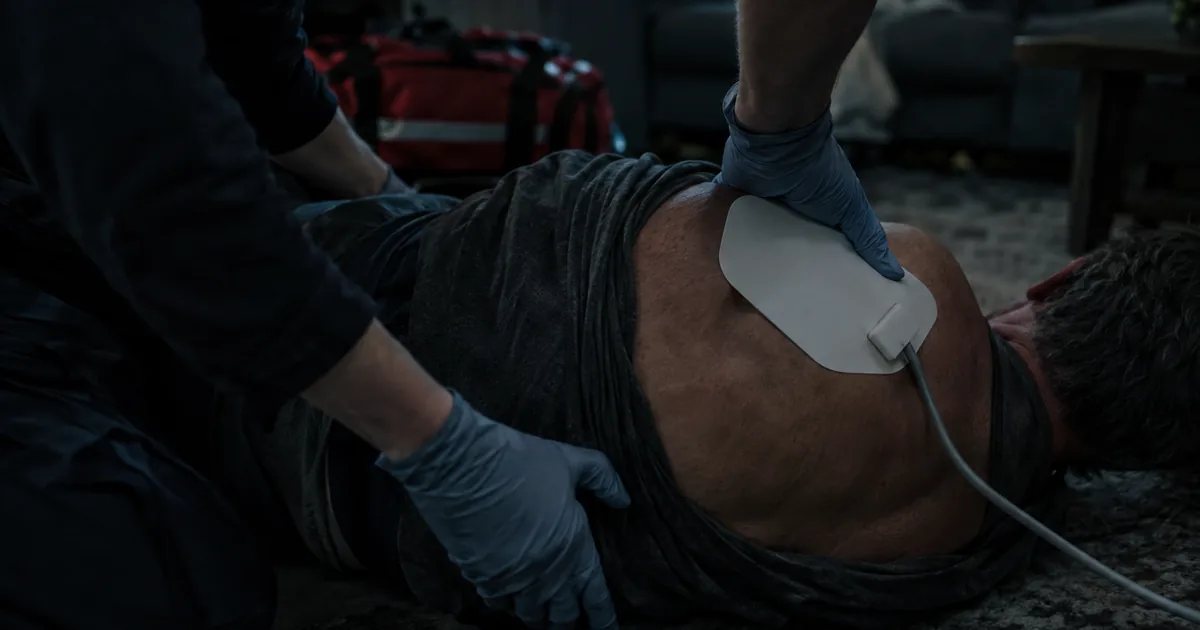
The 61-year-old collapsed while loading feed into his truck, and a bystander started compressions within a minute. The public AED shocked him once. Your crew has delivered two more shocks, and at the rhythm check after the third he is still in coarse VF. The engine company just walked in carrying a second monitor, and your partner asks whether it is time to set up a double sequential shock.
Bottom line: after the third failed shock, check pad contact and position, then move the next shock to an anterior-posterior vector. Use double sequential defibrillation only where your medical director has written it into protocol, with one trained operator and every case reviewed.
What DOSE VF tested
DOSE VF was a three-group cluster randomized trial with crossover in six Ontario paramedic services. It enrolled from March 2018 through May 2022, and each service switched strategy every 6 months [1]. Adults qualified with a presumed cardiac out-of-hospital arrest and refractory VF, defined as VF or pulseless VT still present after three consecutive rhythm analyses and standard shocks, each separated by 2 minutes of CPR [1]. Traumatic arrests, DNR directives, drowning, hypothermia, hanging, and suspected overdose were excluded [1].
The first three shocks in every group used the standard anterior-lateral pads. After that, the groups split [1]:
- Standard: pads stayed anterior-lateral.
- Vector change (VC): pads moved to anterior-posterior.
- DSED: a second defibrillator with a second set of pads was placed anterior-posterior. One paramedic pressed the two shock buttons in rapid sequence, less than 1 second apart, anterior-lateral first.
The data and safety monitoring board stopped the trial early, at 405 patients, because COVID-19 staffing shortages lengthened response times and delayed the assigned strategy [1]. The median time from the 911 call to the first shock was about 10 minutes in all three groups [1].
What the trial found
Survival to hospital discharge was 13.3% (18 of 135) with standard defibrillation, 21.7% (31 of 143) with VC, and 30.4% (38 of 125) with DSED [1]. Compared with standard shocks, the adjusted relative risk was 1.71 (95% CI, 1.01 to 2.88) for VC and 2.21 (95% CI, 1.33 to 3.67) for DSED [1].
The secondary outcomes ran in the same direction:
- VF termination: 67.6% standard, 79.9% VC, 84.0% DSED [1].
- ROSC: 26.5% standard, 35.4% VC (RR 1.39; 95% CI, 0.97 to 1.99), 46.4% DSED (RR 1.72; 95% CI, 1.22 to 2.42) [1].
- Discharge with mRS of 2 or less: 11.2% standard, 16.2% VC (RR 1.48; 95% CI, 0.81 to 2.71), 27.4% DSED (RR 2.21; 95% CI, 1.26 to 3.88) [1].
No defibrillator was damaged or malfunctioned during DSED [1]. The authors flagged their own limits [1]:
- The fragility index for the VC survival result was 1.
- The small number of events could overstate the effect.
- About 88% of patients received their assigned strategy.
- Most patients were urban, where a second defibrillator arrives quickly.
- Medical oversight and paramedic feedback were intensive.
Why the 2025 guidelines held back
The 2025 AHA Adult Advanced Life Support guideline rates both strategies the same way. The usefulness of vector change and of double sequential defibrillation for adults with persisting VF or pVT after 3 or more shocks "has not been established" (COR 2b, LOE B-R) [2]. The guideline gives three reasons [2]:
- DOSE VF showed benefit by intention to treat but not when patients were analyzed by the strategy they actually received.
- The DSED survival benefit appeared only in the 17% of patients with incessant VF, not in the 83% whose VF recurred after a successful shock.
- Effective double shocks need timing separated by milliseconds, which two manually fired defibrillators are unlikely to deliver consistently.
The guideline also points out that persistent VF on a rhythm check is usually recurrence after a successful shock, about 80% of the time, and less often true shock failure [2]. It adds that correctable problems in defibrillation technique belong at the front of the line, before alternate strategies [2]. The European Resuscitation Council went further in both directions. It tells clinicians to consider an anterior-posterior vector change once anterior-lateral placement is confirmed correct, and it advises against DSED outside a research setting [3].
What the secondary analyses add
A DOSE VF secondary analysis classified 345 patients by what happened during shocks 1 through 3. Sixty (17%) had shock-refractory VF that never terminated, and 285 (83%) had VF that terminated and recurred [4]. In the shock-refractory group, survival was 28.6% with DSED and 0% with standard shocks (p = 0.041) [4]. In the recurrent group, DSED did not improve survival, but it did improve ROSC and neurologic survival in both groups. VC improved VF termination in every group without improving survival or ROSC [4].
A 2026 per-protocol analysis of 342 patients and 849 post-randomization shocks looked at pad position. Anterior-posterior shocks delivered more current: 19.6 A with VC and 19.2 A on the DSED anterior-posterior pad, against 16.6 A for standard anterior-lateral shocks [5]. Anterior-posterior position was independently associated with ROSC (aOR 2.01; 95% CI, 1.12 to 3.59), but delivered current was not [5]. That points to the second pad position as a likely mechanism behind both alternate strategies.
US practice has barely moved. In 16,450 eligible patients from 906 agencies in the ESO Data Collaborative, DSED use went from 7.3% before the trial to 8.2% after it [6].
Building a refractory VF sequence
A protocol that fits the evidence and the 2025 guidance has these parts:
- Shocks 1 to 3: anterior-lateral pads, a single-shock strategy, and energy per the manufacturer's instructions (COR 2a) [2].
- Before shock 4: confirm pad contact and position and look for correctable technique problems [2].
- Vector change: place anterior-posterior pads during the CPR cycle after the third shock, with minimal interruption, as in DOSE VF [1].
- Drugs: epinephrine after initial shocks have failed (COR 2a), and consider amiodarone or lidocaine (COR 2b) [2].
- DSED, if your system uses it: a written protocol, a second device, one operator firing anterior-lateral then anterior-posterior in under 1 second, and a QA review of every case [1].
- Documentation: record the time and pad position for every shock.
Key Takeaways
- In DOSE VF, survival to discharge was 30.4% with DSED, 21.7% with VC, and 13.3% with standard shocks. The VC result has a fragility index of 1.
- The 2025 AHA guideline rates both VC and DSED as COR 2b, usefulness not established.
- In DOSE VF, 83% of persistent VF was recurrence after a successful shock, and DSED's survival benefit came from the 17% with truly shock-refractory VF.
- Anterior-posterior shocks delivered about 19 to 20 A versus 16.6 A for anterior-lateral, and anterior-posterior position doubled the adjusted odds of ROSC (aOR 2.01).
FAQ
Is double sequential defibrillation recommended by the AHA?
No. The 2025 AHA Adult Advanced Life Support guideline states that its usefulness for persisting VF or pVT after 3 or more shocks has not been established (COR 2b, LOE B-R) [2]. The European Resuscitation Council advises against its use outside a research setting [3].
What is vector change defibrillation?
Vector change moves the pads from the standard anterior-lateral position to anterior-posterior for shocks after the third [1]. In DOSE VF, survival to discharge was 21.7% with vector change versus 13.3% with standard shocks (RR 1.71; 95% CI, 1.01 to 2.88) [1].
How fast should the two shocks be delivered in DSED?
In DOSE VF, one paramedic fired both defibrillators in rapid sequence, less than 1 second apart, with the anterior-lateral shock first [1]. The 2025 AHA guideline notes that effective timing requires millisecond precision that manual activation is unlikely to achieve consistently [2].
Dr. Chet's Take
I have looked at refractory VF from the medical director's chair, as the physician who signs the protocol a crew follows at 3 a.m. and answers for it in the review afterward. This article gets the hard part right. The strongest signal from DOSE VF is about where the pads sit, and that part costs nothing beyond a second set of pads and the discipline to place them during compressions. A crew that changes pad position on schedule and documents each shock has already captured most of what the evidence clearly supports. It also forces the crew to think ahead, because anterior-posterior pads are hard to place once the patient is on a stair chair or halfway down a hallway.
That being said, I do not think DSED should be dismissed. A doubling of survival in the arm assigned to it is a signal worth chasing, and guideline committees are right to ask for better data before calling it standard. The honest problem is that most systems cannot run it the way the trial did. Two devices, one operator, sub-second timing, and close medical oversight with feedback on every case is a research structure. An agency that adopts DSED without that scaffolding ends up with the technique and none of the oversight. I also worry about the second device itself. In a rural county the second monitor often means waiting for another unit, and a crew that holds out for it can lose compressions or delay the vector change it could have done alone.
If you are a medical director, choose one of two paths and write it down: vector change for every crew, or vector change plus DSED inside a reviewed protocol with defined operator training. If you are the paramedic on the call, place the anterior-posterior pads before you need them and call the shock order out loud. If you are running QA, pull every arrest with four or more shocks and check the pad position and the timestamps. If you train new medics, run the fourth-shock sequence in simulation until moving the pads during compressions takes less than one CPR cycle and nobody has to look up the order. Refractory VF rewards the crew that planned the fourth shock before the first.
— Chester Shermer, MD, FACEP | Emergency Medicine, 25+ Years Clinical Experience | State Surgeon
Continue Your Training
If you're a paramedic, flight medic, or EMS medical director (or any clinician treating patients daily) trying to understand how AI will actually impact your clinical practice — not just the hype — I put together a free practical guide. You can download the AI in EM Survival Guide here.
Browse All Courses at Global MedOps Command
Relevant Reading on Global MedOps Command:
How to Avoid Becoming an AI Casualty — Dr. Shermer's guide to navigating AI tools in clinical and operational settings without compromising judgment or patient outcomes.
Emergency Department Efficiency Playbook — Practical systems for throughput, triage optimization, and operational efficiency.
Read more from Dr. Shermer on Medium
Connect with Dr. Shermer: LinkedIn — Chester "Chet" Shermer, MD, FACEP.
References
- Cheskes S, Verbeek PR, Drennan IR, et al. Defibrillation strategies for refractory ventricular fibrillation. N Engl J Med. 2022;387(21):1947-1956. PubMed 36342151
- Wigginton JG, Agarwal S, Bartos JA, et al. Part 9: Adult advanced life support: 2025 American Heart Association guidelines for cardiopulmonary resuscitation and emergency cardiovascular care. Circulation. 2025;152(16 Suppl 2):S538-S577. PubMed 41122884
- Soar J, Böttiger BW, Carli P, et al. European Resuscitation Council Guidelines 2025 adult advanced life support. Resuscitation. 2025;215 Suppl 1:110769. PubMed 41117572
- Cheskes S, Drennan IR, Turner L, et al. The impact of alternate defibrillation strategies on shock-refractory and recurrent ventricular fibrillation: a secondary analysis of the DOSE VF cluster randomized controlled trial. Resuscitation. 2024;198:110186. PubMed 38522736
- Cheskes S, Drennan IR, Turner L, et al. The impact of defibrillation current and pad position on return of spontaneous circulation during refractory ventricular fibrillation. Resuscitation. 2026;222:111061. PubMed 41856454
- Smida T, Crowe R, Drennan IR, et al. Use of double sequential external defibrillation in the United States before and after the DOSE VF randomized clinical trial. Prehosp Emerg Care. 2026. PubMed 42149949
Related simulation training: EM-Sim · Books by Dr. Shermer