BLUF (Bottom Line Up Front)
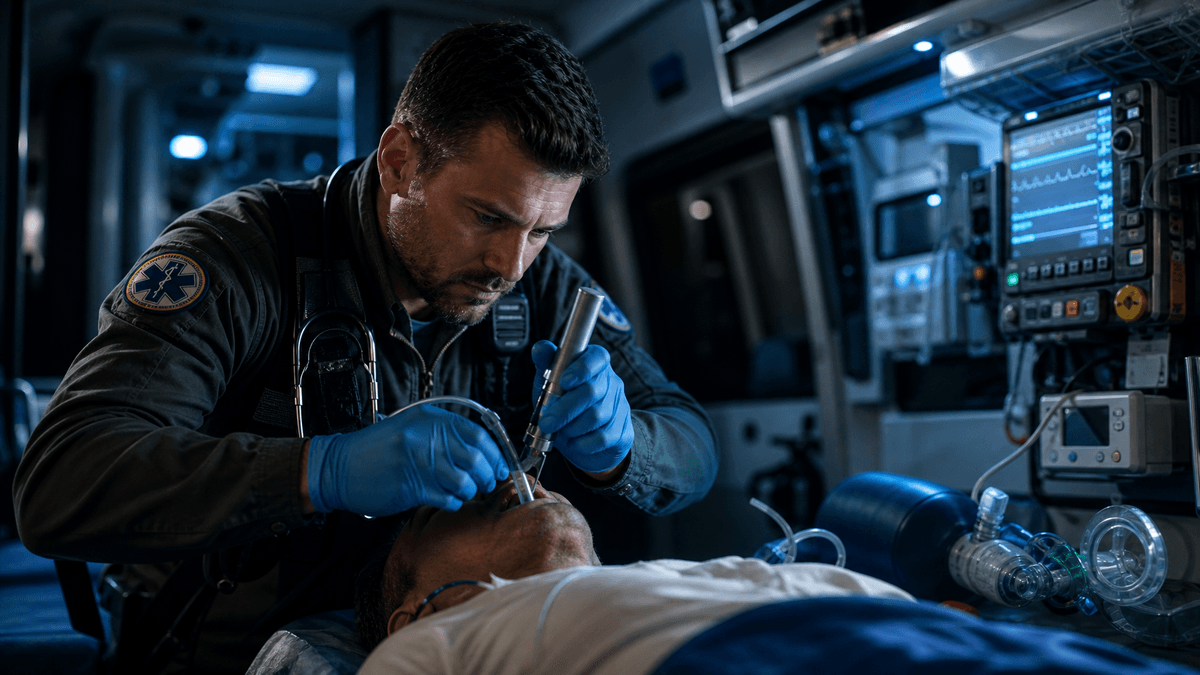
Prehospital airway management fails when providers lack realistic reps. Simulation-based training is no longer optional — it is the only ethical mechanism for building the decision-making and technical competency that real airway emergencies demand.
The airway problem in EMS is not a knowledge problem. Every paramedic program covers RSI pharmacology, intubation sequences, and rescue airway algorithms. What the classroom does not cover is what happens when the 380-pound unresponsive trauma patient arrives at 0200 and your first three intubation attempts fail.
That call will happen. The question is whether you have run through it before.
First-pass prehospital intubation success rates in the United States vary from under 70% in some systems to over 90% in others, according to studies published in Prehospital Emergency Care. The gap does not track to provider intelligence. It tracks to training infrastructure. Providers who practice regularly in scenario-based environments that replicate the variability and stress of real calls outperform those who don't — consistently.
A lecture does not close that gap. Reps do.
Why Do Paramedics Struggle With Prehospital Airway Management?
Emergency medicine has a problem it rarely discusses publicly: providers learn airway management on patients. In hospital emergency departments, residents build skills under direct physician supervision. That system has real limitations, but it works well enough when call volume is high and attendings are present.
In EMS, the volume of advanced airway encounters is lower, the acuity is often higher, and the supervision model is fundamentally different. A rural paramedic may go weeks without performing RSI. When the call comes, the skill has to be there. The protocol will not remind your hands what to do.
The surgical airway situation is worse. Most paramedics graduate their programs having practiced cricothyrotomy exactly once — on a mannequin, in a controlled lab, with an instructor present. Ask any HEMS medical director how many arriving providers have real comfort on that skill. The answers are not encouraging.
Simulation changes that. It gives providers a safe environment to fail — to miss the cords, to recognize an esophageal intubation, to transition to a rescue airway under pressure — without a patient paying the price. More than that, it builds the pattern recognition that turns a protocol step into clinical instinct.
What Does Simulation Actually Deliver for Airway Training?
Traditional mannequin drills share one critical limitation with classroom training: the patient does not deteriorate unexpectedly. The scenario ends when the skill is complete. Real calls don't work that way.
Scenario-based simulation platforms — including EMS-MedSim — replicate the chaos that real calls produce. Difficult anatomy. An unexpected SpO2 drop mid-procedure. Competing stimuli in the environment. The platform's AI Tutor provides real-time feedback on clinical decision-making, not just technique. That distinction matters more than most providers realize. You can execute an intubation correctly and still make the wrong decision about when to intubate, which induction agent to use, or how long to persist before moving to a surgical airway.
That's where providers fail. Not in the mechanics. In the judgment. The EMS-MedSim Critical Care & Flight tier addresses advanced airway cases directly, including RSI scenarios and the decision trees that separate competent providers from excellent ones.
What Is the Medical Director Responsibility for Airway Training?
If you are a medical director, your agency's current airway training is probably insufficient. Quality improvement data from well-run EMS systems consistently shows that agencies with structured simulation-based airway programs outperform those relying on annual competency check-offs. The check-off confirms a provider knows the algorithm. It says nothing about how they perform when the algorithm breaks.
The National Association of EMS Physicians (NAEMSP) has published position statements on prehospital airway management that medical directors should have current. The standards are clear. The training gap in most agencies is just as clear.
That being said, standards and curriculum only matter if providers can access them. Simulation platforms requiring dedicated sim labs and scheduled cohort sessions will never reach the rural paramedic who needs them most. On-demand, scenario-based digital simulation — accessible on a tablet before a night shift — is where prehospital airway training is heading, and where the access problem starts to get solved.
Dr. Chet's Take
I have been a HEMS medical director long enough to have seen what a bad prehospital airway costs — and what an excellent one saves. The difference between those two outcomes was never natural ability. It was preparation. It was having run the scenario before, under stress, with something on the line.
In the military, we do not send medics into the field with skills they have only read about. We train to automaticity, and then we train under stress until the automaticity holds. Prehospital airway management deserves the same standard. EMS-MedSim was built with that gap in mind. The airway scenarios are not easy, because real airways are not easy.