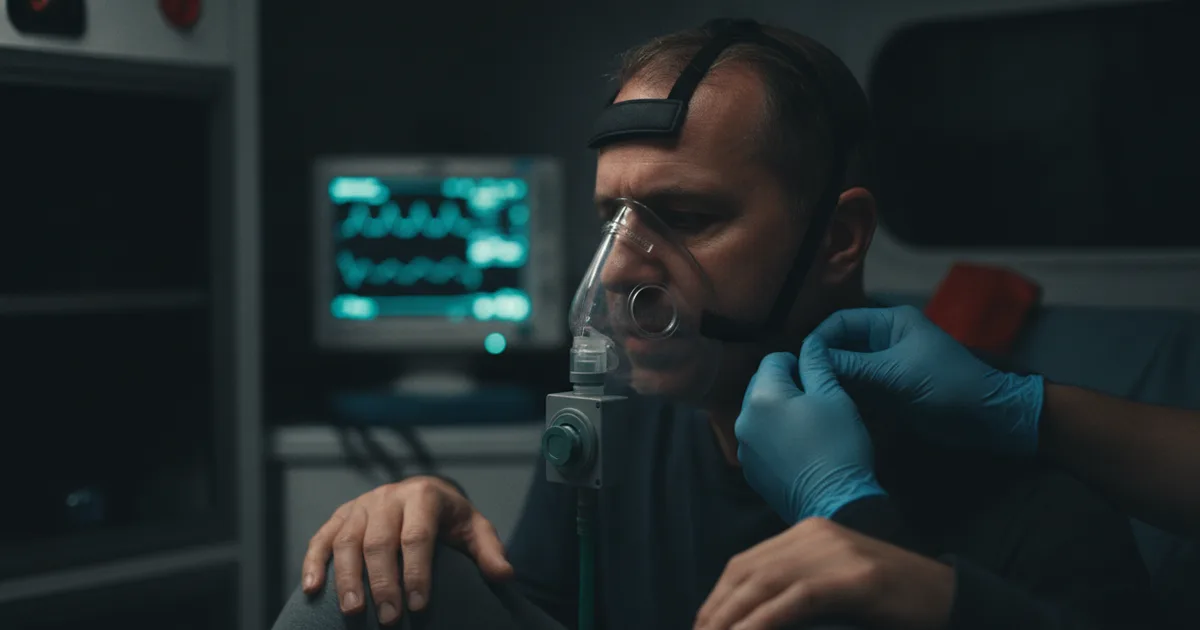
At 02:10, a patient with severe shortness of breath is sitting bolt upright in the ambulance. The monitor shows low oxygen saturation. Your crew has started the treatment in its respiratory-distress protocol, but the patient is still working hard to breathe. CPAP may help. The mask is not the finish line.
The useful question is not only whether CPAP changes a number. It is whether this patient fits the treatment, tolerates the interface, improves, and remains safe while you move toward definitive care. A 2026 review found that prehospital CPAP and other noninvasive ventilation often improve short-term physiology, while effects on patient-centered outcomes remain uncertain (Kristensen et al., 2026).
What CPAP can—and cannot—tell you
Continuous positive airway pressure (CPAP) supplies pressure through a mask while the patient breathes on their own. In prehospital care, that pressure can support oxygenation and reduce visible respiratory distress in selected patients. CPAP is not the same as bilevel positive airway pressure, and neither device replaces an airway plan for a patient who cannot breathe or protect the airway (NAEMSP position statement, 2022).
The best recent overview is a 2026 scoping review of prehospital treatment for acute COPD exacerbations. It mapped 34 studies, including seven CPAP studies and seven studies of noninvasive ventilation. The reviewers found consistent short-term physiologic improvement with CPAP and noninvasive ventilation, but limited randomized evidence for outcomes such as survival, intubation, or hospital stay. The review did not formally assess risk of bias, so it maps what has been studied rather than proving that one approach works for every patient (Kristensen et al., 2026).
A large Australian randomized trial helps put those findings in context. It assigned 708 adults with severe, non-traumatic respiratory distress to usual care or usual care plus CPAP. At emergency department arrival, the CPAP group had a greater median reduction in dyspnea score and respiratory rate. The trial found no difference in hospital length of stay or mortality, and it was not designed to settle every question about those outcomes (Finn et al., 2022).
That is a useful result, not a promise of rescue. CPAP may ease distress during the ride. The evidence does not let a crew assume that it will prevent intubation, shorten every admission, or reverse the cause of respiratory failure. Treat the patient’s response as the result that matters, not the presence of a mask (Finn et al., 2022; Kristensen et al., 2026).
Choose the patient before choosing pressure
NAEMSP’s 2022 position statement supports noninvasive ventilation for selected prehospital patients with respiratory failure, including patients with COPD, asthma, or pulmonary edema. It also puts responsibility on medical directors to ensure training in patient selection, equipment use, adjunctive care, and assessment of response (McCoy et al., 2022). When the cause is sympathetic crashing acute pulmonary edema, CPAP is only half of the treatment: see SCAPE in the field: CPAP and nitroglycerin, together.
Selection is not a device setting. The Australian trial excluded patients with reduced consciousness, systolic blood pressure below 90 mm Hg, suspected pneumothorax, vomiting, or aspiration. Those were that trial’s criteria, not universal numbers for every service; crews must use their own medical director’s protocol (Finn et al., 2022). NAEMSP also notes that positive pressure can reduce venous return and cardiac output, so shock or hypotension calls for caution. Positive pressure may worsen a pneumothorax, another reason to assess the patient rather than apply the device by reflex (McCoy et al., 2022).
Before applying a mask, ask whether the patient can cooperate, maintain spontaneous breathing, and protect the airway. If the answer is no—or if the patient deteriorates, vomits, or cannot tolerate the interface—follow the protocol’s stop and escalation steps. CPAP must not delay ventilation or airway care when the patient needs them (McCoy et al., 2022; Finn et al., 2022).
Make CPAP a treatment loop
Record the patient’s condition before the mask goes on. Then compare the same measures after you start: respiratory rate, oxygen saturation, blood pressure, work of breathing, mental status, and tolerance. This is a practical way to make “better” observable; NAEMSP specifically calls for training in response assessment, and the trial assessed dyspnea, respiratory rate, oxygen saturation, and comfort (McCoy et al., 2022; Finn et al., 2022).
Do not copy a pressure number from a paper into a local protocol. In the Australian trial, crews started at 10 cm H₂O and adjusted in 1 cm H₂O steps using oxygen saturation, respiratory rate, and comfort. That was the study’s device and treatment plan, not a universal starting dose (Finn et al., 2022). Follow the settings and escalation limits approved for your equipment and service.
Tolerance is part of the treatment. In the trial, 37 of the 358 patients who had a mask applied did not tolerate CPAP through transport; anxiety or claustrophobia was reported among the reasons. Explain what the mask will feel like, coach the patient, and watch for a changing clinical picture. Do not force a mask onto a patient who is worsening or cannot keep it on safely (Finn et al., 2022).
If the patient improves, keep reassessing and tell the receiving team what changed. If the patient does not improve, becomes hypotensive, loses alertness, or cannot tolerate CPAP, use the escalation plan rather than waiting for the device to work. Those branch points should be clear in the local protocol and practiced before they occur on a real call (McCoy et al., 2022; Finn et al., 2022).
Practice the branch point, not just the mask
A training session should include a patient who improves, one who does not, and one who becomes less stable after CPAP begins. Ask the crew to say what they will reassess, what finding changes the plan, and what they will report at handoff. NAEMSP calls for appropriate training and quality improvement around prehospital noninvasive ventilation; short, repeatable simulation can make those expectations visible to the whole crew (McCoy et al., 2022).
EMS-MedSim’s scenario library can support repeated practice of prehospital decisions. The wider Global MedOps Command training work connects EMS learning with emergency medicine and transport education. For the emergency-department side of the same handoff, EM-Sim focuses on emergency medicine simulation.
Dr. Chet's Take
I have spent 25 years in emergency medicine, and I have seen crews reach for a device because the patient looks bad. CPAP can be a good choice. It is not a substitute for thinking. The Australian trial gives us a practical signal: selected patients felt less dyspneic and arrived breathing more slowly, but the study did not show a shorter hospital stay or lower mortality (Finn et al., 2022). That is the distinction I want crews to carry. Relief matters. It is not the same as resolution.
That being said, the evidence is not a clean endorsement for every short-of-breath patient. The 2026 review found gains in short-term physiology but uncertainty about outcomes that matter most to patients. The review also did not rate study quality, which limits how far I can take its conclusions (Kristensen et al., 2026). In HEMS and critical care transport, a treatment that works for one patient can become a distraction if nobody checks whether it is working for the next one.
If you are running this call, set a point to reassess before you start CPAP. Say what improvement would look like and what would make you stop. Write down the patient’s response, not just the device and pressure. Then give the receiving team the trend and the reason you continued or changed the plan. That is good medicine in a moving ambulance.
Key Takeaways
- CPAP can reduce dyspnea and respiratory rate in selected prehospital patients, but it is not proven to improve every major outcome.
- Patient selection, tolerance, and repeated reassessment matter as much as the pressure setting.
- Use your service protocol; study thresholds and settings are not universal instructions.
- If the patient worsens or cannot tolerate the mask, follow the escalation plan.
If you're a EMT, paramedic, flight medic, CCTP, or EMS medical director trying to understand how AI will actually impact your clinical practice — not just the hype — I put together a free practical guide. You can download it here: AI in EM Survival Guide.
FAQ
When should EMS use CPAP in the ambulance?
Use it for a patient who meets your service’s criteria for noninvasive ventilation and can tolerate the mask, with a plan to assess response and escalate if needed. NAEMSP supports prehospital use for selected respiratory failure, while the evidence review finds that outcomes depend on a still-limited evidence base (McCoy et al., 2022; Kristensen et al., 2026).
Does prehospital CPAP reduce intubation or mortality?
The 708-patient Australian trial found greater improvement in dyspnea and respiratory rate, but no difference in hospital length of stay or mortality. The 2026 scoping review also found patient-centered outcomes uncertain, so crews should not promise that CPAP will prevent intubation or death (Finn et al., 2022; Kristensen et al., 2026).
When should EMS stop CPAP?
Follow the local protocol if the patient worsens, becomes hypotensive or less alert, vomits, or cannot tolerate the mask. The Australian trial stopped CPAP for airway concerns, systolic blood pressure below 90 mm Hg, intolerance, vomiting, reduced responsiveness, or suspected pneumothorax; those were trial rules, not a replacement for local protocol (Finn et al., 2022).
Is CPAP the same as BiPAP?
No. CPAP applies continuous positive pressure; BiPAP provides different inspiratory and expiratory pressures. Both are forms of noninvasive ventilation, but equipment, settings, and patient selection should follow the service’s training and protocol (McCoy et al., 2022).
References
- Kristensen JT, Bülow A, Jensen ASR, et al. Prehospital treatment modalities for acute exacerbation of chronic obstructive pulmonary disease: a scoping review. BMC Emergency Medicine. 2026.
- Finn JC, Brink D, McKenzie N, et al. Prehospital continuous positive airway pressure (CPAP) for acute respiratory distress: a randomised controlled trial. Emergency Medicine Journal. 2022.
- McCoy AM, Morris D, Tanaka K, et al. Prehospital Noninvasive Ventilation: An NAEMSP Position Statement and Resource Document. Prehospital Emergency Care. 2022.
- Related simulation training: MilMedSim.
- Books by Dr. Shermer.