The Prehospital Airway Problem
Airway management is the highest-stakes skill in prehospital care — and the most frequently mismanaged. A 2019 systematic review in Prehospital Emergency Care found that prehospital RSI was associated with improved outcomes in traumatic brain injury when performed by well-trained providers, but with worse outcomes when performed by providers with low intubation volume.
The difference isn't the drug protocol. It's the decision-making.
RSI Indications: The Prehospital Standard
RSI is indicated prehospitally when the patient:
- Cannot protect their airway (GCS ≤ 8 with absent gag, active vomiting, or massive facial trauma)
- Cannot maintain adequate oxygenation despite high-flow O₂ and positioning
- Cannot maintain adequate ventilation (respiratory failure, severe bronchospasm unresponsive to treatment)
- Has a predicted clinical course requiring intubation before hospital arrival (long transport, deteriorating TBI)
The key word is predicted. Prehospital RSI is a proactive intervention. Waiting until the patient is in full respiratory arrest eliminates the "controlled" from "controlled airway."
Drug Selection and Dosing
Induction agents:
- Ketamine (1.5–2 mg/kg IV): First-line for most prehospital RSI. Maintains hemodynamic stability, provides analgesia, and is safe in hypotension. Avoid in known elevated ICP (relative contraindication — evidence is evolving).
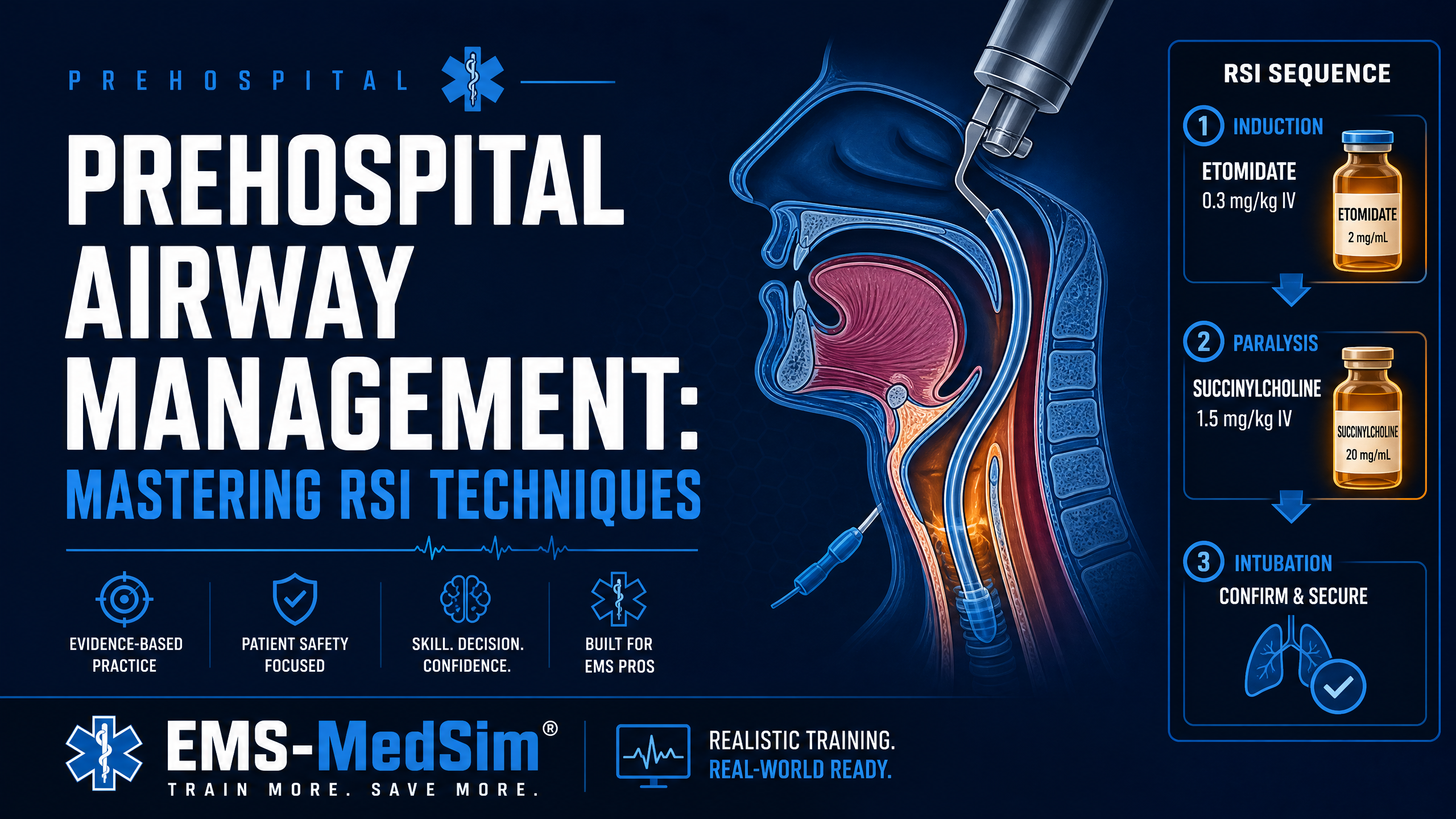
- Etomidate (0.3 mg/kg IV): Hemodynamically neutral, rapid onset. Adrenal suppression concern in sepsis is largely theoretical at single-dose prehospital use.
Paralytic agents:
- Succinylcholine (1.5 mg/kg IV): Fastest onset (45–60 seconds), shortest duration. Contraindicated in crush injuries >72 hours, burns >24 hours, denervation injuries, personal/family history of malignant hyperthermia.
- Rocuronium (1.2 mg/kg IV): Non-depolarizing alternative. Onset 60–90 seconds. Reversible with sugammadex (16 mg/kg) if available.
The Failed Airway Algorithm
Every prehospital RSI attempt must be preceded by a mental rehearsal of the failed airway plan. Before you push drugs, answer these three questions:
- Can I BVM this patient if I fail? (Assess for beard, obesity, edentulous, age >55 — the MOANS mnemonic)
- What is my backup device? (Supraglottic airway — King LT, i-gel, or LMA)
- Do I have a surgical airway option? (Needle or surgical cric kit immediately accessible)
If you cannot confidently answer all three, reconsider whether RSI is the right intervention for this patient in this environment.
BVM-First: When the Evidence Supports Staying Basic
The AIRWAYS-2 trial (2018, JAMA) randomized 1,523 patients with out-of-hospital cardiac arrest to supraglottic airway vs. tracheal intubation. The supraglottic group had better neurological outcomes at 30 days.
This doesn't mean intubation is wrong in cardiac arrest — it means that for many prehospital patients, a well-placed supraglottic airway with excellent BVM technique delivers equivalent or superior oxygenation with less risk of procedure-related complications (esophageal intubation, prolonged CPR interruption, hypoxia during laryngoscopy).
The takeaway: RSI is a tool, not a goal. The goal is oxygenation and ventilation. Choose the tool that best achieves that goal for this patient, in this environment, with your current skill level.
Post-Intubation Management
Successful intubation is not the end of airway management — it's the beginning.
- Confirm placement: Waveform capnography is the gold standard. EtCO₂ should be 35–45 mmHg in non-arrest patients.
- Secure the tube: Commercial tube holder or tape. Document depth at teeth.
- Set ventilator parameters: TV 6–8 mL/kg IBW, rate 10–12/min. Avoid hyperventilation (causes cerebral vasoconstriction in TBI).
- Sedate and analgize: Post-intubation sedation is mandatory. Midazolam 0.05–0.1 mg/kg + fentanyl 1–2 mcg/kg is a common prehospital regimen.
Simulation as Skill Maintenance
Intubation is a perishable skill. Studies show that providers who perform fewer than 12 intubations per year have significantly higher first-attempt failure rates. If your call volume doesn't provide adequate exposure, simulation is the evidence-based solution.
Branching scenario simulation — where your airway decision triggers downstream consequences — builds the decision-making framework that transfers to real patients. It's not a replacement for cadaver labs or airway manikins, but it's the most accessible tool for maintaining clinical judgment between real-world exposures.
Practice your airway decision-making with EMS-MedSim's prehospital simulation scenarios. Try one free — no signup required.
Frequently Asked Questions
When is RSI indicated in the prehospital setting?
When a patient cannot protect or maintain their airway and less-invasive measures have failed or are inadequate — always within your local protocol and medical direction.
When is staying with a BVM better than intubating?
When the airway is manageable with basic adjuncts and good two-person technique — a well-sealed BVM with an OPA or NPA often outperforms a rushed intubation attempt, especially on short transports.
What is the failed airway plan?
Move immediately to the rescue sequence rather than repeating attempts: supraglottic airway or resumed BVM ventilation, and in a can't-intubate-can't-oxygenate situation, a surgical airway per protocol.