BLUF (Bottom Line Up Front)
Tactical EMS providers operate in a legally and clinically distinct environment from standard EMS — and their training requirements reflect that. In 2026, effective TEMS preparation means competency in warm zone casualty care, the EMS-law enforcement operational interface, and scenario types that standard EMS simulation does not cover.
Tactical EMS is not a specialty for providers who want to wear tactical gear. It is a distinct operational discipline with a specific set of clinical responsibilities, legal considerations, and decision-making environments that do not exist in standard EMS practice.
Getting that distinction wrong has consequences — for the tactical team, for the patient, and for the provider.
What Is TEMS and How Does It Differ from Standard EMS?
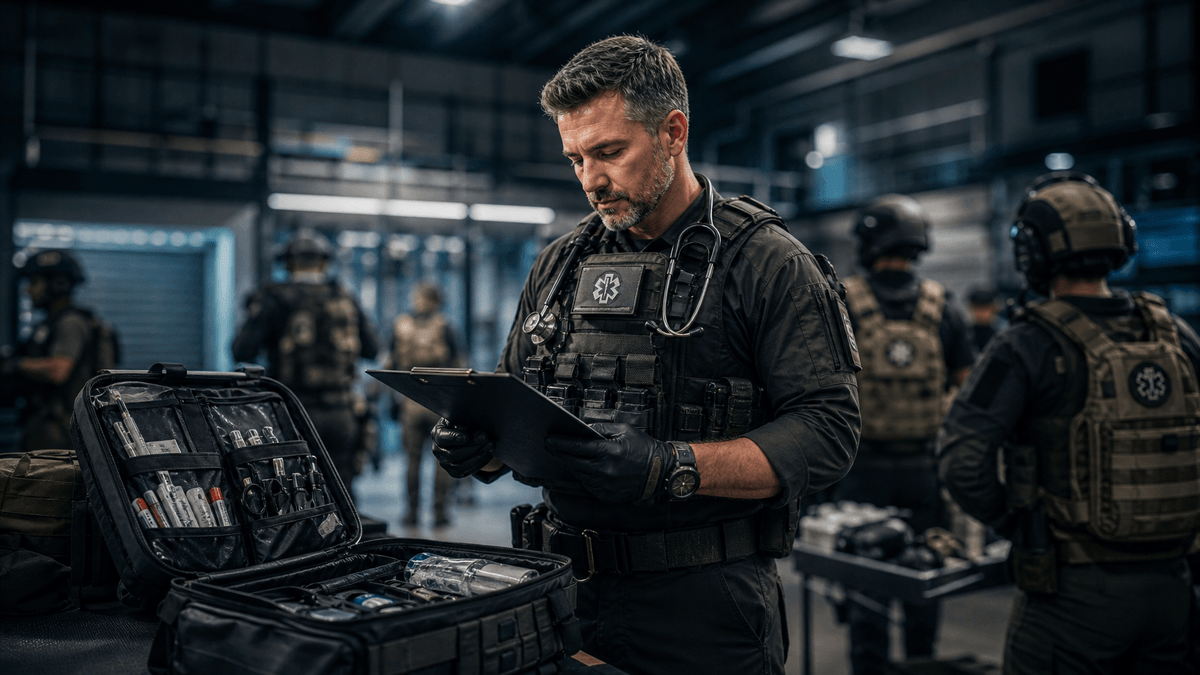
Tactical Emergency Medical Support (TEMS) refers to the integration of EMS-trained personnel into law enforcement tactical operations. TEMS providers work in direct coordination with SWAT, hostage rescue, and other specialized law enforcement units, providing medical support in environments where standard EMS cannot safely operate.
The operational distinction that matters most is the zone of care. Standard EMS operates almost exclusively in the cold zone — the area of safety beyond the perimeter of an active incident. TEMS providers operate in the warm zone — the transition area between the hot zone (active threat) and the cold zone (full safety). That zone requires a fundamentally different operational posture. Tactical awareness, cover and concealment, understanding of the incident perimeter, and direct coordination with the law enforcement command structure are all competencies that standard EMS training does not address.
The clinical content is also distinct. Penetrating trauma — gunshot wounds, blast injuries, stab wounds — is the dominant mechanism in tactical environments. Hemorrhage control, tourniquet application, wound packing, and tension pneumothorax decompression are the core skills. The TECC (Tactical Emergency Casualty Care) protocol is the civilian standard, adapted from the military's TCCC framework for the operational and legal environment that civilian tactical providers work in.
Why Does the TECC vs. TCCC Distinction Matter?
TCCC was developed for military medics operating in combat environments. It is a proven framework built on battlefield data from over two decades of conflict. TECC adapts those principles to the civilian law enforcement environment — a different operational context with different legal authority, different resources, and a different patient population.
TEMS providers are not military medics. They operate under civilian EMS medical direction, within state EMS scope of practice, in coordination with civilian law enforcement. The protocols, the equipment lists, and the decision authorities are all different. A ground paramedic who has completed TCCC training has a solid clinical foundation. That being said, they are not automatically prepared for the TEMS operational environment without additional training specific to the civilian tactical context.
The National EMS Management Association (NEMSMA) publishes TEMS position statements that address these distinctions directly. The Counter Narcotics and Terrorism Operational Medical Support (CONTOMS) program at the Uniformed Services University has trained TEMS providers for decades and remains a gold standard for formal TEMS education. Both are worth reviewing as you build or evaluate a TEMS training program.
How Do You Address the Simulation Gap in Tactical Medicine?
Table-top exercises and classroom instruction remain the dominant training modality for many TEMS programs. They are useful for establishing a shared operational language and reviewing protocols. They are insufficient for building the clinical decision-making that warm zone casualty care demands.
TEMS providers encounter scenarios where the patient is accessible but the threat is not resolved. Clinical decisions have to be made quickly, in a physically and operationally constrained environment, with incomplete information about the tactical situation. That decision environment cannot be replicated with a slide deck.
Scenario-based simulation that places providers in high-stress, high-acuity presentations — penetrating trauma, tension pneumothorax, multi-casualty incidents — builds the pattern recognition and decision speed that tactical environments require. EMS-MedSim includes trauma and casualty care scenarios that provide that scenario-based preparation for TEMS candidates and experienced tactical providers maintaining readiness.
For the mass casualty component specifically — the multi-victim shooting, the blast incident — see my piece on AI in mass casualty triage at medium.com/@chet.shermer, which addresses both the promise and the significant limitations of algorithmic decision support in MCI environments.
What Does Best-Practice TEMS Training Look Like in 2026?
The agencies running the best TEMS programs in 2026 share several characteristics. They have a physician medical director who is actively involved in TEMS operations — not just signing off on protocols from a distance. They use scenario-based training that replicates tactical conditions, not just clinical ones. They maintain provider readiness between operations with regular case review and simulation, rather than waiting for the next live exercise.
They also recognize that the clinical and the operational are inseparable in tactical medicine. A TEMS provider who is clinically excellent but operationally unprepared is a liability to the tactical team. The reverse is equally true.
Dr. Chet's Take
The military perspective informs everything I think about TEMS. In the Army National Guard, we train medics to operate under conditions where the patient care environment is actively hostile — where the right clinical decision has to be executed quickly, under stress, with limited equipment and no backup immediately available.
That's exactly what TEMS providers face in the warm zone. The clinical skill set has a well-established civilian training pathway. The operational competency — knowing how to move, communicate, and make decisions in a tactical environment — is where I see the most significant gaps in civilian TEMS programs. Table-top exercises don't close that gap. Integrated scenario training does.