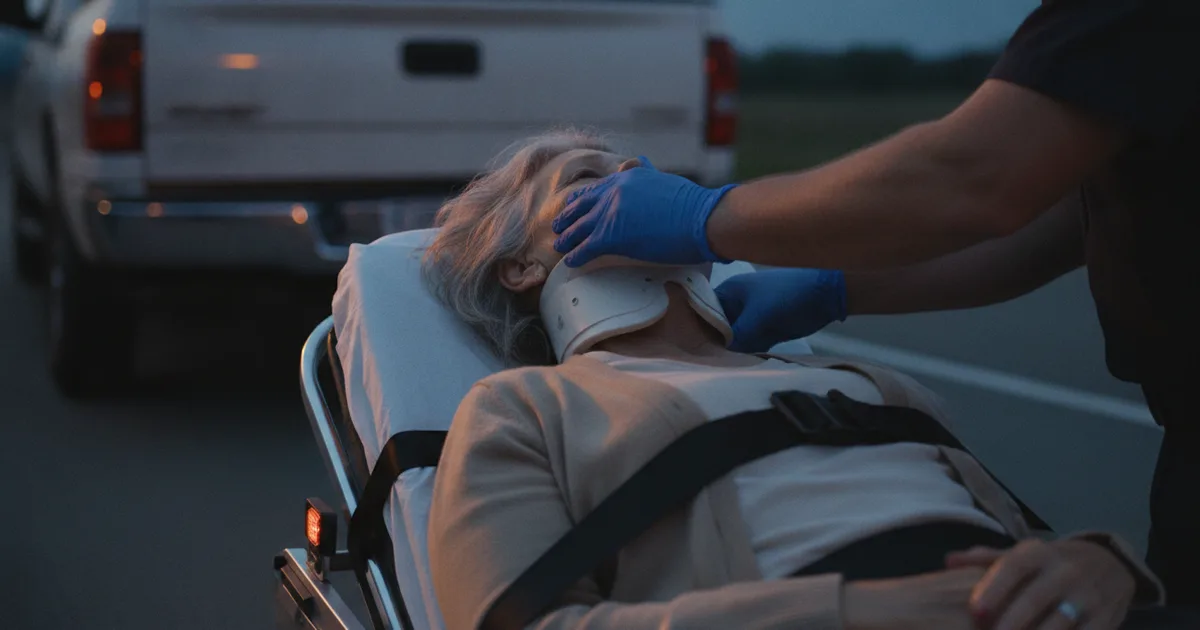
A 41-year-old welder was rear-ended at a stoplight. He was out of his pickup and walking around before your unit arrived, and the muscles on both sides of his neck started to ache about twenty minutes later. He is alert and oriented, with GCS 15 and normal vital signs. He has no midline tenderness, normal strength and sensation in all four limbs, and he turns his head 45 degrees to each side without pain. His mother, 72, was in the passenger seat. She has the same soreness, no midline tenderness, and a normal neurologic exam.
Bottom line: the welder meets none of the joint-statement indications for spinal motion restriction and clears the Canadian C-Spine Rule as paramedics use it, so he rides seated on the cot without a collar. His mother also meets none of the joint-statement indications, but she cannot clear the Canadian rule, because age 65 or older is a high-risk factor. A protocol built on that rule keeps her in motion restriction, lying on the cot with the head raised slightly. Neither patient needs a long backboard.
What the 2018 Joint Statement Changed
In 2018 the American College of Surgeons Committee on Trauma, ACEP, and NAEMSP published one joint position statement on spinal care in the field [1]. It replaced "spinal immobilization" with "spinal motion restriction" (SMR), because collars and boards reduce unwanted motion but do not immobilize the spine [1].
After blunt trauma, the statement lists these indications for SMR [1]:
- Acutely altered level of consciousness, such as GCS below 15 or evidence of intoxication
- Midline neck or back pain or tenderness
- Focal neurologic signs or symptoms
- Anatomic deformity of the spine
- Distracting circumstances or injury
The statement also accepts a scoop stretcher, a vacuum splint, or the ambulance cot as ways to achieve SMR [1]. The long board is one option among several, not the default.
The evidence that motion restriction helps is weak. A retrospective comparison of two university hospitals found less neurologic disability among 120 Malaysian patients with blunt spinal injury, none of whom were immobilized, than among 334 New Mexico patients, all of whom were (OR 2.03, 95% CI 1.03 to 3.99) [2]. The two systems differed in more than immobilization, so the study cannot prove harm, but it found no sign that immobilization helped. For cervical injuries alone, the difference was not significant (OR 1.52, 95% CI 0.64 to 3.62) [2]. A 2026 scoping review of 27 studies found no clear advantage for routine full immobilization over selective strategies [3].
NEXUS and the Canadian Rule Were Built for the ED
Both decision rules most crews know were derived to decide who needs neck imaging in the emergency department, not who needs a collar in the field.
NEXUS studied 34,069 blunt trauma patients at 21 US centers [4]. A patient was low risk with no midline cervical tenderness, no focal neurologic deficit, normal alertness, no intoxication, and no painful distracting injury. The criteria missed 8 of 818 cervical spine injuries (sensitivity 99.0%), with a specificity of 12.9% [4].
The Canadian C-Spine Rule was derived in 8,924 alert, stable adults with GCS 15 in 10 Canadian emergency departments [5]. It asks three questions. Is there a high-risk factor: age 65 or older, a dangerous mechanism, or paresthesias in the extremities? Is there a low-risk factor that allows a range-of-motion test: a simple rear-end collision, sitting position, ambulatory at any time since the injury, delayed onset of neck pain, or no midline tenderness? Can the patient actively rotate the neck 45 degrees left and right [5]? In derivation, it had 100% sensitivity and 42.5% specificity for 151 important injuries [5].
When the two rules were compared head to head in 8,283 patients, the Canadian rule was more sensitive (99.4% versus 90.7%) and more specific (45.1% versus 36.8%), and it missed 1 important injury against 16 for NEXUS [6]. That analysis excluded 845 patients (10.2%) whose physicians did not test range of motion [6]. If you use the Canadian rule, you have to complete the rotation test.
Michigan tested its own field clearance criteria prospectively. Across 8,975 patients, field criteria of altered mental status, neurologic deficit, spine pain or tenderness, intoxication, or suspected extremity fracture identified 280 of 295 spine injuries (94.9%) [7]. Of the 15 missed, 13 were stable injuries [7].
Paramedics Can Apply the Canadian Rule
The Ottawa group tested the Canadian rule in the hands of paramedics. In 7 Canadian regions, 1,949 alert, stable adults were assessed by paramedics and then immobilized anyway [8]. Paramedics classified all 12 important injuries correctly (sensitivity 100%, 95% CI 74% to 100%), and 37.7% of immobilizations could have been avoided [8]. Agreement between paramedics was high (kappa 0.93), and when they misread the rule, they erred toward immobilizing [8].
The implementation study let paramedics act on the result, using a version of the rule modified for paramedic use. From 2011 to 2015 in Ottawa, crews assessed 4,034 low-risk adults with GCS 15 and stable vital signs and transported eligible patients without immobilization [9]. There were 11 important injuries. Paramedics classified them with a sensitivity of 90.9% (95% CI 58.7% to 99.8%), so one injured patient was classed as not needing immobilization, and no patient had an adverse event or a spinal cord injury [9]. Immobilization was avoided in 2,583 patients (64.0%) [9].
These studies enrolled adults with GCS 15 and stable vital signs in Canadian systems. They do not apply to the intoxicated patient, the obtunded patient, or the head-injured patient covered in our traumatic brain injury guide. Your agency protocol decides which rule you use.
Penetrating Trauma: Leave the Board Behind
A National Trauma Data Bank study of 45,284 penetrating trauma patients found unadjusted mortality of 14.7% in those immobilized and 7.2% in those who were not [10]. After adjustment, the odds ratio for death was 2.06 (95% CI 1.35 to 3.13) [10]. The authors estimated that 1,032 patients would need immobilization to benefit one, while one death might be associated with every 66 [10]. The study is retrospective, and sicker patients may have been immobilized more often.
The Eastern Association for the Surgery of Trauma reviewed 24 studies and pooled 5 [11]. No study showed a benefit of spine immobilization for mortality or neurologic injury, even with a direct neck wound, and immobilization was associated with higher mortality (RR 2.4, 95% CI 1.07 to 5.41) [11]. EAST recommends against routine spine immobilization in adults with penetrating trauma [11]. The time belongs to hemorrhage control and transport. For how assessment errors build on scene, see our post on trauma assessment errors.
Key Takeaways
- After blunt trauma, SMR is indicated for altered consciousness or intoxication, midline pain or tenderness, a focal deficit, spinal deformity, or a distracting injury or circumstance.
- In the paramedic implementation study, the modified Canadian C-Spine Rule avoided immobilization in 64.0% of 4,034 alert, stable adults with no spinal cord injury.
- Age 65 or older, a dangerous mechanism, or paresthesias rule out field clearance by the Canadian rule.
- In adult penetrating trauma, EAST recommends against routine immobilization, which was associated with higher mortality (RR 2.4).
FAQ
Does every trauma patient need a cervical collar?
No. The 2018 joint statement from ACS-COT, ACEP, and NAEMSP limits spinal motion restriction after blunt trauma to patients with altered consciousness or intoxication, midline neck or back pain or tenderness, a focal neurologic deficit, a spinal deformity, or a distracting injury or circumstance [1]. Mechanism alone is not on that list.
Can paramedics clear the cervical spine in the field?
Paramedics can decide who needs motion restriction during transport, where protocol allows it; that is not radiographic clearance, which stays with the emergency department. In Ottawa, paramedics applied the Canadian C-Spine Rule to 4,034 alert, stable adults and transported 64.0% without immobilization, with no adverse events or spinal cord injuries [9]. The rule applies to patients with GCS 15 and stable vital signs. A patient with no high-risk factor and at least one low-risk factor must then rotate the neck 45 degrees left and right [5].
Should penetrating trauma patients be put on a backboard?
Not routinely. The EAST guideline found no benefit for mortality or neurologic outcome and an association with higher mortality, and it recommends against routine spine immobilization in adults with penetrating trauma [11]. The recommendation is against routine use; a patient with a new focal deficit after a penetrating wound remains a clinical judgment.
Dr. Chet's Take
I have spent more than 25 years as an emergency physician at a Level I academic trauma center, and I serve as medical director for a HEMS and critical care ground transport service. This article gets the main point right. The collar and the board were never proven to protect anyone, and the field now has decision tools that are at least as good as the habit they replace. The Ottawa paramedic data are the part I would put in front of any agency still collaring by mechanism. Crews applied the rule, agreed with each other, and erred toward caution when they were unsure. That is exactly the behavior a medical director wants from a clearance protocol. The core argument holds, and an agency that still boards every fender-bender is spending crew time and patient comfort on a ritual.
That being said, the article understates one tension. The joint statement and the Canadian rule do not agree on the older patient. A 72-year-old with no midline tenderness meets none of the joint-statement indications, yet she cannot clear the Canadian rule on age alone. The honest answer is that I would rather restrict motion in the older patient on a cot than skip it. Older necks break with less force, often in a fall from standing, and the fracture often sits high in the cervical spine. Pain reports are less reliable in that patient, and a stiff, arthritic neck can hide a new injury inside an old complaint. A soft approach to the elderly is where selective protocols get into trouble.
If you are the medical director, pick one rule, write it into the protocol, and teach the rotation test until every crew performs it the same way. Then audit the records of the patients your crews did not restrict, not only the ones they did, and look for the patients who came back to an emergency department with neck pain. If you are running the call, document each criterion you checked by name, because a protocol that lets you withhold a collar also asks you to show why. If you are flying, remember that the scoop and the vacuum mattress travel better than a board on a long transport. Selective restriction is the standard now, and good documentation is what makes it defensible.
— Chester Shermer, MD, FACEP | Emergency Medicine, 25+ Years Clinical Experience | State Surgeon
Continue Your Training
If you're an EMT, paramedic, flight medic, or CCTP (or any clinician treating patients daily) trying to understand how AI will actually impact your clinical practice — not just the hype — I put together a free practical guide. You can download the AI in EM Survival Guide here.
Browse All Courses at Global MedOps Command
Relevant Reading on Global MedOps Command:
How to Avoid Becoming an AI Casualty — Dr. Shermer's guide to navigating AI tools in clinical and operational settings without compromising judgment or patient outcomes.
Emergency Department Efficiency Playbook — Practical systems for throughput, triage optimization, and operational efficiency.
Read more from Dr. Shermer on Medium
Connect with Dr. Shermer: LinkedIn — Chester "Chet" Shermer, MD, FACEP.
References
- Fischer PE, Perina DG, Delbridge TR, et al. Spinal motion restriction in the trauma patient: a joint position statement. Prehosp Emerg Care. 2018;22(6):659-661. PubMed 30091939
- Hauswald M, Ong G, Tandberg D, Omar Z. Out-of-hospital spinal immobilization: its effect on neurologic injury. Acad Emerg Med. 1998;5(3):214-219. PubMed 9523928
- Cucci F, Marasciulo D, Lupo R, et al. Prehospital spinal immobilization and motion restriction strategies: a scoping review of the literature. Injury. 2026;57(3):113024. PubMed 41547085
- Hoffman JR, Mower WR, Wolfson AB, et al. Validity of a set of clinical criteria to rule out injury to the cervical spine in patients with blunt trauma. N Engl J Med. 2000;343(2):94-99. PubMed 10891516
- Stiell IG, Wells GA, Vandemheen KL, et al. The Canadian C-spine rule for radiography in alert and stable trauma patients. JAMA. 2001;286(15):1841-1848. PubMed 11597285
- Stiell IG, Clement CM, McKnight RD, et al. The Canadian C-spine rule versus the NEXUS low-risk criteria in patients with trauma. N Engl J Med. 2003;349(26):2510-2518. PubMed 14695411
- Domeier RM, Swor RA, Evans RW, et al. Multicenter prospective validation of prehospital clinical spinal clearance criteria. J Trauma. 2002;53(4):744-750. PubMed 12394877
- Vaillancourt C, Stiell IG, Beaudoin T, et al. The out-of-hospital validation of the Canadian C-Spine Rule by paramedics. Ann Emerg Med. 2009;54(5):663-671. PubMed 19394111
- Vaillancourt C, Charette M, Sinclair J, et al. Implementation of the modified Canadian C-Spine Rule by paramedics. Ann Emerg Med. 2023;81(2):187-196. PubMed 36328852
- Haut ER, Kalish BT, Efron DT, et al. Spine immobilization in penetrating trauma: more harm than good? J Trauma. 2010;68(1):115-120. PubMed 20065766
- Velopulos CG, Shihab HM, Lottenberg L, et al. Prehospital spine immobilization/spinal motion restriction in penetrating trauma: a practice management guideline from the Eastern Association for the Surgery of Trauma (EAST). J Trauma Acute Care Surg. 2018;84(5):736-744. PubMed 29283970
Related simulation training: EMS-MedSim · EM-Sim · Books by Dr. Shermer