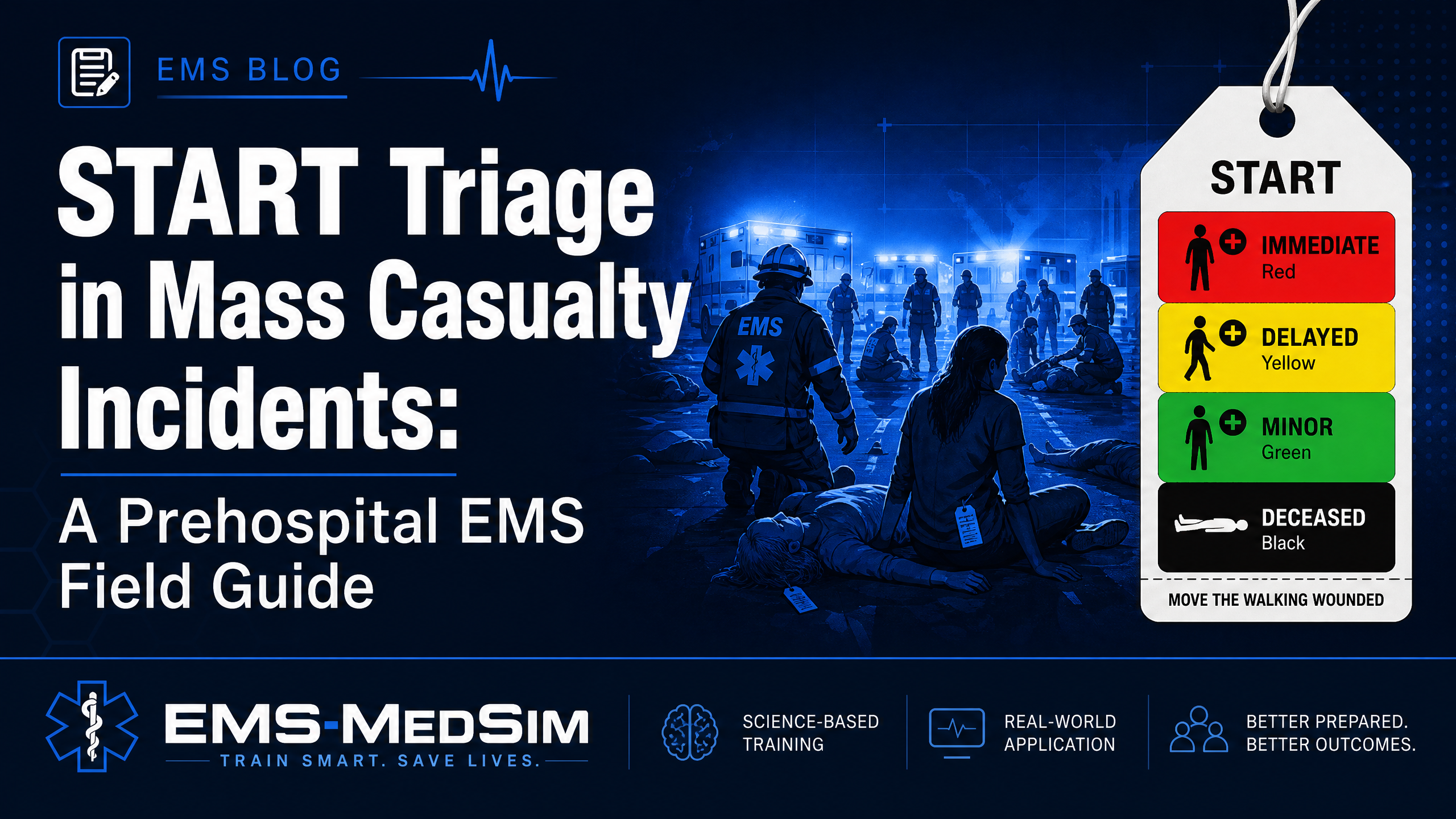
When Patients Outnumber Resources
A mass casualty incident (MCI) is any event in which the number of patients exceeds the immediate capacity of available EMS resources. This threshold is not fixed — a two-car collision with four critical patients can constitute an MCI for a single-unit rural crew, while a major urban system may manage 20 patients before declaring an MCI.
The fundamental challenge of an MCI is not clinical complexity — it is resource allocation under uncertainty. The START triage algorithm exists to solve exactly this problem: how to rapidly sort patients into priority categories so that the greatest number of lives can be saved with the resources available.
The START Algorithm: Simple Triage and Rapid Treatment
START (Simple Triage and Rapid Treatment) was developed by Hoag Hospital and Newport Beach Fire Department in the 1980s and remains the most widely adopted prehospital triage system in the United States. It uses three physiological parameters — respirations, perfusion, and mental status — to assign each patient to one of four color-coded categories in 30 seconds or less.
Step 1: Walk-Away Triage
Before applying the algorithm to individual patients, direct all patients who can walk to a designated assembly point. These patients are tagged GREEN (Minor) — they are ambulatory, which indicates they have adequate airway, breathing, and circulation. This single step can sort 20–40% of victims in a typical MCI.
Step 2: Respirations
For non-ambulatory patients, assess breathing:
- Not breathing: Open the airway (head-tilt chin-lift or jaw thrust). If breathing resumes → RED. If still not breathing → BLACK (Expectant/Deceased).
- Respirations > 30/min: Tag RED (Immediate).
- Respirations present and ≤ 30/min: Proceed to Step 3.
Step 3: Perfusion
Assess radial pulse or capillary refill:
- No radial pulse or capillary refill > 2 seconds: Tag RED (Immediate). Control major hemorrhage with a tourniquet or pressure dressing.
- Radial pulse present or capillary refill ≤ 2 seconds: Proceed to Step 4.
Step 4: Mental Status
Give a simple command ("Squeeze my hand" or "Open your eyes"):
- Does not follow commands: Tag RED (Immediate).
- Follows commands: Tag YELLOW (Delayed).
START Triage Summary Table
| Category | Color | Criteria | Action |
|---|---|---|---|
| Immediate | RED | Abnormal respirations, absent pulse/perfusion, or altered mental status | Treat first |
| Delayed | YELLOW | Stable vitals, follows commands | Treat after RED |
| Minor | GREEN | Ambulatory | Treat last |
| Expectant | BLACK | Apneic after airway opening | No resuscitation |
JumpSTART: Pediatric Modification
START was designed for adults. For pediatric patients (generally < 8 years or < 25 kg), the JumpSTART modification addresses two key physiological differences:
- Children may have respiratory arrest from hypoxia without primary cardiac arrest. JumpSTART adds a step: if a child is apneic after airway opening, check for a pulse. If a pulse is present, give five rescue breaths. If breathing resumes → RED. If still apneic → BLACK.
- "Follows commands" is replaced with AVPU ≤ P (responds to Pain or Unresponsive) for children who may not understand verbal commands.
Know your local protocol — some systems use JumpSTART for all pediatric patients; others apply it only to pre-verbal children.
Common START Triage Pitfalls
Over-triaging to RED. The most common error. Anxiety, pain, and the sight of blood cause providers to assign RED to patients who are physiologically stable. Remember: RED requires an objective physiological abnormality, not subjective distress.
Spending time treating during triage. START triage is a sorting tool, not a treatment protocol. The only interventions permitted during primary triage are airway repositioning and tourniquet application for life-threatening hemorrhage. Everything else waits.
Failing to re-triage. Patient condition changes. A YELLOW patient can deteriorate to RED within minutes. Assign a re-triage interval (typically every 5–10 minutes) and communicate changes to the treatment sector.
Ignoring the BLACK category. Declaring a patient expectant is one of the hardest decisions in emergency medicine. It is also one of the most important. A provider who spends 20 minutes on a non-survivable injury while three RED patients deteriorate has made a triage error, not a compassionate one.
Inadequate scene size-up. Before triaging a single patient, broadcast a scene size-up: mechanism of injury, estimated patient count, resources needed, and hazards. This information drives the ICS response and determines whether mutual aid is needed.
ICS Integration: Your Role in the Command Structure
The Incident Command System (ICS) is the organizational framework for managing MCIs. As a first-arriving EMS provider, you may assume the role of EMS Branch Director until relieved. Key ICS positions relevant to EMS:
Incident Commander (IC): Overall scene authority. Establishes command post, requests resources, and coordinates with law enforcement and fire.
Medical Branch Director: Oversees all medical operations. Coordinates with the IC on resource requests and hospital notifications.
Triage Sector: Performs primary triage and tags patients. Communicates patient counts by category to the Medical Branch Director.
Treatment Sector: Provides care to tagged patients in designated areas (RED treatment area, YELLOW treatment area). Prioritizes RED patients.
Transport Sector: Coordinates ambulance loading and hospital destination assignments. Distributes patients across receiving facilities to prevent hospital surge.
Staging Sector: Holds incoming units until assigned. Prevents freelancing and traffic congestion at the scene.
Communicate using ICS terminology and avoid freelancing — operating outside your assigned role degrades the overall response.
Hospital Notification and Patient Distribution
Transport sector responsibilities include notifying receiving hospitals with the METHANE report:
- Major incident declared
- Exact location
- Type of incident
- Hazards present or suspected
- Access routes
- Number of casualties (by category)
- Emergency services on scene
Distribute patients across multiple facilities to prevent any single hospital from being overwhelmed. Trauma centers receive RED patients; community EDs receive YELLOW and GREEN. Coordinate with medical control for hospital capacity updates.
Situational Awareness Under Stress
MCIs are cognitively overwhelming. Noise, visual chaos, radio traffic, and the emotional weight of mass casualties create conditions where experienced providers make errors they would never make in routine practice.
Strategies to maintain situational awareness:
- Verbalize your triage findings as you move through the scene. This creates a verbal record and forces deliberate assessment.
- Use your triage tags. Do not rely on memory for patient locations or categories.
- Communicate early and often with your sector supervisor. If you are overwhelmed, say so.
- Control your breathing. Tactical breathing (4-count inhale, 4-count hold, 4-count exhale) activates the parasympathetic nervous system and reduces cognitive tunnel vision.
Training for MCI Response
MCI response is a team skill that degrades rapidly without practice. Tabletop exercises, functional drills, and simulation-based training are all effective, but simulation offers a unique advantage: it allows providers to experience the cognitive and emotional pressure of a real MCI in a controlled environment.
EMS-MedSim includes a branching MCI/START Triage scenario that places providers in a multi-patient scene, requiring real-time triage decisions, ICS role assignment, and transport coordination — the same cognitive demands present in an actual event.
Key Takeaways
START triage is a 30-second, three-parameter algorithm that saves lives by ensuring the right patients receive care first. Walk-away triage sorts the GREEN patients immediately. Respirations, perfusion, and mental status determine the remaining categories. Avoid the common pitfalls of over-triaging, treating during triage, and neglecting re-triage. Integrate seamlessly into ICS, communicate using METHANE, and distribute patients across receiving facilities. Most importantly, train regularly — because an MCI is not the time to learn the algorithm for the first time.
Frequently Asked Questions
What does START stand for?
Simple Triage and Rapid Treatment — the walking filter followed by respirations, perfusion, and mental status checks described in this guide.
How does JumpSTART differ from START?
It adapts the algorithm to pediatric physiology — most notably, an apneic child with a pulse receives a brief trial of rescue ventilations before being categorized.
What is the most common triage mistake?
Stopping to treat. During START triage the only interventions are airway positioning and major hemorrhage control — everything else waits for the treatment area.