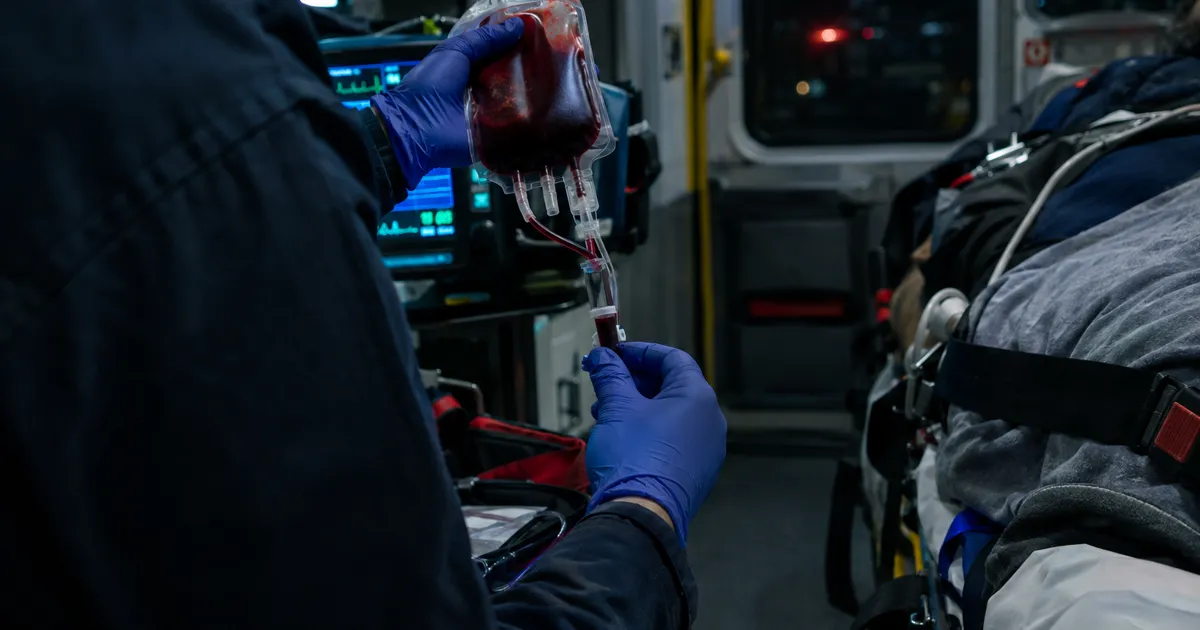
A trauma patient is cold, pale, and tachycardic after a rollover. The blood pressure is falling. Your service carries low-titer group O whole blood; another nearby team carries red cells and plasma. Both crews can start a transfusion before the patient reaches the trauma center. Which product should the medical director choose?
Two large randomized trials published in 2026 sharpen the answer: neither showed prehospital whole blood to be superior to blood-component therapy as tested. That is not the same as proving the two strategies equivalent, and it is not evidence that prehospital blood should stop. It is a reason to separate two questions: whether to give blood early, and which blood product a system should carry. (SWiFT; TOWAR)
What the 2026 trials actually tested
SWiFT was a phase 3 randomized trial across 10 air ambulance services in England. Teams gave up to two units of whole blood or standard care with up to two units each of red cells and plasma. Of 942 randomized patients, 616 were included in the primary analysis after exclusions for nontraumatic bleeding or traumatic cardiac arrest. Death or massive transfusion within 24 hours occurred in 48.7% of the whole-blood group and 47.7% of the component group. The relative risk was 1.02, with a 95% confidence interval of 0.80 to 1.31; the trial did not show whole blood was superior. (SWiFT trial)
TOWAR asked a related question across 44 US air-medical bases. It compared up to two units of low-titer group O whole blood with blood components selected as indicated. The primary outcome was death within 30 days. Among 993 patients in the primary analysis, mortality was 25.9% with whole blood and 20.5% with components; the adjusted odds ratio was 1.24 (95% CI 0.87–1.76; P=0.24). The result did not show a statistically significant survival advantage for whole blood. (TOWAR trial)
Read those results precisely. “No superiority shown” is not “the treatments are identical.” The confidence intervals leave room for effects in either direction, and neither trial was designed to prove equivalence. The two studies also used different comparators and primary outcomes. SWiFT tested a specific whole-blood strategy against red cells plus plasma; TOWAR compared whole blood with pragmatic, as-indicated component therapy. Both studied air-medical systems, not every ground EMS model. (SWiFT trial; TOWAR trial)
Do not confuse product choice with early blood
The trials compare one prehospital blood strategy with another. They do not compare whole blood with no transfusion, and they do not settle whether a patient in hemorrhagic shock should receive blood before hospital arrival. That distinction matters when a headline turns a product comparison into a claim that prehospital transfusion has failed. (SWiFT trial; TOWAR trial)
The 2025 NAEMSP trauma transfusion position statement addressed an earlier evidence base. It recommended blood products over crystalloids for traumatic life-threatening bleeding in systems able to support a high-quality program, and listed low-titer group O whole blood as the first-choice product. It also called for combined clinical and injury-pattern indications, active monitoring for transfusion-related adverse events, plans to limit product waste, and ongoing coordination among EMS, trauma centers, and blood suppliers. The two phase 3 trials arrived after that position statement, so medical directors should read the recommendations alongside the newer direct comparisons rather than treat either document as the whole answer. (NAEMSP position statement)
The practical question is now local: does whole blood make a safer, more reliable, or more workable program for this service than components? The randomized trials do not answer every operational question for a ground agency, a long rural transport, or a system with a different blood-supply chain. They do remove one easy argument: a service should not claim that whole blood has proven survival superiority over components based on the 2026 trial results. (SWiFT trial; TOWAR trial)
Build the program around the patient and the system
Start with the patient, not the bag. The 2025 civilian EMS clinical practice guideline describes a structured assessment using physiology, signs of poor perfusion, and injury pattern; it also stresses that local medical oversight and protocols govern use. The guideline is a living document, so agencies should check for updates and apply it with their own medical director rather than copy a threshold without context. (Prehospital Blood Transfusion Coalition guideline)
Then examine the whole transfusion pathway. Can crews recognize the service’s approved trigger? Can they verify and document the product, monitor the patient, recognize a suspected reaction, and hand the product information to the receiving team? Are storage, transport, supplier coordination, quality review, and unused-unit management assigned to named people? The NAEMSP statement and civilian EMS guideline both treat prehospital transfusion as a coordinated program, not a bag added to a vehicle. (NAEMSP position statement; civilian EMS guideline)
This is a good scenario for deliberate practice: crews can rehearse the trigger, the transfusion check, reassessment, and a clean handoff before a real call. The EMS-MedSim scenario library can support that work. The handoff also connects naturally to the receiving-side decisions practiced at EM-Sim and to trauma-resuscitation training at MilMedSim. Cross-service planning is part of the broader work of Global MedOps Command.
Dr. Chet's Take
I have spent more than 25 years in emergency medicine and have served as a HEMS medical director. My position is simple: do not turn a comparison between two blood strategies into an argument against prehospital blood. SWiFT compared whole blood with red cells plus plasma. TOWAR compared it with components selected as indicated. Neither trial compared whole blood with no blood. Both failed to show that whole blood was superior on the primary outcome they tested. They answer the question they were designed to ask: what happens when clinicians select one blood-product strategy over another? That is important evidence for our local systems. It is not permission to erase the question those trials did not ask. (SWiFT trial; TOWAR trial)
That being said, we should stop describing whole blood as proven better than components for prehospital trauma care. A biologically appealing product and a simpler package are not the same as a demonstrated survival advantage. The honest answer is that both 2026 trials leave room for further study, and both were conducted in air-medical systems. If your service carries whole blood, put the protocol, outcomes, storage plan, and blood-bank partnership on the medical director’s review agenda. Include product waste, reaction reporting, and how often crews meet the trigger. If your service uses components, these trials do not create a reason to switch. The patient still needs a clear trigger, early recognition, careful monitoring, and a coordinated receiving-team handoff. (SWiFT trial; TOWAR trial; NAEMSP position statement)
Key Takeaways
- In SWiFT and TOWAR, prehospital whole blood did not show superiority over component therapy for the primary outcome tested. (SWiFT trial; TOWAR trial)
- The results do not prove equivalence, and they do not compare whole blood with no prehospital blood. (SWiFT trial; TOWAR trial)
- Both trials studied air-medical services, so ground EMS systems should avoid assuming the findings settle every local workflow or product decision. (SWiFT trial; TOWAR trial)
- Review product choice, clinical triggers, monitoring, storage, supplier coordination, and quality review with the medical director and blood bank. (NAEMSP position statement; civilian EMS guideline)
FAQ
Does prehospital whole blood improve survival after traumatic hemorrhage?
The 2026 SWiFT and TOWAR trials did not show whole blood to be superior to blood-component therapy on their primary outcomes. They do not prove the strategies are equivalent, and they do not compare whole blood with no transfusion. (SWiFT trial; TOWAR trial)
Should EMS replace whole blood with components after the 2026 trials?
The trials do not establish one universal product choice for every EMS system. Review local protocols and outcomes with the medical director, receiving trauma centers, and blood supplier, using the trial results alongside current guidance. (NAEMSP position statement; civilian EMS guideline)
Do the 2026 whole-blood trials apply to ground EMS?
Both trials were conducted in air-medical systems. Their findings matter to EMS, but ground agencies should assess how their population, response model, transport times, and blood-supply arrangements compare before changing a local protocol. (SWiFT trial; TOWAR trial)
If you're a EMT, paramedic, flight medic, CCTP, or EMS medical director trying to understand how AI will actually impact your clinical practice — not just the hype — I put together a free practical guide. You can download it here: AI in EM Survival Guide.
References
- Smith JE, et al. Prehospital Whole Blood in Traumatic Hemorrhage—A Randomized Controlled Trial. New England Journal of Medicine. 2026.
- Sperry JL, et al. Prehospital Resuscitation with Type O Whole Blood for Trauma and Hemorrhage. New England Journal of Medicine. 2026.
- Brown JB, et al. Prehospital Trauma Compendium: Transfusion of Blood Products in Trauma—A Position Statement and Resource Document of NAEMSP. Prehospital Emergency Care. 2025.
- Levy MJ, et al. Prehospital blood transfusion coalition clinical practice guideline for civilian emergency medical services. Trauma Surgery & Acute Care Open. 2025.
- Related reading: Books by Dr. Shermer.