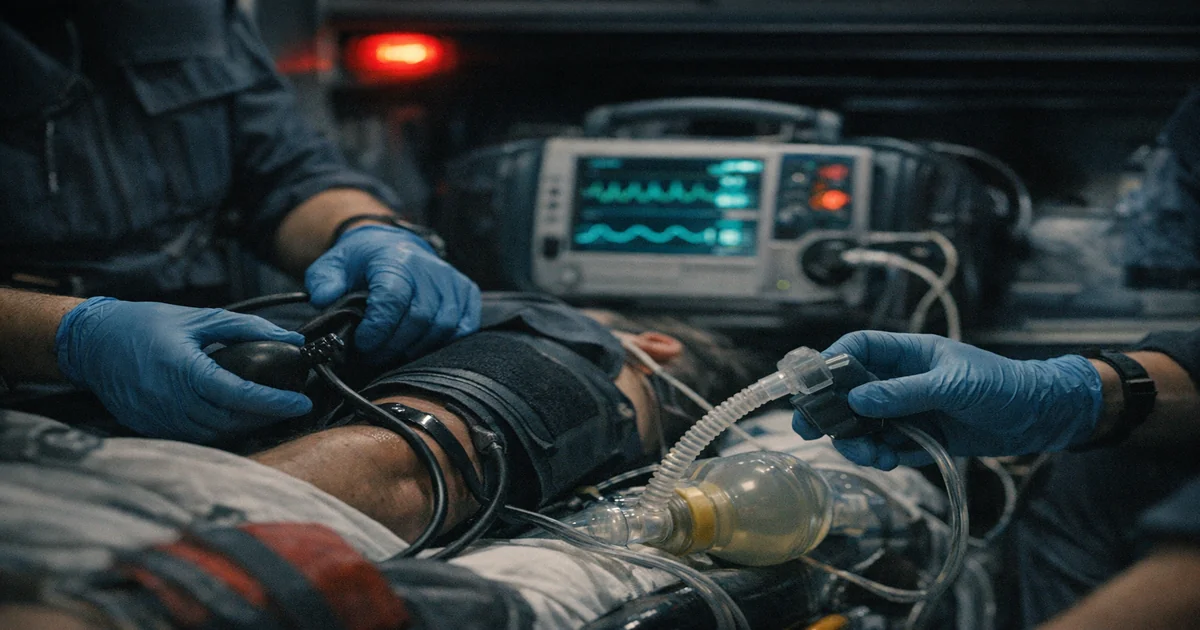
A patient with a head injury can look stable when the ambulance doors close. The blood pressure is 104. The pulse oximeter says 96%. The patient is talking, but the answers are getting slower. Ten minutes later the pressure is 88, the oxygen saturation is 89%, and the capnography waveform has disappeared into a bad ventilation pattern.
That change is not a footnote for the receiving team. It is a new injury process. The impact damaged the brain; hypoxia, hypotension, and abnormal carbon dioxide can damage it again. The 2023 third edition of the prehospital traumatic brain injury guideline makes the field job clear: find those insults early, correct them, and keep reassessing the patient (prehospital TBI guideline).
The first priority is preventing avoidable secondary injury
Primary brain injury happens at the moment of impact. EMS cannot reverse that tissue damage. EMS can reduce secondary insults that worsen perfusion or oxygen delivery during the minutes before definitive care (2023 guideline executive summary). That is why a repeat set of vital signs is not routine paperwork. It is a test of whether the brain is still being protected.
A large multicenter cohort of 14,994 adults with confirmed TBI found that prehospital hypoxia, hypotension, and hypocarbia were each associated with higher risks of death and an unfavorable discharge disposition (JAMA Network Open cohort study). The association does not prove that every adverse value caused the outcome. It does tell the crew which correctable physiologic problems deserve immediate attention.
Blood pressure: do not wait for 90
The 2023 prehospital TBI guideline recommends an adult systolic blood pressure target of 110 mm Hg or greater, while stating that the best target may be higher (prehospital TBI guideline). The same guideline recommends measuring blood pressure frequently, every 5 to 10 minutes, or continuously when possible (prehospital TBI guideline).
When hypotension occurs, the guideline recommends intravenous fluid treatment to shorten the duration of hypotension and recommends blood products and/or isotonic fluid for hypotensive patients (prehospital TBI guideline). Follow the medical director's protocol, consider the patient's bleeding pattern and other injuries, and document the lowest pressure, the intervention, and the response.
Oxygen and ventilation are separate problems
A normal-looking oxygen saturation at one moment does not remove the need for continued observation. The guideline recommends continuous pulse oximetry and supplemental oxygen to keep saturation above 90% after suspected TBI; it also recommends continuous oxygen for suspected severe TBI to limit hypoxic secondary injury (prehospital TBI guideline). Correct low saturation by checking airway position, increasing oxygen support, and escalating ventilation or airway equipment when needed (prehospital TBI guideline).
Oxygenation is not ventilation. A patient may have an acceptable pulse oximeter reading while moving too little air or ventilating too fast. For altered consciousness, the guideline recommends continuous capnography with end-tidal carbon dioxide between 35 and 45 mm Hg (prehospital TBI guideline). It recommends avoiding prophylactic hyperventilation because low carbon dioxide can reduce cerebral blood flow; hyperventilation is reserved for active cerebral herniation signs and should be guided by capnography (prehospital TBI guideline).
A practical crew check is to look at the patient, the bag, and the waveform together. Is the chest moving? Is the bag delivering the intended rate? Is the waveform present and plausible? Is the number changing with the patient's mental status? If the waveform disappears, treat it as a clinical problem until the airway, circuit, and patient have all been checked.
Reassessment turns a handoff into a trend
The guideline recommends reporting the Glasgow Coma Scale every 30 minutes in the prehospital setting and whenever mental status changes (prehospital TBI guideline). A single GCS number does not tell the receiving team whether the patient improved, worsened, or stayed the same. Record the components when possible, note sedatives or paralytics that affect the exam, and report the change with the time.
Build the reassessment around the next decision. Repeat blood pressure and oxygen saturation. Confirm capnography. Check pupils after resuscitation and stabilization. Measure temperature and work toward normal temperature, because the guideline recommends measuring temperature and maintaining euthermia (prehospital TBI guideline). Then ask what the trend means: Is the patient stable enough for the planned destination, or has the physiology changed the destination and the receiving-team notification?
This is also where simulation earns its place. Run a short scenario in which the first pressure is 118, the second is 103, and the third is 86. Require the crew to say the trend out loud, name the intervention, and repeat the measurement. The EMS-MedSim scenario library, part of Global MedOps Command, can support that kind of deliberate practice without waiting for a rare call.
Destination is part of treatment
For suspected moderate-to-severe TBI, the guideline recommends direct transport to a facility with CT neuroimaging, prompt neurosurgical care, intracranial-pressure monitoring, and the ability to treat intracranial hypertension when that destination is available (prehospital TBI guideline). The mode of transport should minimize time to needed definitive interventions, and EMS systems should maintain destination protocols for suspected TBI (prehospital TBI guideline).
The handoff should include the worst values and the trend: lowest systolic pressure, lowest oxygen saturation, end-tidal carbon dioxide range, GCS components and changes, airway interventions, fluids or blood products, medications that confound the exam, and destination reasoning. That information gives the receiving team a timeline rather than a snapshot.
Dr. Chet's Take
I have taken enough HEMS and critical-care transport handoffs to know that the first set of vitals is often the least useful set. A patient with a head injury can arrive talking and leave the scene with a falling pressure, a poor waveform, and a team that has not yet said the trend out loud. The 2023 prehospital TBI guideline gets the central point right: protect oxygenation, protect perfusion, measure ventilation, and repeat the exam. The work is not glamorous. It is disciplined prevention of the second hit.
That being said, the numbers are not magic. I do not want a crew driving a pressure upward without asking why it fell, and I do not want a crew treating a capnography number while ignoring the patient and the airway. The honest answer is that much of this evidence is observational, and the ideal blood-pressure target is still not settled (prehospital TBI evidence summary). What is settled is that prolonged hypoxia, hypotension, and hypocarbia deserve a fast response (prehospital TBI guideline). If you are running this call, write the trend down, say it during the radio report, and make the next measurement before the patient makes the decision for you.
Key Takeaways
- Treat suspected TBI as a moving physiologic problem, not a one-time exam (2023 prehospital TBI guideline).
- Target adult systolic blood pressure at 110 mm Hg or greater under the 2023 guideline, treat hypotension promptly, and avoid inducing hypertension (2023 prehospital TBI guideline).
- Use continuous pulse oximetry and capnography when indicated; target oxygen saturation above 90% and end-tidal carbon dioxide between 35 and 45 mm Hg (2023 prehospital TBI guideline).
- Report trends, not only the first GCS and first vital signs (2023 prehospital TBI guideline).
- Choose the destination that can deliver the needed neurotrauma care within the local trauma system (2023 prehospital TBI guideline).
FAQ
What blood pressure should EMS target after suspected traumatic brain injury?
The 2023 third-edition prehospital TBI guideline recommends an adult systolic blood pressure of at least 110 mm Hg, while acknowledging that the best target may be higher (prehospital TBI guideline). Treat hypotension promptly and use the local protocol for fluids or blood products (prehospital TBI guideline).
What end-tidal carbon dioxide range should EMS use in traumatic brain injury?
For altered consciousness, target an end-tidal carbon dioxide value of 35 to 45 mm Hg with continuous capnography (prehospital TBI guideline). Avoid routine hyperventilation; the guideline reserves it for active cerebral herniation signs and recommends capnography to guide it (prehospital TBI guideline).
Where should a patient with moderate or severe traumatic brain injury go?
When feasible, transport directly to a facility with CT neuroimaging, prompt neurosurgical care, intracranial-pressure monitoring, and treatment for intracranial hypertension (prehospital TBI guideline). Follow local trauma-system destination protocols and communicate the patient's physiology and trend before arrival (prehospital TBI guideline).
If you're a EMT, paramedic, flight medic, CCTP, or EMS medical director trying to understand how AI will actually impact your clinical practice — not just the hype — I put together a free practical guide. You can download it here: AI in EM Survival Guide.
Sources
- Lulla A, et al. Prehospital Guidelines for the Management of Traumatic Brain Injury: 3rd Edition
- Maiga AW, et al. Adverse Prehospital Events and Outcomes After Traumatic Brain Injury
- Badjatia N, et al. Optimal Prehospital Blood Pressure in Major Traumatic Brain Injury
- Related simulation training: MilMedSim and EM-Sim
- Books by Dr. Shermer