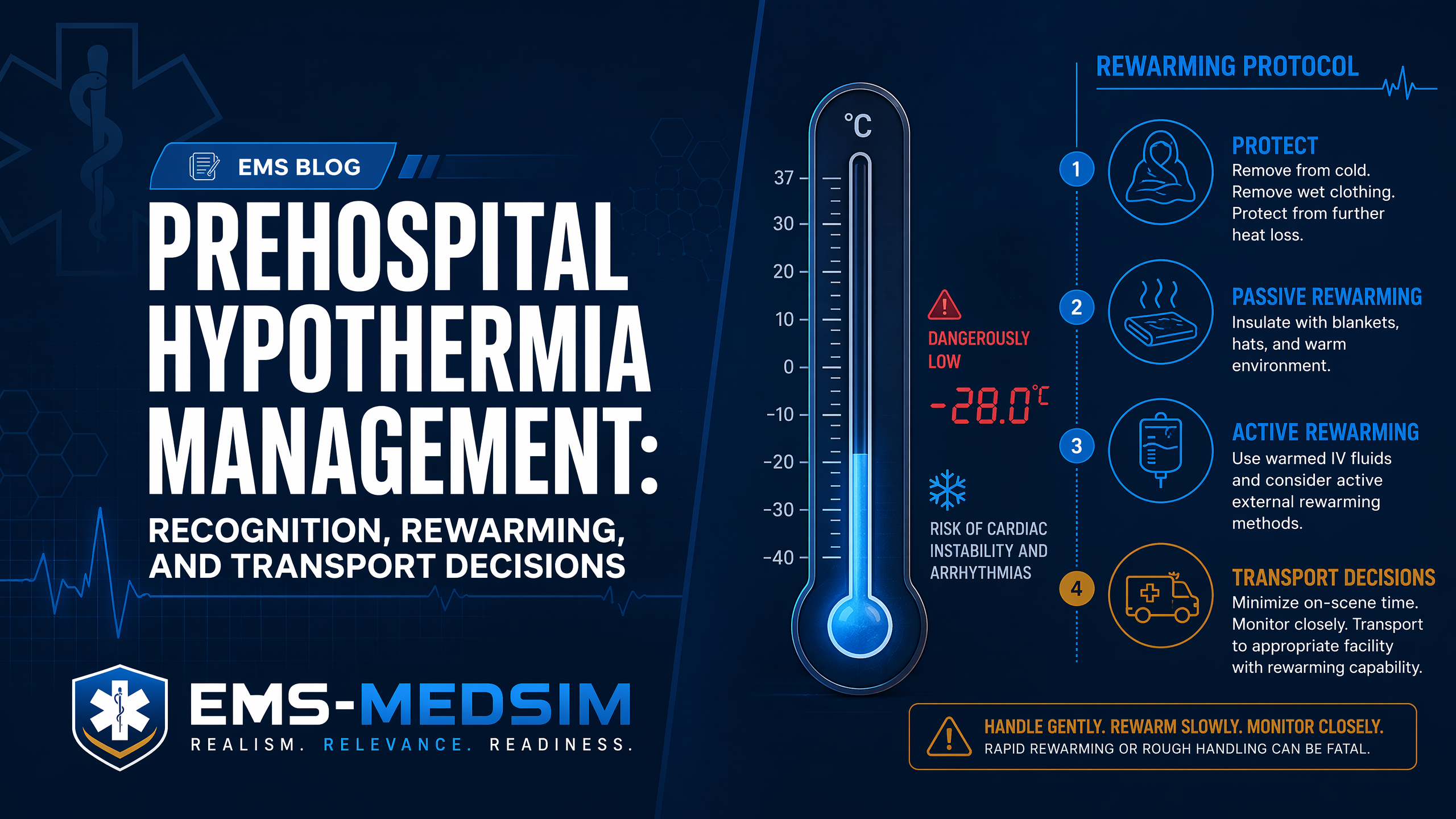
The Cold Patient: More Than a Temperature Problem
Hypothermia is defined as a core body temperature below 35°C (95°F). In the prehospital environment, it presents across a wide spectrum — from the mildly shivering hiker to the pulseless patient found in cardiac arrest after prolonged cold exposure. The physiological consequences are profound and progressive, affecting every organ system from the myocardium to the coagulation cascade.
The EMS provider's role is not simply to warm the patient — it is to recognize the stage of hypothermia, apply appropriate field rewarming, prevent further heat loss, and make a critical transport decision that may determine whether the patient survives.
Classifying Hypothermia: The Swiss Staging System
The Swiss Staging System is the most clinically useful classification for prehospital providers because it correlates clinical findings with core temperature ranges — allowing staging without a thermometer.
| Stage | Clinical Findings | Core Temp | Mortality Risk |
|---|---|---|---|
| HT I (Mild) | Conscious, shivering | 32–35°C | Low |
| HT II (Moderate) | Impaired consciousness, no shivering | 28–32°C | Moderate |
| HT III (Severe) | Unconscious, vital signs present | 24–28°C | High |
| HT IV (Cardiac Arrest) | No vital signs | < 24°C | Very high (but survivable) |
| HT V | Irreversible hypothermia | — | Near 100% |
The absence of shivering in a cold patient is an ominous sign. Shivering is the body's primary thermogenic defense mechanism. When it stops, it indicates either that the patient has warmed sufficiently (HT I resolution) or that the hypothermia has progressed to a stage where the shivering reflex is suppressed (HT II–III).
Scene Assessment and Preventing Further Heat Loss
Before any rewarming intervention, stop the heat loss. This is the single most impactful prehospital action:
- Remove wet clothing — water conducts heat away from the body roughly 25 times faster than air, so wet fabric strips heat continuously until it is removed.
- Insulate from the ground — conductive heat loss to cold ground is significant. Place the patient on a blanket or backboard with insulation beneath.
- Cover the head — once the body is wrapped, the head is the largest remaining uninsulated surface.
- Move to a warm environment — the ambulance with heat running is the immediate goal.
- Handle gently — the hypothermic myocardium is exquisitely sensitive to mechanical stimulation. Rough movement can precipitate ventricular fibrillation.
Field Rewarming Techniques
Rewarming strategy depends on the stage of hypothermia and available resources.
Passive External Rewarming (HT I)
For mild hypothermia with intact shivering, passive rewarming is appropriate and effective. Remove wet clothing, insulate with dry blankets, and allow the patient's own thermogenesis to restore temperature. Provide warm, sweet oral fluids if the patient is fully alert and has an intact gag reflex.
Active External Rewarming (HT II–III)
For moderate to severe hypothermia, passive rewarming is insufficient. Apply heat to high-vascularity areas:
- Chemical heat packs to the axillae, groin, and lateral neck (where major vessels are superficial)
- Warm blankets (if available via heated blanket cabinet)
- Heated, humidified oxygen via NRB or BVM — reduces respiratory heat loss and provides modest core rewarming
Do not apply heat directly to extremities. Peripheral vasodilation from external heat causes cold, acidotic blood from the extremities to return to the core — a phenomenon called "afterdrop" — which can precipitate cardiac arrest.
Active Internal Rewarming (HT III–IV)
Definitive active internal rewarming (warm IV fluids, thoracic lavage, ECMO) is a hospital-based intervention. Prehospital providers should focus on preventing further heat loss and initiating transport to a facility capable of ECMO if cardiac arrest is present.
Warm IV fluids (42°C) can be administered prehospital if a fluid warmer is available, but the rewarming contribution is modest — the primary benefit is preventing additional cooling from room-temperature crystalloids.
Cardiac Arrest in Hypothermia: "Not Dead Until Warm and Dead"
The dictum "no one is dead until they are warm and dead" reflects a fundamental principle of hypothermia resuscitation: the hypothermic myocardium may be in a metabolically suspended state that is fully reversible with rewarming. Documented survivals from cardiac arrest with core temperatures as low as 13.7°C exist in the literature.
CPR in the Hypothermic Patient
For HT IV (cardiac arrest), initiate CPR per standard ACLS protocols with the following modifications:
- Check for pulse for 60 seconds before initiating CPR — the hypothermic heart may have a very slow, weak pulse that is difficult to detect.
- Defibrillation: Attempt defibrillation for VF/pVT. If the core temperature is < 30°C, the myocardium may be refractory to defibrillation. Limit to three defibrillation attempts until the temperature exceeds 30°C.
- Medications: Epinephrine and amiodarone have reduced efficacy at core temperatures < 30°C and may accumulate to toxic levels. Many protocols recommend withholding or spacing medications until temperature > 30°C.
- CPR compression rate and depth: Standard AHA parameters apply. Mechanical CPR devices (LUCAS, AutoPulse) are particularly valuable for prolonged transport to ECMO-capable facilities.
The ECMO Decision
Extracorporeal membrane oxygenation (ECMO) — specifically extracorporeal rewarming (ECR) — is the definitive treatment for HT IV cardiac arrest and can achieve rewarming rates of 8–12°C per hour. Survival rates for ECMO-rewarmed hypothermic cardiac arrest patients exceed 50% in select series.
Not every hospital has ECMO capability. The transport decision for a hypothermic cardiac arrest patient should consider:
- Distance to ECMO-capable facility vs. nearest ED
- Estimated transport time and feasibility of continuous CPR
- Potassium level — serum K⁺ > 12 mEq/L is associated with irreversible cell death and is a contraindication to ECMO in most protocols
- Mechanism and duration of arrest — submersion (cold water drowning) patients have better outcomes than non-submersion hypothermic arrests
Contact medical control early for guidance on the ECMO transport decision.
Special Populations
Alcohol intoxication is the most common comorbidity in urban hypothermia. Alcohol causes peripheral vasodilation and impairs the shivering response, accelerating heat loss. It also masks the altered mental status of hypothermia. Treat the hypothermia — do not attribute altered mental status to intoxication alone.
Elderly patients have impaired thermoregulation and may develop hypothermia at ambient temperatures as high as 60°F (15°C), particularly in poorly heated homes. Consider hypothermia in any elderly patient with altered mental status, falls, or weakness during cool weather.
Trauma patients are at high risk for hypothermia due to exposure, hemorrhage, and the administration of room-temperature IV fluids. The "lethal triad" of hypothermia, acidosis, and coagulopathy is a major driver of trauma mortality — aggressive temperature management in trauma patients is a damage control priority.
Documentation and Handoff
At hospital handoff, communicate:
- Estimated duration of cold exposure
- Scene temperature and environmental conditions
- Core temperature if measured (tympanic or rectal)
- Interventions performed and patient response
- Cardiac rhythm history (any VF episodes)
- Potassium level if obtained prehospital
This information directly guides the receiving team's rewarming strategy and ECMO candidacy assessment.
Key Takeaways
Hypothermia is a spectrum, and the prehospital response must match the stage. Stop heat loss first — remove wet clothing, insulate from the ground, cover the head, and move to a warm environment. Apply active external rewarming to the axillae and groin for moderate to severe hypothermia; avoid peripheral warming to prevent afterdrop. For hypothermic cardiac arrest, initiate CPR, limit defibrillation attempts below 30°C, and make an early transport decision to an ECMO-capable facility. Remember: the hypothermic patient who appears dead may be fully resuscitable — and your prehospital decisions determine whether they get the chance.
Frequently Asked Questions
How is hypothermia staged without a thermometer?
The Swiss staging system grades severity from consciousness, shivering, and vital signs — findings available at any scene.
Why do we say 'not dead until warm and dead'?
Profound hypothermia can mimic death while protecting the brain, so death is not declared and resuscitation is not abandoned on scene findings alone — decisions wait for rewarming, per guidelines and local protocol.
Why must a hypothermic patient be handled gently?
A cold myocardium is irritable — rough movement or vertical positioning can precipitate ventricular fibrillation. Keep the patient horizontal and move them smoothly.