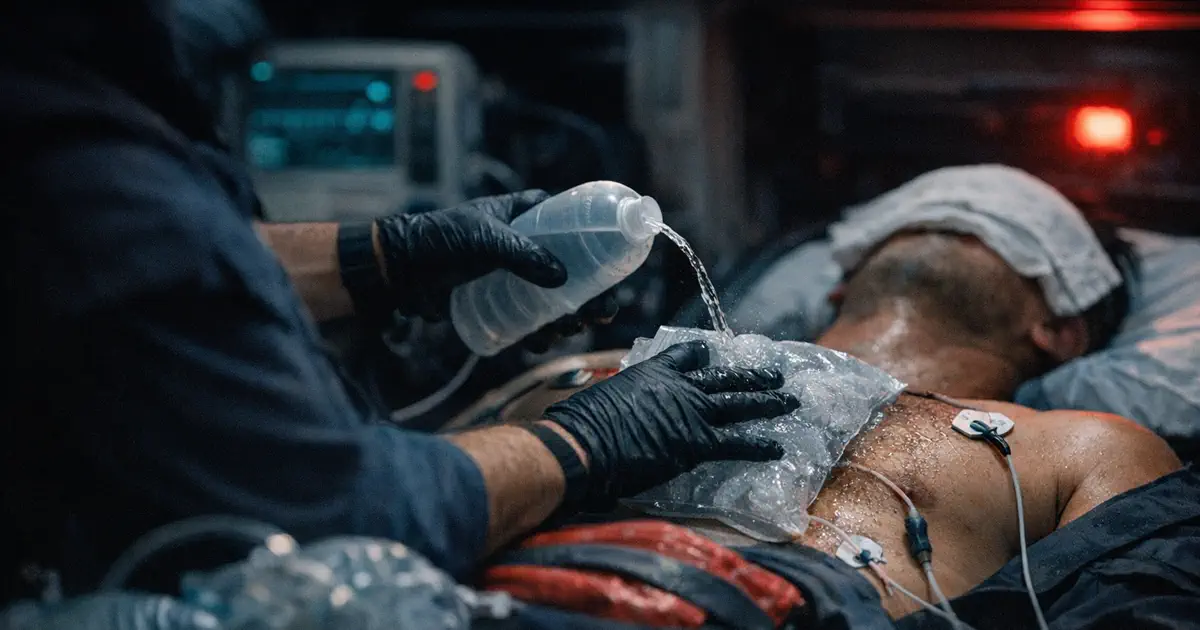
The call comes in as “collapse at a summer event.” On arrival, the patient is confused, hot, and trying to pull away from the crew. The skin may be wet and the first temperature may be wrong. A brief improvement is not reassurance. It is a heat-stroke problem until the team proves otherwise. The 2024 Wilderness Medical Society guideline treats heat illness as a field-and-hospital emergency.
The operational argument is simple: if heat stroke is suspected, cooling is treatment, not a task to postpone until after transport. The Society of Critical Care Medicine’s 2025 guideline recommends active cooling over passive methods and says cold- or ice-water immersion achieves the fastest cooling rate when available. The hard part is building a safe way to act on it.
Recognize the patient before the number
Exertional heat stroke is classically associated with hyperthermia and central nervous system dysfunction after physical activity. Confusion, irrational behavior, combativeness, seizure, collapse, or coma should move heat stroke high on the differential when the environment and history fit, according to the NAEMSP summary of the prehospital consensus statement. A patient does not need to look dry, bright red, or unconscious. Sweating can still be present, and skin temperature by touch is not a core temperature measurement.
For exertional heat stroke, the consensus framework identifies rectal temperature as the useful prehospital core measurement and warns that oral, axillary, aural, tympanic, and temporal readings can be misleading. If a rectal temperature is unavailable, treatment should not wait for a perfect number when the history and neurologic findings are convincing (NAEMSP). Follow local scope, medical direction, and infection-control policy for temperature measurement. The point is not to turn a thermometer into a gatekeeper.
Keep reassessing the brain because patients can have lucid intervals (NAEMSP consensus summary). Document the environment, exertion, neurologic changes, temperature method, and trend for the receiving team.
Cooling is the intervention
Cold-water immersion is preferred when it can be done safely because it cools a large surface area quickly. The 2025 critical care guideline recommends active cooling and prioritizes cold- or ice-water immersion where available. The NAEMSP summary describes a practical target below 38.6 °C within 30 minutes and a minimum desired rate of 0.15 °C per minute, with continuous temperature awareness because overshoot can occur (NAEMSP). Airway, breathing, circulation, seizures, and dysrhythmias still require attention.
Stabilize an immediately lethal problem, then make cooling the priority. Chilled saline alone is not a substitute for surface cooling, according to the NAEMSP consensus summary. The 2025 guideline finds no evidence for temperature-control medications in heat stroke and recommends avoiding them. An antipyretic is not the answer.
When immersion is not feasible, use the best active method the crew can deploy while maintaining monitoring and access. Tarp-assisted cooling is an alternative; fans, showers, and ice packs are slower (NAEMSP). Start with what is available and reassess temperature and neurologic status.
Cool first does not mean careless
“Cool first, transport second” is a systems phrase, not a license for improvisation. A 2021 review of 51 U.S. EMS protocols found that only 9 explicitly recommended cold-water immersion and only 11 instructed crews to cool before transport; 6 said not to delay transport for cooling. The authors called for practical, systematic guidance (Status of US EMS Protocols Regarding Pre-Transfer Cooling).
Before the hot season, decide which calls qualify, where cooling happens, who brings water and ice, how monitoring and airway access are maintained, when transport begins, and which hospital receives the notification. Assign a clinician to the patient and another person to the setup when staffing allows. Call medical control early when the scene or patient makes the plan uncertain.
The receiving hospital needs more than the words “heat stroke.” Report the mechanism, highest temperature and method, neurologic findings, cooling modality and start time, trend, medications, and reason for transport timing. If cooling continues en route, say what the crew is doing and what equipment is needed at the door.
What the newer EMS evidence adds
A 2026 Phoenix report described a prehospital cold-water immersion protocol for 183 adults with heat stroke. Median immersion time was 13.5 minutes; 72.1% had a lower temperature at emergency-department arrival, with a 2.0 °C average decrease among those patients. Median Glasgow Coma Scale rose from 8 before transport to 15 at discharge, and 69.4% were discharged with a score of 15 (Fighting Fire with Ice). The retrospective design supports feasibility, not proof that every system will reproduce these outcomes.
Equipment is part of the intervention. A 2026 simulation study found 14.49 liters of average water loss and structural failure in five of seven tested body bags. Thicker material, fused or double-sewn seams, center zippers, and handles performed better, but more research is needed (Body bag integrity in simulated prehospital cold water immersion). Test the actual bag, stretcher, drain plan, and lifting workflow before calling a kit ready.
Use the EMS-MedSim scenario library to rehearse recognition, core-temperature measurement, active cooling, monitoring, medical-control communication, and handoff. Flight and remote teams can compare packaging and transfer choreography with MilMedSim and EM-Sim. The wider Global MedOps Command ecosystem is built around practice under pressure.
Dr. Chet's Take
I have watched heat illness turn from a vague scene complaint into a neurologic emergency while a crew loads the stretcher. In HEMS and critical care transport, physiology does not wait for a convenient handoff. Suspected heat stroke deserves active cooling early. Do not let a borderline tympanic number or short transport make you comfortable. The 2024 Wilderness Medical Society update and 2025 critical care guideline point to the same priority: cool while you continue resuscitation (Wilderness Medical Society; SCCM guideline).
That being said, “cool first” does not mean “ignore everything else.” Airway compromise, seizure, dysrhythmia, or shock still demands immediate action. Cooling is not a comfort measure to delegate after the important work. A bag, tarp, or tub adds lifting, exposure, monitoring, and water-management problems. Those problems are solvable when the medical director, training officer, and crews test the plan before July.
If you are running this call, name the concern, record how you measured temperature, start the best available active cooling, and give the hospital a trend. Then make the team practice the awkward parts. The safest system has rehearsed its first bucket of ice.
Key Takeaways
- Heat stroke is a neurologic emergency; peripheral readings and skin appearance should not overrule the history and mental status (NAEMSP).
- Start active cooling promptly and prioritize cold- or ice-water immersion when feasible and safe (SCCM guideline).
- “Cool first, transport second” requires tested roles, monitoring, medical-control communication, and a hospital plan (EMS protocol survey).
- New EMS data support feasibility, not certainty; test equipment and validate locally (Phoenix protocol study; body-bag study).
- Simulation should rehearse cooling, handoff, and cleanup as well as diagnosis.
FAQ
What is the fastest way to cool a patient with heat stroke in the field?
Cold- or ice-water immersion cools fastest when available and safe (SCCM heat-stroke guideline). If immersion cannot be done, begin the best active alternative rather than waiting (NAEMSP consensus summary).
Should EMS transport a heat-stroke patient before cooling?
Not automatically. The safest sequence depends on resources, staffing, patient stability, and local protocol; agencies should decide the workflow before the call and notify the hospital early (NAEMSP).
Is a tympanic thermometer accurate enough for exertional heat stroke?
The NAEMSP consensus summary identifies rectal temperature as the useful core measurement and warns that tympanic and other peripheral methods may read lower (NAEMSP). Follow local scope and infection-control requirements, but do not delay treatment solely because rectal measurement is unavailable when the clinical picture is compelling.
Do antipyretics help with heat stroke?
The 2025 Society of Critical Care Medicine guideline found no evidence for temperature-control medications in heat stroke and recommends avoiding them (SCCM guideline). Treat the cause with active cooling while addressing immediate threats.
How can an EMS agency prepare for prehospital cold-water immersion?
Write a local procedure covering patient selection, staffing, temperature measurement, monitoring, water and ice, airway access, lifting, cleaning, transport timing, medical control, and hospital notification. Test the actual equipment in simulation; a 2026 study found water loss and structural failures in tested body bags (body-bag integrity study).
If you're a EMT, paramedic, flight medic, CCTP, or EMS medical director trying to understand how AI will actually impact your clinical practice — not just the hype — I put together a free practical guide. You can download it here: AI in EM Survival Guide.
Sources
- Wilderness Medical Society Clinical Practice Guidelines for the Prevention and Treatment of Heat Illness: 2024 Update
- Society of Critical Care Medicine Guidelines for the Treatment of Heat Stroke
- NAEMSP: Consensus Statement — Prehospital Care of Exertional Heat Stroke
- Status of US Emergency Medical Service Protocols Regarding Pre-Transfer Cooling for Exertional Heat Stroke
- Fighting Fire with Ice: A Multisite Collaboration to Evaluate the Impact of Prehospital Cold Water Immersion on Heat Stroke Patients
- Body bag integrity in simulated prehospital cold water immersion: A comparison study
- Training next steps: EMS-MedSim scenario library, MilMedSim, and EM-Sim
- Global MedOps Command
- Books by Dr. Shermer