BLUF (Bottom Line Up Front)
Most EMS agencies collect more quality data than they act on. The agencies that consistently close performance gaps use QI data to identify specific clinical deficiencies, then drive targeted simulation training to address them. The loop — identify, train, measure — is what separates high-performing systems from agencies that run the same check-offs year after year and wonder why outcomes don't improve.
EMS quality improvement is not a documentation exercise. It is a clinical performance system. The two get confused more often than they should.
Every state-licensed EMS agency in the United States is required to maintain some form of QA/QI infrastructure. The regulatory baseline typically covers call documentation, protocol compliance review, and adverse event reporting. Agencies meet that baseline. What most of them don't do is use the data those systems generate to actually change how their providers perform.
The data is there. The will to act on it is where the gap lives.
What Does Protocol Compliance Data Actually Measure?
Protocol adherence rates are the starting point for QI, not the endpoint. A provider who administers the correct medication at the correct dose for the correct indication is protocol-compliant. That's the floor, not the ceiling. What protocol data doesn't tell you is whether the provider understood why — whether their clinical reasoning was sound, whether they would make the same call correctly in a slightly different presentation.
That matters because emergencies don't present the way protocols are written. The 60-year-old diabetic who presents with altered mental status and a blood glucose of 62 gets dextrose. Straightforward. But the same patient whose glucose is 62 and who is also in an active STEMI, with a family reporting three days of vomiting — that call requires reasoning, not just protocol recall. Compliance data won't tell you how your providers handle the second version of that call.
Trending catches what individual case review misses, and individual case review catches what trending misses. You need both.
Why Is Reactive Case Review Not Enough?
Most EMS agencies do case review reactively — after a bad outcome, a complaint, or a near miss. The call comes in, the chart gets pulled, someone gets called into an office. That model identifies failures after they happen. It does not identify patterns before they recur.
Proactive case review, paired with call outcome data, identifies where provider performance consistently deviates from optimal — not just where it catastrophically fails. A well-run QI program identifies that intubation first-pass success rates drop on night shifts. It identifies that pediatric weight-based dosing errors cluster around a specific protocol. It identifies that transport time decisions for stroke patients vary depending on which crew responds, not just which hospital they're headed to.
These patterns are in your data. The question is whether your QI infrastructure is structured to surface them.
How Do You Close the Loop Between QI Data and Training?
QI without a training mechanism is diagnosis without treatment. You can identify the performance gap. Without a structured way to address it, the gap stays.
This is where simulation training becomes a direct operational tool, not just a professional development add-on. When QI data shows that your providers are underperforming on stroke recognition, you run stroke recognition scenarios. When the data shows inconsistent RSI decision-making, you run RSI scenarios — not just skill checks, but clinical decision scenarios where the patient presentation varies and the right answer isn't always immediately obvious.
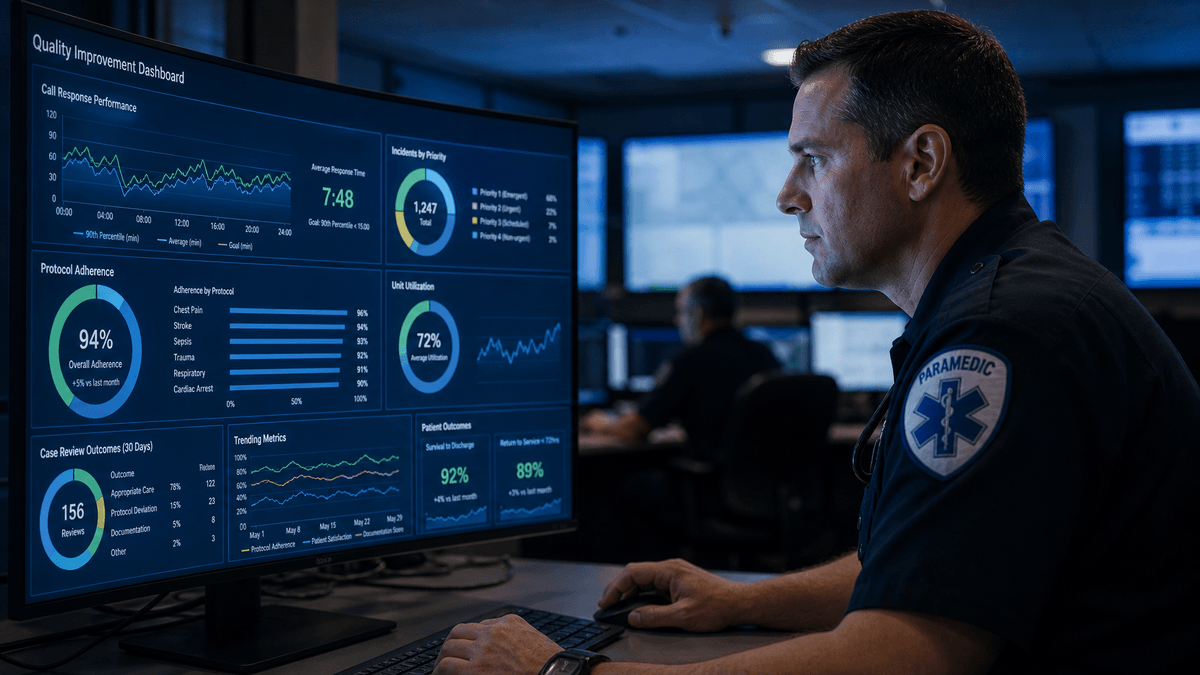
EMS-MedSim's Agency QA/QI dashboard was built specifically for this loop. The dashboard gives medical directors and agency supervisors visibility into provider performance across scenario types, completion rates, and decision accuracy — the same data points you need to identify training gaps and measure whether targeted simulation is closing them. It's the only prehospital simulation platform I'm aware of that ties QI tracking directly to scenario-based training in a single tool.
That being said, the platform only works if the agency has a medical director who is willing to use data to drive decisions rather than to document compliance. The technology is straightforward. The culture change is harder.
What Do High-Performing EMS Systems Do Differently?
High-performing EMS systems treat QI data as a clinical intelligence tool. They review it on a regular cadence — monthly, not just after adverse events. They identify patterns, not just individual outliers. They link training directly to the gaps QI identifies. And they measure outcomes after training to determine whether the intervention worked.
The National EMS Management Association (NEMSMA) and NAEMSP both publish guidance on EMS quality management that is worth having in your operational framework. The NHTSA EMS data standards provide the definitional foundation for consistent data collection. The agencies that use these frameworks don't have better providers than average — they have better systems for identifying and addressing gaps.
Dr. Chet's Take
Twenty-five years of emergency medicine gives you a specific kind of pattern recognition: you start to see the same preventable mistakes appearing with different faces. In EMS, I have seen the same airway errors, the same missed stroke signs, the same pediatric dosing near-misses appear in QI reviews across different agencies, different states, different years.
The agencies that stopped those patterns from repeating shared one thing — they used their data to drive training, not just to satisfy state reporting requirements. That's what the Agency QA/QI dashboard in EMS-MedSim is designed to support. Not compliance documentation. Actual performance improvement.