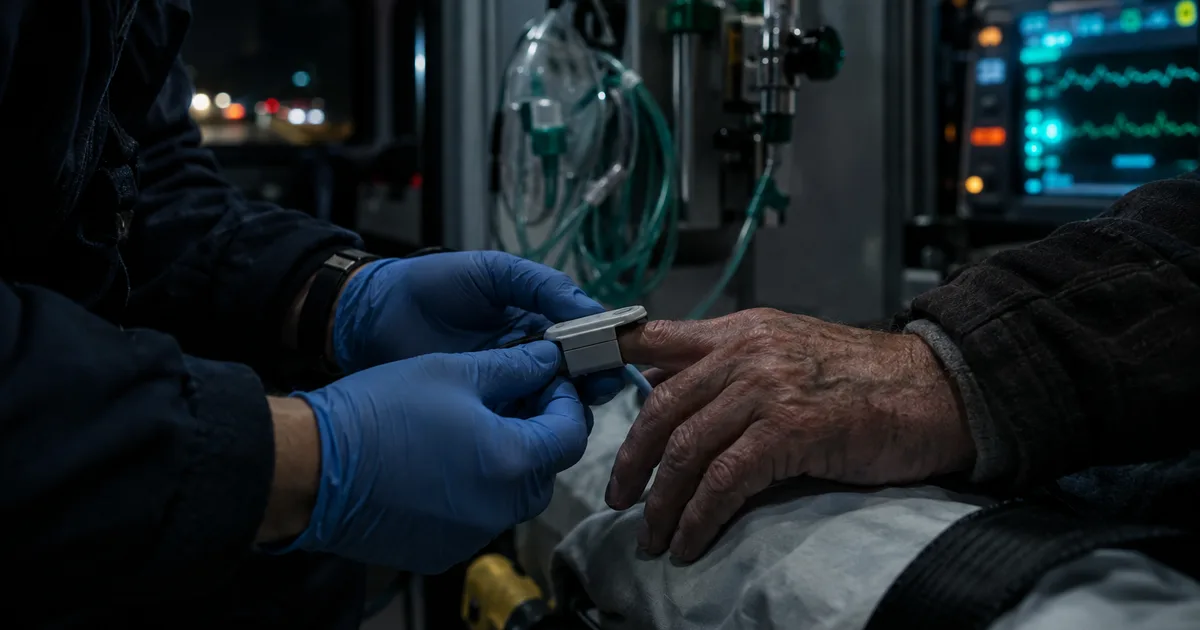
The 12-lead in the back of the truck shows inferior ST elevation, and the patient is a 61-year-old welder pressing a fist into his sternum at 0300. The pulse oximeter shows a clean waveform and reads 96% on room air. Your partner reaches for a nonrebreather before the STEMI alert is even called, because that is how the reflex was trained. Two randomized trials and the 2025 US acute coronary syndrome guideline say that reflex buys this patient nothing.
Bottom line: in suspected MI, give oxygen when SpO2 is below 90% and titrate to 90% or higher; leave it off when the saturation is 90% or above.
What AVOID Tested in the Ambulance
AVOID was a multicenter, prospective, open-label randomized trial run by Ambulance Victoria and 9 metropolitan PCI hospitals in Melbourne, Australia, from October 2011 to July 2014 [1]. Paramedics enrolled adults 18 or older with chest pain that began less than 12 hours earlier and STEMI on the prehospital 12-lead, defined as ST elevation of 0.1 mV or more in 2 contiguous limb leads, 0.2 mV or more in 2 contiguous chest leads, or new left bundle branch block [1]. Exclusions were SpO2 below 94%, bronchospasm needing nebulized salbutamol driven by oxygen, oxygen given before randomization, altered conscious state, and planned transport to a nonparticipating hospital [1].
The oxygen arm received 8 L/min by face mask, continued until transfer from the cath lab to the cardiac care ward. The comparator received no oxygen unless SpO2 fell below 94%, then 4 L/min by nasal cannula or 8 L/min by mask to a target of 94% [1]. Paramedics randomized 638 patients; 441 had confirmed STEMI and formed the primary analysis (218 oxygen, 223 no oxygen) [1]. By cath lab arrival, 7.7% of the no-oxygen group was on oxygen [1].
The primary endpoint was infarct size by cardiac enzymes. Geometric mean peak troponin I was 57.4 versus 48.0 μg/L (ratio 1.20, 95% CI 0.92 to 1.56, P = 0.18), and peak CK was 1,948 versus 1,543 U/L (ratio 1.27, 95% CI 1.04 to 1.52, P = 0.01) [1]. Recurrent MI before discharge occurred in 5.5% of the oxygen group and 0.9% of controls (P = 0.006), and arrhythmia in 40.4% versus 31.4% (P = 0.05) [1]. At 6 months, cardiac MRI in 139 patients showed a median infarct size of 20.3 g with oxygen and 13.1 g without (P = 0.04) [1]. In-hospital death was 1.8% versus 4.5%, a difference that did not reach significance (P = 0.11) [1]. The authors concluded that supplemental oxygen in nonhypoxic STEMI carried a signal for increased early myocardial injury and was associated with larger infarcts at 6 months [1]. The paper describes a similar trend across clinical subgroups but places those estimates in an online supplement, so they are not reported here.
What DETO2X-AMI Added at Scale
DETO2X-AMI was a registry-based randomized trial built on Sweden's national SWEDEHEART registry [2]. It enrolled patients 30 or older with chest pain or shortness of breath for less than 6 hours, SpO2 of 90% or higher, and either ischemic ECG changes or an elevated troponin on admission [2]. Patients on ongoing oxygen or with cardiac arrest before enrollment were excluded. Screening happened in ambulances, emergency departments, coronary care units, and cath labs, and 66.9% of patients arrived by ambulance [2].
The 6,629 patients received oxygen at 6 L/min by open face mask for 6 to 12 hours (median 11.6 hours) or ambient air [2]. MI was the final diagnosis in 75.6%, and 44.5% had STEMI [2]. One-year all-cause death, the primary endpoint, was 5.0% with oxygen and 5.1% with air (HR 0.97, 95% CI 0.79 to 1.21, P = 0.80) [2]. Rehospitalization with MI was 3.8% versus 3.3% (HR 1.13, 95% CI 0.88 to 1.46) [2]. Hypoxemia, defined as SpO2 below 90%, developed in 1.9% of the oxygen group and 7.7% of the air group, and those patients were treated outside the protocol [2].
Longer follow-up closed the remaining questions. Death or heart failure hospitalization at 1 year was 8.0% versus 7.9% (HR 0.99, 95% CI 0.84 to 1.18), and cardiovascular death over a median 2.1 years was 5.2% versus 4.8% (HR 1.07, 95% CI 0.87 to 1.33) [3].
The Subgroups Where Oxygen Should Have Helped
Three prespecified DETO2X analyses looked for a benefit in the patients medics worry about most. In 2,807 STEMI patients who underwent PCI, the 1-year composite of death, MI rehospitalization, cardiogenic shock, or stent thrombosis was 6.3% with oxygen and 7.5% with air (HR 0.85, 95% CI 0.64 to 1.13, P = 0.27) [4]. Death alone showed no difference (HR 0.86, 95% CI 0.61 to 1.22) [4].
Among 5,010 confirmed MI patients split by baseline saturation, the composite of death, MI rehospitalization, or heart failure occurred in 17.3% of the low-normal group (SpO2 90% to 94%) and 9.5% of the high-normal group (95% to 100%) [5]. Oxygen did not improve outcomes in either band (interaction P = 0.79 for the composite) [5]. Patients who developed hypoxemia had the highest event rate at 23.6% [5]. The authors read a low-normal saturation as a marker of a sicker patient rather than a target for treatment.
Normoxemic COPD patients carried twice the 1-year mortality of everyone else (10.8% versus 4.8%) [6]. Within the 296 COPD patients, oxygen did not change all-cause death (HR 0.99, 95% CI 0.50 to 1.99, interaction P = 0.96) [6].
Why the Thresholds Differ: 90% Versus 94%
The trials defined normoxemia differently, and that explains most of the protocol confusion. AVOID excluded patients below 94% and rescued controls at that line [1]. DETO2X enrolled down to 90% and defined hypoxemia as below 90% [2]. The Australian and New Zealand resuscitation council starts oxygen below 94%, or below 88% with COPD or known CO2 retention [9].
The 2025 ACC/AHA/ACEP/NAEMSP/SCAI guideline adopts the 90% line. Oxygen for ACS patients below 90%, titrated to 90% or higher, is Class 1 with LOE C-LD [7]. Routine oxygen at 90% or higher carries a Class 3: No Benefit rating with LOE A, the strongest evidence grade in the document [7]. The writing committee notes that patients with home oxygen, active bronchospasm requiring oxygen, or cardiac arrest at presentation were excluded from the trials [7].
The wider oxygen literature points the same way. The IOTA meta-analysis pooled 25 randomized trials and 16,037 acutely ill adults, including MI patients; liberal oxygen raised in-hospital mortality (RR 1.21, 95% CI 1.03 to 1.43) and 30-day mortality (RR 1.14, 95% CI 1.01 to 1.29) [8]. Median baseline SpO2 across those trials was 96% [8].
Patients the Trials Did Not Answer For
The evidence covers the alert, talking, perfusing patient with a believable pleth. It does not cover the patient in cardiogenic shock, acute pulmonary edema, or post-arrest care. ANZCOR lists signs of heart failure or shock as indications for oxygen on their own, and directs oxygen when saturation cannot be obtained because of poor perfusion [9]. Treat those patients for the physiology in front of you, and document why oxygen went on.
Key Takeaways
- Suspected MI with SpO2 below 90%: start oxygen and titrate to 90% or higher (Class 1); at 90% or above, routine oxygen is Class 3: No Benefit, LOE A [7].
- In AVOID, 8 L/min in nonhypoxic STEMI was associated with recurrent MI in 5.5% versus 0.9% and a larger 6-month infarct on MRI (20.3 g versus 13.1 g) [1].
- Across 6,629 DETO2X patients, 1-year mortality was 5.0% with oxygen and 5.1% with air, and the 2,807-patient STEMI-PCI subgroup showed no benefit (HR 0.85, 95% CI 0.64 to 1.13) [2,4].
- 7.7% of room-air patients in DETO2X became hypoxemic, so keep continuous SpO2 on, and report a 90% to 94% saturation at handoff as a high-risk marker [2,5].
FAQ
Should EMS give oxygen to every chest pain patient?
No. Two randomized trials enrolling more than 7,000 patients found no benefit from routine oxygen when saturation was normal, and the 2025 US guideline rates routine use at SpO2 of 90% or higher as Class 3: No Benefit [7]. Patients in shock or pulmonary edema fall outside that evidence and are treated for their physiology.
What oxygen saturation needs oxygen in a heart attack?
The 2025 ACC/AHA guideline uses below 90%, with oxygen titrated to 90% or higher [7]. Some Australian and New Zealand protocols use below 94%, or below 88% with COPD [9]. Follow the threshold your medical director has written into protocol.
Does oxygen help STEMI patients going to the cath lab?
In 2,807 DETO2X STEMI patients who underwent PCI, oxygen did not reduce death, reinfarction, shock, or stent thrombosis at 1 year [4]. The smaller AVOID trial found more recurrent MI and larger infarcts with 8 L/min in STEMI patients who were not hypoxic [1].
Dr. Chet's Take
I have signed oxygen protocols as a HEMS and critical care transport medical director, and I have watched how long a habit outlives its evidence. This article gets the core argument right. Oxygen for the normoxic chest pain patient is a ritual, and the trials behind that conclusion are large, randomized, and boringly consistent. What strikes me is how much of the problem is training memory. The mnemonic that taught a generation of medics to treat chest pain put oxygen near the front, and mnemonics are hard to retire. The welder in that opening scene gets better care from a medic who spends the first five minutes on the 12-lead, the aspirin, and the destination call than from one who spends it fitting a mask. Pulling oxygen out of the routine also frees a pair of hands. That trade is worth making on every call.
That being said, the threshold is only as good as the number feeding it. A pulse oximeter reading on a cold, vasoconstricted, diaphoretic patient is a guess unless the waveform looks right, and I would rather a medic distrust a bad pleth than chase it. The honest answer is that nobody has studied the patient whose saturation sits at 91% on a bumpy road with a sensor that keeps dropping out. In that patient I want clinical judgment documented in plain words. I also want flight crews to reassess saturation after liftoff instead of putting oxygen on in anticipation of altitude. Reacting to a real drop is defensible. Treating a drop that has not happened brings back the exact practice the trials retired.
If you are the medical director, pull ninety days of chest pain charts and count how many show oxygen applied with a documented saturation of 90% or higher. That number tells you whether your protocol changed practice or only changed paper. Share the count with your crews at the next case review so they see their own data. Then fix the training, because crews repeat what they rehearsed under pressure. If you are the medic on the call, put the mask on for a number below the line or for physiology that demands it, and write down which one it was. If the saturation is normal, say so in the chart and move on to the work that changes outcome. Oxygen is a drug, and it gets an indication like every other drug in the box.
— Chester Shermer, MD, FACEP | Emergency Medicine, 25+ Years Clinical Experience | State Surgeon
Continue Your Training
If you're an EMT, paramedic, flight medic, or CCTP (or any clinician treating patients daily) trying to understand how AI will actually impact your clinical practice — not just the hype — I put together a free practical guide. You can download the AI in EM Survival Guide here.
Browse All Courses at Global MedOps Command
Relevant Reading on Global MedOps Command:
How to Avoid Becoming an AI Casualty — Dr. Shermer's guide to navigating AI tools in clinical and operational settings without compromising judgment or patient outcomes.
Emergency Department Efficiency Playbook — Practical systems for throughput, triage optimization, and operational efficiency.
Read more from Dr. Shermer on Medium
Connect with Dr. Shermer: LinkedIn — Chester "Chet" Shermer, MD, FACEP.
References
- Stub D, Smith K, Bernard S, et al. Air versus oxygen in ST-segment-elevation myocardial infarction. Circulation. 2015;131(24):2143-2150. PubMed 26002889
- Hofmann R, James SK, Jernberg T, et al. Oxygen therapy in suspected acute myocardial infarction. N Engl J Med. 2017;377(13):1240-1249. PubMed 28844200
- Jernberg T, Lindahl B, Alfredsson J, et al. Long-term effects of oxygen therapy on death or hospitalization for heart failure in patients with suspected acute myocardial infarction. Circulation. 2018;138(24):2754-2762. PubMed 30767504
- Hofmann R, Witt N, Lagerqvist B, et al. Oxygen therapy in ST-elevation myocardial infarction. Eur Heart J. 2018;39(29):2730-2739. PubMed 29912429
- James SK, Erlinge D, Herlitz J, et al. Effect of oxygen therapy on cardiovascular outcomes in relation to baseline oxygen saturation. JACC Cardiovasc Interv. 2020;13(4):502-513. PubMed 31838113
- Andell P, James S, Östlund O, et al. Oxygen therapy in suspected acute myocardial infarction and concurrent normoxemic chronic obstructive pulmonary disease: a prespecified subgroup analysis from the DETO2X-AMI trial. Eur Heart J Acute Cardiovasc Care. 2020;9(8):984-992. PubMed 31081342
- Rao SV, O'Donoghue ML, Ruel M, et al. 2025 ACC/AHA/ACEP/NAEMSP/SCAI guideline for the management of patients with acute coronary syndromes. Circulation. 2025;151(13):e771-e862. PubMed 40014670
- Chu DK, Kim LH, Young PJ, et al. Mortality and morbidity in acutely ill adults treated with liberal versus conservative oxygen therapy (IOTA): a systematic review and meta-analysis. Lancet. 2018;391(10131):1693-1705. PubMed 29726345
- Australian and New Zealand Committee on Resuscitation. Guideline 14.2: Acute coronary syndromes: initial medical therapy. ANZCOR Guideline 14.2
Related simulation training: EM-Sim · Books by Dr. Shermer