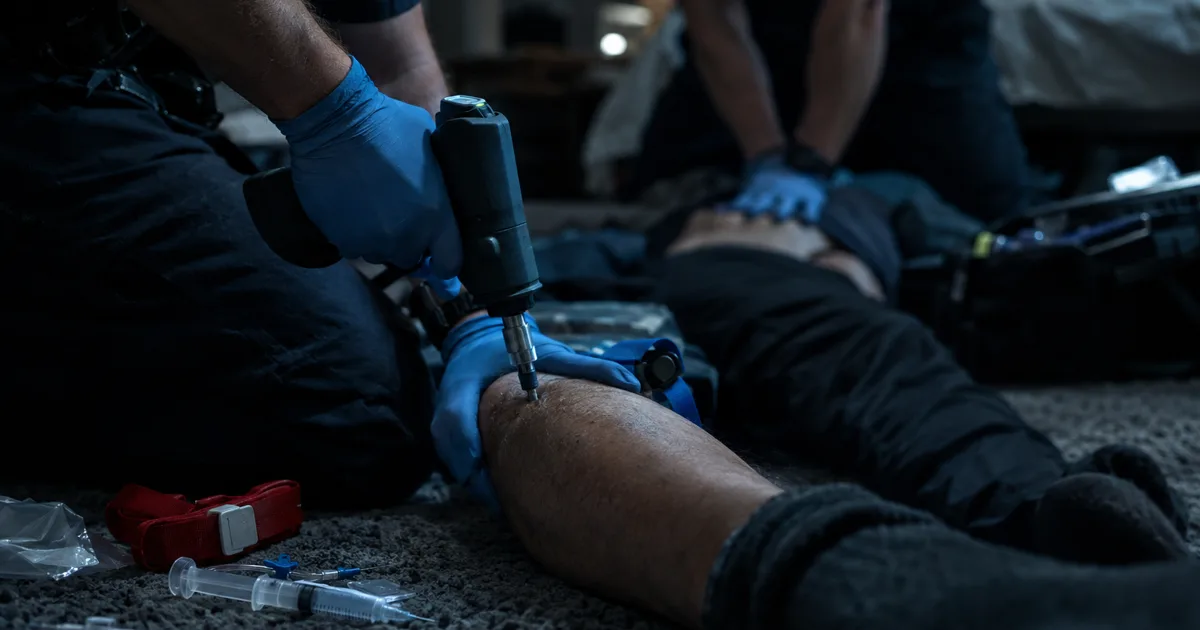
The engine crew has been on the chest for six minutes when you kneel beside a 74-year-old woman in PEA on her bedroom carpet. Her arms are thin, cool, and bruised from old blood draws, and the first 20-gauge in the antecubital fossa blows. Your partner already has the IO driver out of the bag and is asking whether to drill the tibia. The epinephrine is drawn up and waiting on a route.
Bottom line: start with IV, and move to IO without hesitation once two IV attempts fail. Two large randomized trials found no survival advantage for drilling first, and the pooled data lean toward IV for return of circulation.
PARAMEDIC-3: 6,082 Patients, No Survival Gain
PARAMEDIC-3 was a pragmatic, open-label randomized trial run across 11 UK emergency medical systems (10 NHS ambulance services and one air ambulance) from November 2021 to July 2024 [1]. Adults 18 or older in out-of-hospital cardiac arrest who needed vascular access for drugs during ongoing CPR were randomized to an IO-first or IV-first strategy; known or apparent pregnancy was the only exclusion. Paramedics chose the site and had two attempts at the allocated route before switching at their discretion.
Of 6,082 patients, 3,040 went to IO-first and 3,042 to IV-first. Thirty-day survival was 4.5% (137 of 3,030) with IO and 5.1% (155 of 3,034) with IV, an adjusted odds ratio of 0.94 (95% CI 0.68 to 1.32; P = 0.74) [1]. Favorable neurologic outcome at discharge, defined as a modified Rankin score of 0 to 3, was 2.7% versus 2.8%. Return of spontaneous circulation at any time was lower with IO: 36.0% versus 39.1% (adjusted odds ratio 0.86, 95% CI 0.76 to 0.97). Sustained ROSC at hospital handover was 21.7% versus 24.6%. The authors reported that the survival result was consistent across their prespecified subgroups, which included initial rhythm, witness status, and bystander CPR.
The speed argument for IO did not hold up. Median time from arrival on scene to drug administration was 14 minutes in the IO group and 15 minutes in the IV group, and call-to-drug time was 24 minutes in both [1]. In the IO arm, 73.5% of first successful IO lines were proximal tibial and 17.1% proximal humeral, chosen by the paramedic rather than by protocol. Only one adverse event was reported, and it was not serious.
The authors offered several explanations for the lower ROSC rate with IO: malpositioned or dislodged needles, slower peak drug concentrations, and a site effect, with animal data favoring the humerus over the tibia. The trial did not assess needle position. It stopped at the end of its funding period after 6,082 of a planned 15,000 patients, so it was underpowered to detect a one-point survival difference. A preplanned Bayesian analysis put the probability that IO-first improved 30-day survival at 18.4%, and the probability that it reduced ROSC at 98.0% [2].
IVIO: Higher Access Success, Same Outcomes
IVIO was a Danish randomized trial of adults with nontraumatic out-of-hospital cardiac arrest who needed vascular access [3]. The protocol called for at least two attempts at the allocated route, and the IO arm was further randomized to the humeral or tibial site [4]. Of 1,506 patients randomized, 1,479 entered the primary analysis: 731 IO and 748 IV.
Access succeeded within two attempts in 92% of the IO group and 80% of the IV group [3]. That gap did not change outcomes. Sustained ROSC, the primary endpoint, occurred in 30% with IO and 29% with IV (risk ratio 1.06, 95% CI 0.90 to 1.24; P = 0.49). Thirty-day survival was 12% versus 10%, and favorable neurologic outcome, defined as a modified Rankin score of 0 to 3, was 9% versus 8%. Prespecified adverse events were uncommon. At one year, 11% of the IO group and 9% of the IV group were alive (risk ratio 1.24, 95% CI 0.91 to 1.67), and the authors concluded that long-term outcomes did not differ between strategies [5].
Survival ran higher in both IVIO arms than in PARAMEDIC-3, so absolute numbers do not transfer between systems. Neither trial was designed to show the two routes are equivalent; both tested whether IO-first was superior, and it was not.
The Pooled Evidence and a Retracted Trial
A 2026 individual participant data meta-analysis by both trial teams combined 7,561 patients [6]. Thirty-day survival showed no difference (odds ratio 1.01, 95% CI 0.81 to 1.25; moderate certainty). Favorable neurologic outcome showed no difference (odds ratio 1.08, 95% CI 0.83 to 1.41; low certainty). For sustained ROSC, the point estimate favored IV (odds ratio 0.90, 95% CI 0.81 to 1.01; low certainty) without reaching significance.
A third trial dropped out of the evidence base. The Taipei VICTOR trial of humeral IO versus upper-extremity IV was retracted by the BMJ on 18 December 2025 because of problems with randomization and allocation [7]. ILCOR updated its systematic review in January 2026 to include only PARAMEDIC-3 and IVIO, and the retracted trial should no longer appear in training slides or protocol justifications.
What the 2025 Guidelines Say
The 2025 American Heart Association adult ALS guideline gives a Class 1, Level A recommendation to attempt IV access first in adult cardiac arrest, and a Class 2a recommendation for IO when initial IV attempts are unsuccessful or not feasible [8]. It names the optimal IO site, tibial or humeral, as a knowledge gap. The 2025 European Resuscitation Council guideline is more specific: if IV access cannot be achieved rapidly within two attempts, consider IO [9].
These recommendations cover adults. Pediatric arrest, trauma arrest, and patients with no peripheral veins at all are different problems, and nothing in these trials argues against going straight to IO when IV is clearly not feasible.
Building the Protocol and the Training
For an EMS medical director, the protocol change is short: match the adult arrest protocol to the guideline language above and name a defined switch point, so the crew does not spend the arrest chasing veins.
Training matters more than the wording. If IO needle position explains part of the ROSC gap, the fixes are confirming placement with a free flush and no infiltration, securing the line, and re-checking it after every patient move. Agencies that use the humeral site should train arm positioning and landmarking deliberately, because the trials did not resolve which IO site works best. QA should track first-pass IV success and time from arrival to first epinephrine, since the trials showed that route choice alone did not speed drug delivery.
Key Takeaways
- PARAMEDIC-3 found 30-day survival of 4.5% with IO-first versus 5.1% with IV-first across 6,082 patients, with ROSC lower in the IO group (36.0% versus 39.1%).
- In IVIO, IO access succeeded within two attempts more often (92% versus 80%) without improving sustained ROSC or survival.
- The 2025 AHA guideline makes IV-first Class 1; switch to IO after two failed IV attempts or when IV is not feasible.
- Remove the retracted VICTOR trial from training material; the current evidence rests on 2 trials and 7,561 pooled patients.
FAQ
Is IO or IV better in out-of-hospital cardiac arrest?
Neither route improved survival in the two large randomized trials. PARAMEDIC-3 found 30-day survival of 4.5% with IO-first and 5.1% with IV-first, and IVIO found 12% versus 10% [1,3]. ROSC was lower with IO in PARAMEDIC-3, which is part of why current guidelines put IV first [8].
How many IV attempts should a paramedic make before going IO in cardiac arrest?
The 2025 European Resuscitation Council guideline says to consider IO if IV access cannot be achieved rapidly within two attempts [9]. Both trials also allowed two attempts at the allocated route before switching [1,4].
Does IO access get epinephrine in faster during cardiac arrest?
Not in recent trials. In PARAMEDIC-3, median time from scene arrival to drug administration was 14 minutes with IO-first and 15 minutes with IV-first [1]. ILCOR's updated review noted that time to drug was similar between groups in both recent trials.
Dr. Chet's Take
I have been an emergency physician for more than 25 years at a Level I academic trauma center and a HEMS and critical care transport medical director for much of that time, and vascular access in arrest is exactly the kind of protocol line a medical director has to be able to defend. This article is right that the evidence moved, and the core argument holds. Two well-run randomized trials pointed the same direction. That is a clean enough answer to change a protocol. What I like about this evidence is that it is boring. No miracle, no harm signal worth panicking over. Just a reminder that a device being easy to use does not make it the better route for a drug that needs to reach the heart.
That being said, the trials tested a strategy, and most of the patients in them got whichever route worked. The part I think the post understates is skill decay. Peripheral IV success in a cold, collapsed arm during compressions is a hard skill, and a lot of agencies have let it slide because the IO was always there. If your medics cannot hit a vein in two tries on a real arrest, an IV-first protocol becomes a delay protocol. The honest answer is that nobody has measured how IV-first performs in an agency whose crews have stopped practicing it. I would also push back gently on anyone who reads this as an IO problem. A well-placed IO line in trained hands is still a good line, and for the patient with no usable veins it is the right first move.
If you are the medical director, update the adult arrest protocol, then put IV skills back on the training calendar before the change goes live. A protocol that asks for a skill your crews have not practiced in years will fail on the first cold, collapsed arm. Pull a quarter of arrest charts and look at how many IV attempts were made and how long they took. If you are running the call, decide out loud who owns access and when the switch happens before anyone opens a catheter, and assign someone else to watch the clock. Then let the compressions and the defibrillator do their work while the drug finds its way in. The route matters less than the minute you lose arguing about it.
— Chester Shermer, MD, FACEP | Emergency Medicine, 25+ Years Clinical Experience | State Surgeon
Continue Your Training
If you're an EMT, paramedic, flight medic, or CCTP (or any clinician treating patients daily) trying to understand how AI will actually impact your clinical practice — not just the hype — I put together a free practical guide. You can download the AI in EM Survival Guide here.
Browse All Courses at Global MedOps Command
Relevant Reading on Global MedOps Command:
How to Avoid Becoming an AI Casualty — Dr. Shermer's guide to navigating AI tools in clinical and operational settings without compromising judgment or patient outcomes.
Emergency Department Efficiency Playbook — Practical systems for throughput, triage optimization, and operational efficiency.
Read more from Dr. Shermer on Medium
Connect with Dr. Shermer: LinkedIn — Chester "Chet" Shermer, MD, FACEP.
References
- Couper K, Ji C, Deakin CD, et al. A randomized trial of drug route in out-of-hospital cardiac arrest. N Engl J Med. 2025;392(4):336-348. PubMed 39480216
- Couper K, Ji C, Deakin CD, et al. Intraosseous versus intravenous access in adult out-of-hospital cardiac arrest: a Bayesian secondary analysis of the PARAMEDIC-3 randomised controlled trial. Resuscitation. 2026;228:111335. PubMed 42790855
- Vallentin MF, Granfeldt A, Klitgaard TL, et al. Intraosseous or intravenous vascular access for out-of-hospital cardiac arrest. N Engl J Med. 2025;392(4):349-360. PubMed 39480221
- Meilandt C, Fink Vallentin M, Blumensaadt Winther K, et al. Intravenous vs. intraosseous vascular access during out-of-hospital cardiac arrest: protocol for a randomised clinical trial. Resusc Plus. 2023;15:100428. PubMed 37502742
- Vallentin MF, Holmberg MJ, Granfeldt A, et al. Effect of vascular access strategy on long-term outcomes in patients with out-of-hospital cardiac arrest: a randomised clinical trial. Resuscitation. 2026;223:111087. PubMed 41967754
- Holmberg MJ, Couper K, Andersen LW, et al. Intravenous or intraosseous vascular access in cardiac arrest: an individual participant data meta-analysis. Resuscitation. 2026;228:111304. PubMed 42727699
- Retraction: Intraosseous versus intravenous vascular access in upper extremity among adults with out-of-hospital cardiac arrest: cluster randomised clinical trial (VICTOR trial). BMJ. 2025;391:r2558. PubMed 41412600
- Wigginton JG, Agarwal S, Bartos JA, et al. Part 9: Adult advanced life support: 2025 American Heart Association guidelines for cardiopulmonary resuscitation and emergency cardiovascular care. Circulation. 2025;152(suppl 2):S538-S577. AHA guideline
- European Resuscitation Council. European Resuscitation Council Guidelines 2025: Adult Advanced Life Support. ERC guideline
Related simulation training: EM-Sim · Books by Dr. Shermer