By Chester "Chet" Shermer, MD, FACEP Professor of Emergency Medicine, TeleHealth, HEMS and Critical Care Transport, State Surgeon for the Army National Guard
Medication errors kill patients. In the prehospital environment — where you are working in poor lighting, under time pressure, with limited resources and no pharmacist double-checking your work — the margin for error is razor thin. According to data from the National EMS Information System (NEMSIS) and published prehospital quality improvement literature, drug errors account for a disproportionate share of preventable adverse events in EMS, with concentration errors, route errors, and contraindication failures representing the three most common categories.
This post breaks down the five most dangerous prehospital drug errors, the cognitive traps that cause them, and the systematic habits that prevent them. At the end, you will find a link to an interactive simulation that puts you in three real calls where these exact errors are on the table.
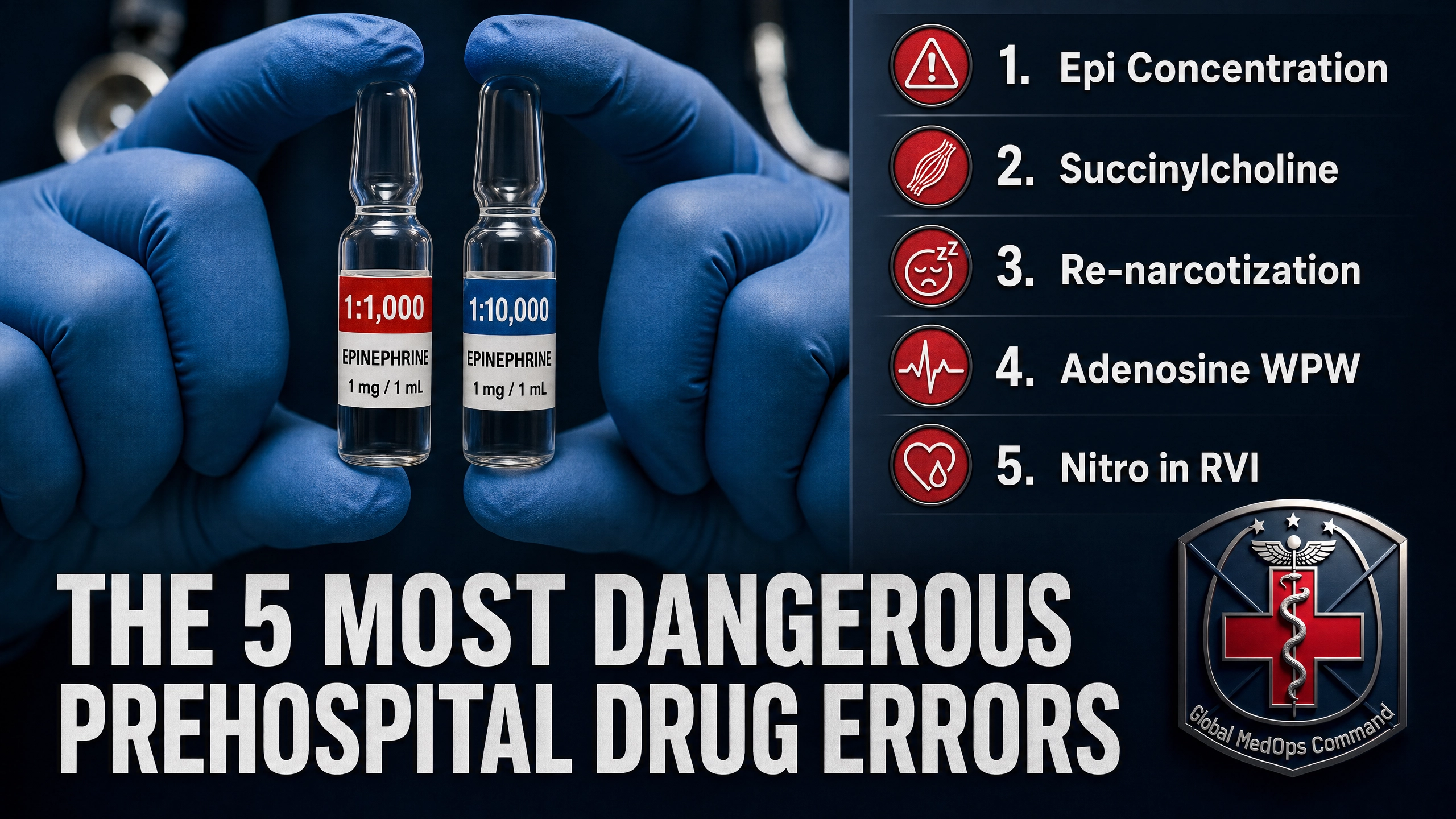
Error #1 — Epinephrine Concentration Confusion (1:1,000 vs. 1:10,000)
This is the single most lethal drug error in prehospital medicine. Epinephrine comes in two concentrations: 1:1,000 (1 mg/mL) for intramuscular injection in anaphylaxis, and 1:10,000 (0.1 mg/mL) for intravenous push in cardiac arrest. The difference is a factor of ten. Giving 1:1,000 IV in a patient who is not in cardiac arrest can cause hypertensive crisis, coronary vasospasm, and ventricular fibrillation.
The cognitive trap is speed. In anaphylaxis with impending airway obstruction, you are moving fast. Both concentrations come in similar-looking ampules. The 1:1,000 ampule may already be drawn up from a prior call. Without a deliberate label check — every time, without exception — you are relying on memory and context, both of which fail under stress.
Prevention protocol:
- Read the label aloud before drawing up any epinephrine
- State the concentration and route before administration: "Epinephrine 1:1,000, 0.3 mg IM, right lateral thigh"
- Never pre-draw epinephrine between calls — draw fresh every time
Error #2 — Succinylcholine in Hyperkalemia
Succinylcholine is a depolarizing neuromuscular blocking agent used for rapid sequence intubation (RSI). It works by binding acetylcholine receptors and causing a brief, synchronized depolarization of skeletal muscle — which transiently raises serum potassium by approximately 0.5 mEq/L in healthy patients. In patients with pre-existing hyperkalemia, that 0.5 mEq/L rise can be enough to trigger ventricular fibrillation.
The high-risk populations are well-defined: crush injury, burns greater than 24 hours old, prolonged immobilization, rhabdomyolysis, renal failure, and denervation injuries (stroke, spinal cord injury, Guillain-Barré). In these patients, succinylcholine is absolutely contraindicated. The alternative is rocuronium at 1.2 mg/kg, which provides equivalent intubating conditions within 60 seconds.
The cognitive trap is that hyperkalemia is invisible in the field. You cannot check a potassium level in the back of an ambulance. You have to recognize the clinical context — a dialysis patient, a crush victim, a patient with peaked T-waves on the 12-lead — and make the substitution before you draw up the drug.
Prevention protocol:
- Before every RSI, run a 30-second mental checklist: "Any reason NOT to use succinylcholine?"
- Memorize the contraindication list: crush injury, burns >24h, renal failure, known hyperkalemia, denervation injury
- Keep rocuronium stocked and know your weight-based dose before the call
Error #3 — Naloxone Duration Mismatch and Re-Narcotization
Naloxone (Narcan) has a half-life of 30–90 minutes. Fentanyl, the dominant opioid in the current overdose epidemic, has a half-life of 2–4 hours. Heroin metabolizes to morphine, which has a half-life of 2–3 hours. The math is straightforward: naloxone wears off before the opioid does.
Re-narcotization — the patient who wakes up, appears stable, and then re-sedates — is a predictable pharmacological event, not a surprise. Yet it continues to cause preventable deaths because providers treat naloxone reversal as the end of the call rather than the beginning of a monitoring window.
The error compounds when providers give a single large bolus of naloxone (2 mg IV) rather than titrating to effect. A large bolus causes acute opioid withdrawal, which is uncomfortable and agitates the patient. Agitated patients refuse transport. Patients who refuse transport and re-narcotize at home die.
Prevention protocol:
- Titrate naloxone to respiratory rate and level of consciousness, not to full awakening
- Target SpO2 >94% and RR >12 — not "patient is awake and talking"
- Document the opioid suspected (fentanyl vs. heroin vs. prescription opioid) — this predicts re-narcotization risk
- Strongly encourage transport for all opioid reversals; document refusal explicitly if the patient declines
- If transporting, reassess mental status and respiratory rate every 5 minutes
Error #4 — Adenosine in Pre-Excited Atrial Fibrillation (WPW)
Adenosine is the first-line drug for stable supraventricular tachycardia (SVT). It works by temporarily blocking the AV node, which terminates most reentrant SVT circuits. In Wolff-Parkinson-White (WPW) syndrome with atrial fibrillation, however, adenosine is contraindicated and potentially lethal.
In WPW with AF, the atria are firing at 300–600 impulses per minute. Normally, the AV node filters this down to a tolerable ventricular rate. Adenosine blocks the AV node — which sounds helpful — but in WPW, this forces all conduction down the accessory pathway, which has no filtering capacity. The result can be ventricular rates exceeding 300 bpm and degeneration into ventricular fibrillation.
The clinical clue is the 12-lead ECG: WPW with AF produces an irregularly irregular rhythm with wide, bizarre QRS complexes and a variable rate. It looks like AF with aberrancy or ventricular tachycardia. If you are uncertain, do not give adenosine. Synchronized cardioversion is the safe choice for any unstable wide-complex tachycardia.
Prevention protocol:
- Before giving adenosine, confirm: regular rhythm, narrow QRS, no delta waves on prior ECGs
- If the rhythm is irregularly irregular with wide QRS — do NOT give adenosine
- When in doubt, cardiovert. Electricity does not care about accessory pathways.
Practice this scenario: The Adenosine in WPW simulation on EMS-MedSim puts you in front of a 34-year-old male with a wide-complex irregular tachycardia and a BP of 88/54. You will make the rhythm call, choose the treatment, and see exactly what happens when adenosine is given to a patient with WPW and AF.
Error #5 — Nitroglycerin in Right Ventricular Infarction
Nitroglycerin is a venodilator. In left ventricular failure, venodilation reduces preload and relieves pulmonary congestion. In right ventricular infarction (RVI), the right ventricle is failing and depends entirely on preload to maintain cardiac output. Venodilation drops preload, drops right ventricular output, drops left ventricular filling, and collapses systemic blood pressure — sometimes within minutes of a single sublingual nitroglycerin tablet.
RVI occurs in approximately 30–40% of inferior STEMIs (ST elevation in leads II, III, aVF). The clinical clue is the right-sided 12-lead: ST elevation in lead V4R is the most sensitive finding. In the field, if you identify an inferior STEMI and the patient is hypotensive or has elevated JVD with clear lungs, assume RVI until proven otherwise.
Prevention protocol:
- For every inferior STEMI, obtain right-sided leads (V3R, V4R) before giving nitroglycerin
- If ST elevation in V4R is present, nitroglycerin is contraindicated
- If right-sided leads are unavailable and the patient has inferior STEMI with hypotension, withhold nitroglycerin and give a 250 mL IV fluid bolus
- Communicate RVI suspicion clearly in your radio report so the receiving team is prepared
Practice this scenario: The Nitroglycerin in RVI simulation on EMS-MedSim walks you through an inferior STEMI with hypotension and clear lungs. You will obtain V4R leads, navigate the nitroglycerin contraindication, manage complete heart block, and deliver a complete cath lab handoff.
The Common Thread: Cognitive Load and Systematic Habits
Every one of these errors shares a root cause: the provider was relying on automatic, pattern-based thinking in a situation that required deliberate, analytical reasoning. Kahneman's System 1 vs. System 2 framework applies directly to prehospital pharmacology. System 1 is fast, intuitive, and error-prone under novel conditions. System 2 is slow, deliberate, and accurate — but it requires activation.
The antidote is not more knowledge. It is systematic habits that force System 2 engagement at the moment of highest risk: the moment before drug administration. A verbal read-back, a contraindication checklist, a weight-based dose confirmation — these are not bureaucratic overhead. They are the cognitive speed bumps that prevent the errors described above.
Practice These Decisions Under Pressure
Reading about drug errors builds knowledge. Making the right decision when the clock is running and the patient is deteriorating builds the automaticity that saves lives.
The High-Risk Medication Administration scenario on EMS-MedSim puts you in three consecutive calls where errors #1, #2, and #3 from this list are directly on the table:
- Arc 1 — Epinephrine Concentration Error: Anaphylaxis with impending airway obstruction. Four drug choices. Two are immediately fatal.
- Arc 2 — Succinylcholine Contraindication: RSI in a crush injury patient with K⁺ 6.8 and peaked T-waves on the 12-lead. One choice causes cardiac arrest.
- Arc 3 — Opioid Re-Narcotization: Fentanyl OD reversed with naloxone. The scenario does not end when she wakes up.
27 branching nodes. 5 critical error paths. Real clinical feedback on every choice.
Start the High-Risk Medication Administration Scenario →
Requires AEMT or higher subscription. View all scenarios and pricing →
Frequently Asked Questions
What is the classic prehospital epinephrine error?
Concentration confusion — pushing the 1 mg/mL (1:1,000) concentration IV when the 0.1 mg/mL (1:10,000) dilution was indicated.
Why can a naloxone patient re-arrest after waking up?
Naloxone's duration is shorter than that of many opioids, so re-narcotization can follow a good initial response — which is why monitoring and transport matter.
When is succinylcholine the wrong paralytic?
When hyperkalemia is plausible — renal failure, crush injury, burns, prolonged immobilization — because it can push potassium higher and precipitate arrest; rocuronium is the alternative.