Prehospital pharmacology is one of the highest-stakes domains in emergency medical services. Unlike the controlled environment of an emergency department, paramedics administer potent, potentially lethal medications in moving vehicles, in low-light conditions, under physiological stress, and often with incomplete patient histories. A single dosing error with epinephrine, succinylcholine, or fentanyl can convert a salvageable patient into a critical deterioration. This guide examines the most clinically dangerous drug categories in the paramedic scope of practice, the mechanisms behind their risk, and the simulation-based training strategies that build the automaticity needed to use them safely.
Why Prehospital Pharmacology Demands a Different Standard
In the hospital, a pharmacist reviews orders, nurses perform independent double-checks, and physicians are immediately available for consultation. In the field, the paramedic is the pharmacist, the nurse, and the physician simultaneously. The cognitive load is enormous: weight-based dosing calculations, route selection, concentration verification, and contraindication screening must all occur in seconds while managing an actively deteriorating patient.
Research consistently shows that medication errors are disproportionately common in high-acuity prehospital calls. A 2019 review in Prehospital Emergency Care found that drug administration errors occurred in approximately 1 in 200 ALS calls, with dosing errors accounting for the majority of incidents. The consequences range from inadequate analgesia to respiratory arrest. Understanding which medications carry the highest risk — and why — is the first step toward error prevention.
The High-Risk Drug Categories
1. Sympathomimetics: Epinephrine
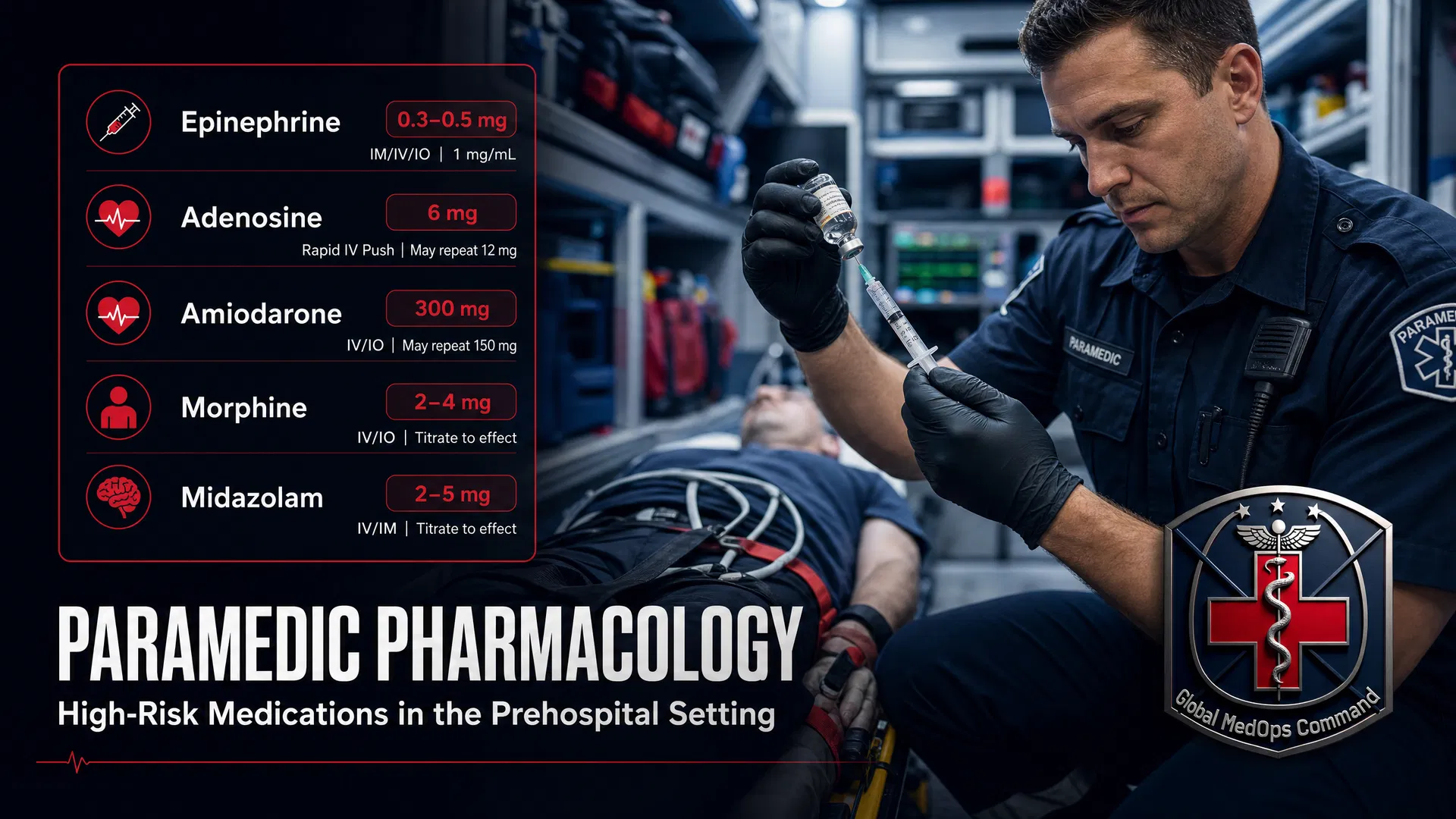
Epinephrine is the cornerstone of cardiac arrest resuscitation and anaphylaxis management, but its therapeutic window is narrow and its adverse effect profile is severe. In cardiac arrest, the standard adult dose is 1 mg IV/IO every 3–5 minutes. In anaphylaxis, the dose is 0.3–0.5 mg IM (1:1,000 concentration) — a tenfold concentration difference from the IV formulation.
The most dangerous error in prehospital epinephrine administration is concentration confusion. Administering 1 mg of the 1:1,000 concentration intravenously to an anaphylaxis patient — rather than the 1:10,000 concentration — can precipitate hypertensive crisis, myocardial ischemia, and ventricular fibrillation. Paramedics must internalize not just the dose but the route-concentration pairing as a single cognitive unit.
Simulation training focus: Practice anaphylaxis scenarios that require the paramedic to verbalize the concentration, route, and dose before administration. Include distractor scenarios where a cardiac arrest occurs immediately after an anaphylaxis call, forcing the provider to consciously switch concentration protocols.
2. Neuromuscular Blocking Agents: Succinylcholine and Rocuronium
Rapid sequence intubation (RSI) is the highest-risk procedure in the paramedic scope of practice. Neuromuscular blocking agents (NMBAs) paralyze the patient completely — including respiratory muscles — creating a "cannot intubate, cannot oxygenate" (CICO) scenario if the airway is lost. There is no margin for error.
Succinylcholine (1.5–2 mg/kg IV) is a depolarizing NMBA with an onset of 45–60 seconds and a duration of 8–12 minutes. Its short duration is its primary safety advantage — if intubation fails, the patient will eventually resume spontaneous respirations. However, succinylcholine is absolutely contraindicated in patients with hyperkalemia, crush injuries older than 72 hours, burns older than 24 hours, denervation injuries, and known personal or family history of malignant hyperthermia. Administering succinylcholine to a hyperkalemic patient can trigger fatal ventricular fibrillation within minutes.
Rocuronium (1.2 mg/kg IV for RSI) is a non-depolarizing NMBA with an onset of 60–90 seconds and a duration of 45–60 minutes. It lacks the contraindications of succinylcholine but commits the provider to a prolonged paralysis window. Sugammadex (16 mg/kg IV) can reverse rocuronium within 3 minutes, but most EMS systems do not carry it — making the decision to use rocuronium a commitment to successful intubation.
Simulation training focus: Every RSI simulation should include a failed intubation branch requiring the paramedic to execute a surgical airway or supraglottic airway rescue. Providers must practice the CICO decision tree until it is automatic, not deliberate.
3. Opioid Analgesics: Fentanyl and Morphine
Opioid analgesia is a core paramedic intervention for trauma, burns, and ischemic chest pain. Fentanyl (1–2 mcg/kg IV/IN) and morphine (0.1 mg/kg IV) are the most commonly used agents. Both carry significant risks of respiratory depression, hypotension, and — in the case of morphine — histamine release that can exacerbate bronchospasm in asthmatic patients.
The most common prehospital opioid error is inadequate weight estimation leading to underdosing or overdosing. Paramedics frequently estimate patient weight visually, and studies show this estimation is inaccurate by 20–30% in obese patients. Weight-based dosing errors in fentanyl are particularly dangerous because the drug's potency (fentanyl is approximately 100 times more potent than morphine on a milligram basis) means small absolute errors produce large clinical effects.
Naloxone (0.4–2 mg IV/IM/IN) is the reversal agent for opioid toxicity and should always be immediately accessible when opioids are administered. Paramedics must also recognize that naloxone's duration of action (30–90 minutes) is shorter than most opioids, creating a risk of re-narcotization after apparent reversal.
Simulation training focus: Include scenarios where the patient's weight is ambiguous or the patient is morbidly obese, requiring the paramedic to use a length-based tape (Broselow or similar) or clinical judgment. Practice naloxone administration for opioid toxicity with a re-narcotization branch 45 minutes into the scenario.
4. Antiarrhythmics: Amiodarone and Adenosine
Antiarrhythmic medications require precise rhythm interpretation before administration — a skill that degrades under stress. Amiodarone (300 mg IV for refractory VF/pVT; 150 mg IV for stable VT) is the preferred antiarrhythmic in cardiac arrest but carries risks of hypotension, bradycardia, and prolonged QT interval. Administering amiodarone to a patient in SVT rather than VT is a common error that can precipitate hemodynamic collapse.
Adenosine (6 mg rapid IV push for SVT, followed by 12 mg if needed) is highly effective for terminating AV-nodal-dependent tachycardias but is absolutely contraindicated in pre-excited atrial fibrillation (WPW syndrome). In WPW with rapid ventricular response, adenosine can paradoxically accelerate conduction through the accessory pathway, causing ventricular fibrillation. Distinguishing regular narrow-complex SVT from pre-excited AF on a field ECG — often with artifact and patient movement — is a high-difficulty clinical skill that requires extensive simulation practice.
Simulation training focus: Build rhythm recognition drills into every antiarrhythmic scenario. Require the paramedic to state the rhythm, rate, and clinical indication before any antiarrhythmic is administered. Include a WPW scenario where adenosine is the wrong choice. The Adenosine in WPW simulation on EMS-MedSim is built specifically for this — a 34-year-old with wide-complex irregular tachycardia where the wrong drug choice triggers VF.
5. Benzodiazepines: Midazolam and Diazepam
Benzodiazepines are used for seizure management, procedural sedation, and hyperactive delirium with severe agitation. Midazolam (0.1–0.2 mg/kg IV/IM/IN) and diazepam (5–10 mg IV/PR) are the most common prehospital agents. Both cause dose-dependent respiratory depression, particularly when combined with opioids — a combination that dramatically increases the risk of respiratory arrest.
The opioid-benzodiazepine combination is the most common drug interaction responsible for prehospital respiratory arrest. Paramedics managing a seizing patient who also received fentanyl for pain must treat the combined respiratory depression risk as a separate clinical problem requiring continuous monitoring and airway readiness.
Simulation training focus: Include scenarios where the paramedic must manage a seizing patient who has already received opioids, requiring them to titrate benzodiazepine dose carefully and prepare for respiratory support.
Building Pharmacology Automaticity Through Simulation
Clinical automaticity — the ability to execute the correct pharmacological decision without conscious deliberation — is the goal of high-fidelity simulation training. Research in cognitive psychology shows that automaticity requires approximately 10,000 repetitions of a skill under varied conditions. No paramedic accumulates that volume of high-acuity pharmacology exposure in field practice alone. Simulation is the only scalable mechanism for closing that gap.
Effective pharmacology simulation has three components:
1. Scenario fidelity: The scenario must present the drug decision in its full clinical context — not as an isolated pharmacology quiz but as a patient who is deteriorating, whose history is incomplete, and whose presentation requires the paramedic to simultaneously manage airway, circulation, and medication administration.
2. Decision branching: Every pharmacology scenario should have at least one branch where the standard drug choice is contraindicated or where the patient's response to the drug is unexpected. This forces the paramedic to develop contingency thinking rather than protocol-following.
3. Immediate feedback: After each scenario, the paramedic should receive a structured debrief that identifies the specific decision point where the pharmacological error occurred, the mechanism of the error (dose calculation, concentration confusion, contraindication missed), and the correct decision pathway.
EMS-MedSim's AI-powered simulation platform delivers all three components at scale. The Virtual FTO provides real-time feedback on drug selection, dose calculation, and administration timing — the same feedback a physician preceptor would provide, available on demand for every scenario repetition.
The Five Rules of Prehospital Pharmacology Safety
Every paramedic should internalize these five rules as non-negotiable:
- Verify the concentration before every draw. Epinephrine 1:1,000 and 1:10,000 are different drugs for different routes. Read the label every time.
- Calculate weight-based doses before the call, not during it. Know your dose ranges for common weights (50 kg, 70 kg, 100 kg) before you need them.
- State the drug, dose, route, and indication aloud before administration. Verbalization catches errors that silent cognition misses.
- Know your reversal agents. Naloxone for opioids. Sugammadex for rocuronium (if available). Flumazenil for benzodiazepines (use with caution in chronic users). Atropine for organophosphate toxicity.
- Treat the patient, not the protocol. Protocols are starting points. Clinical judgment — built through simulation — is what keeps patients alive when the protocol doesn't fit.
Conclusion
Prehospital pharmacology is not a memorization exercise — it is a clinical judgment skill that must be built through deliberate, high-fidelity practice. The medications that save lives in the field are the same ones that can cause rapid deterioration when used incorrectly. Simulation-based training that emphasizes decision branching, contraindication recognition, and dose calculation under stress is the most effective tool available for building the pharmacological automaticity that prehospital providers need.
EMS-MedSim offers dedicated pharmacology scenarios for EMTs, AEMTs, and paramedics — each designed by board-certified emergency physicians to reflect the real clinical decisions providers face in the field.
Frequently Asked Questions
Which prehospital drug classes carry the highest risk?
The five covered here: sympathomimetics (epinephrine), neuromuscular blockers, opioid analgesics, antiarrhythmics, and benzodiazepines.
How does simulation make pharmacology safer?
Repeated decision practice under realistic pressure turns dose, indication, and contraindication checks into automatic habits instead of recall tasks performed under stress.
Continue Reading
- EMS Simulation Tutorial: Build Clinical Automaticity in 5 Steps — How deliberate simulation practice builds the automaticity that prehospital pharmacology demands
- Prehospital Airway Management: RSI, Supraglottic Airways, and Surgical Airway Decision-Making — The airway management decisions that follow RSI drug administration
- Prehospital Cardiac Arrest Management: High-Performance CPR and ROSC Strategies — Epinephrine and amiodarone in the context of cardiac arrest resuscitation
Practice What You Just Learned — Interactive Simulation
Reading about high-risk medications is essential. Executing the right decision under pressure is what saves lives.
The High-Risk Medication Administration scenario puts you in three back-to-back calls where the wrong drug, wrong concentration, or wrong route has immediate, visible consequences:
- Arc 1 — Epinephrine Concentration Error: Anaphylaxis patient in impending airway obstruction. Four drug choices — two are immediately fatal.
- Arc 2 — Succinylcholine Contraindication: RSI in a crush injury patient with K⁺ 6.8 and peaked T-waves. One choice causes cardiac arrest.
- Arc 3 — Opioid Re-Narcotization: Fentanyl OD reversed with naloxone. The scenario doesn't end when she wakes up — it ends when you get her safely to the ED.
27 branching nodes. 5 critical error paths. Real clinical feedback on every choice.
Start the High-Risk Medication Administration Scenario →
Requires AEMT or higher subscription. View all scenarios and pricing →