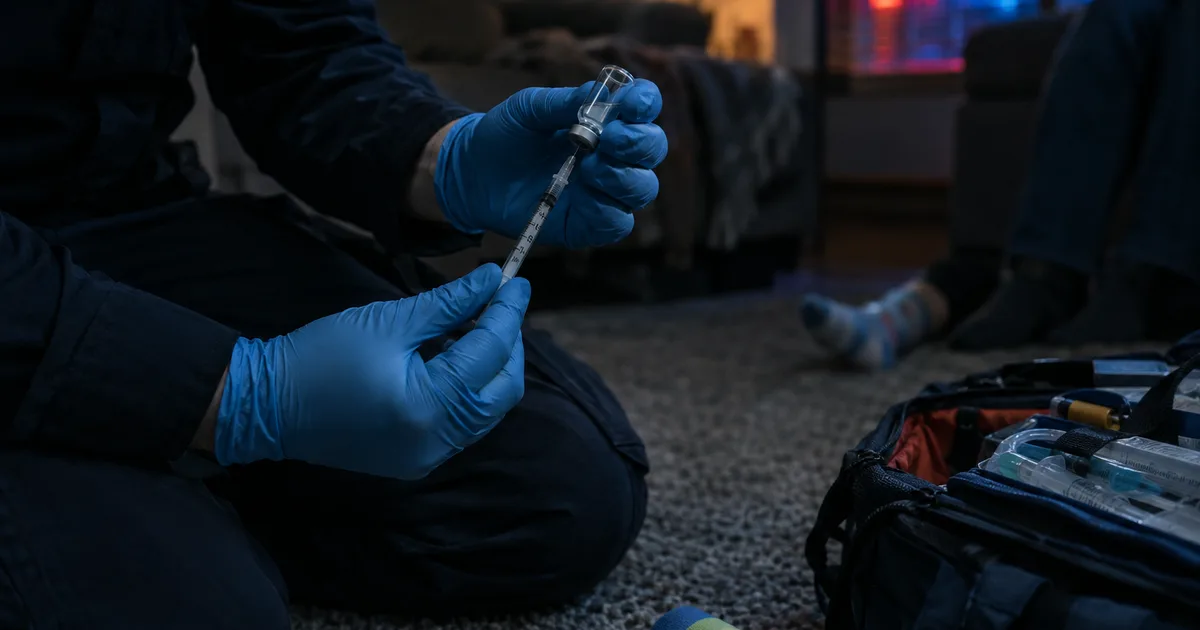
The 2-year-old has been shaking on the living room floor for about ten minutes when you walk in, still in a generalized tonic-clonic seizure. Your partner lays out the length-based tape, calls the zone, and starts the math out loud: 12 kg, 0.2 mg/kg, 5 mg/mL. Your partner lands on 0.24 mL, a half dose, and you catch it only because you ran the same numbers in your head. The IV kit is already open on the floor.
Bottom line: for a child still seizing at your arrival, give midazolam 0.2 mg/kg IM, maximum 10 mg, without waiting for a line, and check the volume against a precalculated chart before you push. Underdosing is the error the data show most often, and time spent on an IV pushes the first dose later.
How often the first dose is wrong
Shah and colleagues studied children 0 to 17 years old who were actively seizing and transported by three EMS agencies, before and after each agency rewrote its seizure protocol to match the national evidence-based guideline [1]. It was a retrospective, cross-sectional study of 533 children [1]. After the change, paramedics were more likely to give midazolam at all (61% before vs 71% after; OR 1.60, 95% CI 1.10 to 2.30) and more likely to give the first dose IN or IM (49% vs 77%; OR 3.24, 95% CI 2.01 to 5.21) [1].
The dosing problem did not improve. Across the study, the first midazolam dose came about 14 minutes after paramedic arrival. Paramedics gave an incorrect weight-based dose to 130 of 359 treated children (36%), and 94 of those 130 (72%) got less than the recommended dose [1]. On ED arrival, 152 of 533 children (29%) had a persistent or recurrent seizure, and 90 (17%) had respiratory failure during EMS or ED care [1]. The authors concluded that the protocol increased midazolam use but that children frequently received an incorrect weight-based dose [1].
National data show the same pattern. Ramgopal and Martin-Gill analyzed 361,177 pediatric seizure encounters in the National EMS Information System from 2019 to 2021 [2]. They classified 43.4% of initial EMS benzodiazepine doses as inappropriately low. A low first dose, or use of lorazepam or diazepam instead of midazolam, was associated with additional doses [2].
Why the IV costs you time
RAMPART was a double-blind, randomized noninferiority trial run by 4,314 paramedics in 33 US EMS agencies, with 79 receiving hospitals [3]. It enrolled 893 children and adults whose convulsions had lasted more than 5 minutes and who were still convulsing after paramedics arrived. Children had to weigh an estimated 13 kg or more [3]. Patients received IM midazolam by autoinjector (10 mg, or 5 mg for 13 to 40 kg) or IV lorazepam (4 mg, or 2 mg for 13 to 40 kg) [3]. The primary outcome was no seizures and no rescue therapy at ED arrival, which occurred in 73.4% with IM midazolam and 63.4% with IV lorazepam (difference 10 percentage points, 95% CI 4.0 to 16.1) [3]. Intubation rates were 14.1% and 14.4% [3]. Among patients whose seizures stopped, median time to active treatment was 1.2 minutes for IM and 4.8 minutes for IV [3].
The pediatric analysis covered 120 children, 60 per arm [4]. Seizures stopped before ED arrival in 68.3% with IM midazolam and 71.7% with IV lorazepam (risk difference −3.3%, 99% CI −24.9% to 18.2%) [4]. In children younger than 11, the rates were 68.1% and 69.4% (risk difference −1.3%, 99% CI −25.7% to 23.1%) [4]. Treatment started sooner with IM, and safety profiles were similar. The authors cautioned that a secondary analysis this small limits the conclusions [4]. The pediatric data show no benefit from IV, and the IV took longer.
The intranasal question
Two large cohorts point the same direction on IN midazolam. Shavit and colleagues studied 1,172 children 0 to 18 years old treated with midazolam for an active seizure by Israel's national EMS mobile intensive care units from 2017 to 2019 [5]. The protocol dose was 0.1 mg/kg IV or 0.2 mg/kg IN or IM [5]. A second midazolam dose was needed in 39.2% overall: 31.9% after a first IV dose, 48.5% after IN, and 35.6% after IM [5]. Compared with IV, the adjusted odds ratio for a second dose was 1.65 (95% CI 1.13 to 2.42) for IN and 0.97 (0.62 to 1.53) for IM [5]. The median first IN dose was 0.25 mg/kg, so the IN failures did not come from underdosing [5].
Ramgopal and colleagues used 2018 to 2022 records from about 2,000 US agencies in the ESO Data Collaborative and kept only 2,923 transported children whose first midazolam dose was appropriate [6]. An appropriate dose was within 80% to 120% of 0.2 mg/kg IM or IN (up to 10 mg) or 0.1 mg/kg IV (up to 4 mg), per the 2022 NASEMSO model guideline [6]. The outcome, a second benzodiazepine dose, stood in for ongoing seizure. It occurred in 21.6% after IM, 25.4% after IN, and 18.5% after IV [6]. Compared with IM, the adjusted odds were 1.39 (1.10 to 1.76) for IN and 1.00 (0.80 to 1.26) for IV [6]. Median time from EMS arrival to first dose was 7.3 minutes for IM, 7.8 for IN, and 13.1 for IV [6]. In the 836 children with an EMS impression of status epilepticus, the point estimates were similar but the confidence intervals crossed 1 [6].
Both studies are retrospective, and neither randomized route. The national guideline lists IN alongside IM and buccal as first-line routes [7].
The criteria to act on
The 2014 evidence-based guideline makes two recommendations that drive the call [7]. Check capillary glucose in every actively seizing child and treat a level below 60 mg/dL with IV dextrose or IM glucagon. Give a benzodiazepine at 0.2 mg/kg by a non-IV route (buccal, IM, or IN) as first-line therapy for status epilepticus, in preference to the rectal route [7]. RAMPART's enrollment trigger is a workable bedside definition: convulsions longer than 5 minutes that continue after you arrive [3]. If an IV is already in place, the NASEMSO dose is 0.1 mg/kg, maximum 4 mg [6].
What PediDOSE is testing
PediDOSE is a phase 3, stepped-wedge trial in EMS systems across 20 US metropolitan areas through PECARN, run under exception from informed consent [8]. It enrolls children 6 months to 13 years with a paramedic-witnessed seizure who are transported by a participating agency. It excludes benzodiazepine allergy, known or presumed pregnancy, and severe growth restriction [8]. Each agency switches from its weight-based protocol to IM or IN midazolam at 5 mg/mL, dosed by age with no calculation:
- 6 to 16 months: 1.25 mg (0.25 mL)
- 17 months to 5 years: 2.5 mg (0.5 mL)
- 6 to 11 years: 5 mg (1 mL)
- 12 to 13 years: 10 mg (2 mL) [8]
Bands under 2 years were added only after data safety review [8]. The primary outcome is seizure on ED arrival, judged by rapid-response EEG within 15 minutes or clinician assessment. The safety outcome is respiratory failure, defined as BVM ventilation, CPAP, BiPAP, a supraglottic airway, or intubation before or within 30 minutes of ED arrival [8]. The trial is powered at 87% with 4,840 children to detect a drop in seizures on arrival from 39% to 29%. The authors anticipated completion in 2026 [8].
Key Takeaways
- Give midazolam 0.2 mg/kg IM, maximum 10 mg, for a child still seizing after 5 minutes, and do not hold the first dose for IV access.
- In a three-agency study, 36% of weight-based doses were wrong and 72% of those were low. A precalculated volume chart by tape zone is the fix you can deploy now.
- After an appropriate first dose, IN needed a second dose more often than IM (adjusted OR 1.39). Choose IM when both routes are practical.
- Check glucose on every actively seizing child and treat below 60 mg/dL.
FAQ
What is the midazolam dose for a pediatric seizure in EMS?
The national guideline uses 0.2 mg/kg IM or IN as first-line therapy [7]. The 2022 NASEMSO model guideline caps IM or IN at 10 mg and uses 0.1 mg/kg IV, up to 4 mg, when a line is already in place [6].
Is intranasal or intramuscular midazolam better for seizures in children?
No randomized trial has compared them in EMS. Two large retrospective cohorts found more second doses after IN than after IM, including when the IN dose was correct [5,6]. RAMPART showed that IM midazolam is at least as effective as IV lorazepam [3].
What is the PediDOSE trial?
PediDOSE is a PECARN stepped-wedge trial in 20 US metropolitan areas comparing weight-based midazolam dosing with four standardized age-based IM or IN doses for children 6 months to 13 years [8]. Its primary outcome is seizure on ED arrival, and its safety outcome is respiratory failure. Results were not yet published at the time of writing.
Dr. Chet's Take
I have spent my career as an ED attending and as a HEMS and critical care transport medical director, and this article lands on the right problem. The drug is settled. Midazolam works, and it works IM. What fails is the arithmetic, done kneeling on a carpet with a screaming parent behind you. Pediatric seizures are common enough across a system to matter and rare enough for any one paramedic that nobody stays sharp on the math between calls. A dosing error under that pressure is a predictable human result, and a protocol that depends on mental math at 2 a.m. is one I own as a medical director. The core argument holds: get the right volume into the muscle early and most of these children do fine.
That being said, I think the article is a little kind to the IV. The honest answer is that I see crews start a line before the first dose because it feels like control, and the data do not reward that instinct in this population. I also want medical directors to stop treating the length-based tape as the fix. The tape gives you a weight. It does not give you a volume, and the volume is where the half doses come from. I would also take a correct IN dose at minute three over a perfect IM dose at minute ten, because the route argument matters less than the clock. If PediDOSE shows age-based dosing is safe, the bigger lesson will be that removing a step beats training people harder on it.
If you are the medical director, build a one-page pediatric seizure card with midazolam in milliliters by tape zone for your concentration, and pull every pediatric midazolam chart from the last year to see how many doses fell outside that card. If you are running the call, read the volume off the card, have your partner confirm it out loud, and give it IM before anyone opens the IV start kit. Then move to airway and glucose. Medical directors should add time from arrival to first midazolam to the monthly QA report and post each crew's median time where the crews will see it every month. Your first job on a seizing child is the correct volume of midazolam in the thigh.
— Chester Shermer, MD, FACEP | Emergency Medicine, 25+ Years Clinical Experience | State Surgeon
Continue Your Training
If you're an EMT, paramedic, flight medic, or CCTP (or any clinician treating patients daily) trying to understand how AI will actually impact your clinical practice — not just the hype — I put together a free practical guide. You can download the AI in EM Survival Guide here.
Browse All Courses at Global MedOps Command
Relevant Reading on Global MedOps Command:
How to Avoid Becoming an AI Casualty — Dr. Shermer's guide to navigating AI tools in clinical and operational settings without compromising judgment or patient outcomes.
Emergency Department Efficiency Playbook — Practical systems for throughput, triage optimization, and operational efficiency.
Read more from Dr. Shermer on Medium
Connect with Dr. Shermer: LinkedIn — Chester "Chet" Shermer, MD, FACEP.
References
- Shah MI, Ostermayer DG, Browne LR, et al. Multicenter evaluation of prehospital seizure management in children. Prehosp Emerg Care. 2021;25(4):475-486. PubMed 32589502
- Ramgopal S, Martin-Gill C. Prehospital seizure management in children: an evaluation of a nationally representative sample. J Pediatr. 2023;257:113379. PubMed 36889629
- Silbergleit R, Durkalski V, Lowenstein D, et al. Intramuscular versus intravenous therapy for prehospital status epilepticus. N Engl J Med. 2012;366(7):591-600. PubMed 22335736
- Welch RD, Nicholas K, Durkalski-Mauldin VL, et al. Intramuscular midazolam versus intravenous lorazepam for the prehospital treatment of status epilepticus in the pediatric population. Epilepsia. 2015;56(2):254-262. PubMed 25597369
- Shavit D, Strugo R, Siman-Tov M, et al. Assessment of first-line therapy with midazolam for prehospital seizures in children. JAMA Netw Open. 2023;6(4):e236990. PubMed 37014644
- Ramgopal S, Owusu-Ansah S, Crowe RP, et al. Association of midazolam route of administration and need for recurrent dosing among children with seizures cared for by emergency medical services. Epilepsia. 2024;65(5):1294-1303. PubMed 38470335
- Shah MI, Macias CG, Dayan PS, et al. An evidence-based guideline for pediatric prehospital seizure management using GRADE methodology. Prehosp Emerg Care. 2014;18(Suppl 1):15-24. PubMed 24298939
- Shah MI, Adelgais KM, Chamberlain JM, et al. Methodology for the Pediatric Dose Optimization for Seizures in Emergency Medical Services (PediDOSE) study. Trials. 2025;27(1):53. PubMed 41388551
Related simulation training: EMS-MedSim · Books by Dr. Shermer