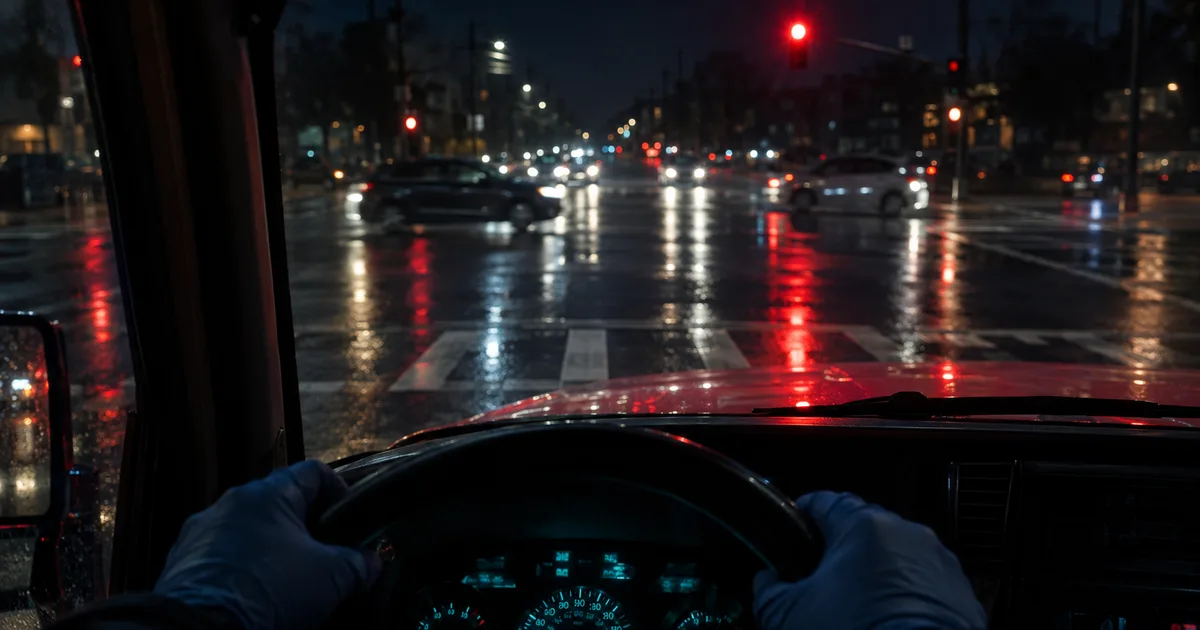
Most EMS agencies in the United States still run hot to the large majority of their 911 calls. The national data say that habit buys a minute or two on most trips and roughly doubles or triples the odds of the ambulance crashing on the way. Very few of those patients turn out to need anything in the first ten minutes that a non-emergent arrival would have missed. One Texas agency changed its dispatch rules around that fact and cut its lights-and-siren responses in half.
Bottom line: assign lights and siren by call type, using local data on how often a time-critical intervention actually happens, and transport hot only when the patient needs a hospital intervention the minutes will change. Audit the calls that fall on the wrong side of the line.
What the Minutes Are Worth
The 2022 joint statement on lights and siren (L&S), endorsed by 14 organizations including NAEMSP, ACEP, NAEMT, NASEMSO, the International Association of Fire Chiefs, and the International Academies of Emergency Dispatch, summarizes more than a dozen studies: the average time saved with L&S response or transport ranges from 42 seconds to 3.8 minutes [1].
Fleischman and colleagues measured it on 48,308 scene transports in Multnomah County, Oregon, in 2008, using computer-aided dispatch timestamps [2]. L&S saved an average of 3.1 minutes on transports shorter than 8.8 minutes and 5.3 minutes on longer transports [2]. That is real time on a long rural run. On a short urban trip, it is three minutes.
The joint statement also makes the systems argument: in most settings, emergency department, operative, and inpatient efficiencies can compensate for minutes lost on a non-L&S response [1].
What the Minutes Cost
Watanabe and colleagues used the 2016 National EMS Information System (NEMSIS) data set to study 19 million 911 scene responses by transport-capable units [3]. Crashes were identified by the "type of response delay" and "type of transport delay" fields coded as a crash involving the ambulance, which undercounts minor events. During the response phase, the crash rate was 4.6 per 100,000 without L&S and 5.4 per 100,000 with L&S (adjusted odds ratio 1.5, 95% CI 1.2 to 1.9) [3]. During transport, it was 7.0 versus 17.1 per 100,000 (AOR 2.9, 95% CI 2.2 to 3.9) [3]. Excluding runs with only partial L&S use did not change the result [3].
The transport phase is the more dangerous one, and it is the phase where the patient and the attending provider are both in the box. The joint statement adds that ambulance crashes cluster at intersections and traffic signals, that 84% involve three or more people, and that one survey estimated about four "wake effect" collisions, caused by but not involving the emergency vehicle, for every crash an emergency vehicle is in [1].
How Often the Patient Needed It
Jarvis and colleagues analyzed 5,977,612 911 calls from 1,187 agencies in the 2018 ESO national electronic record data set [4]. They defined a potentially life-saving intervention (PLSI) liberally and in advance: interventions, medications, and critical hospital notifications such as STEMI or stroke alerts. Red lights and sirens were used on 85.8% of calls, but only 6.9% of calls involved a PLSI [4]. The yield varied by call type: 45.0% for cardiac arrest and 37.0% for diabetic problems, with glucose the most common single PLSI [4].
Transport looks similar. Ross and colleagues reviewed 2,091 consecutive trauma patients transported by three EMS agencies to three urban and suburban trauma centers over two years [5]. The outcome was a time-critical hospital intervention (TCHI) within 15 minutes of arrival. Crews used L&S on 19.8% of transports, and 22.9% of those patients received a TCHI, most often an airway or respiratory procedure (87.2% of all TCHIs) [5]. The crews' decision had a sensitivity of 87.2% and a specificity of 84.0%, with a positive predictive value of 23.0% and a negative predictive value of 99.2% [5]. Abnormal GCS, abnormal systolic blood pressure, and age also predicted TCHI [5]. Crews were good at identifying who did not need a hot transport; most hot transports still did not lead to an urgent hospital procedure.
Building a Dispatch Threshold
Williamson County EMS in suburban Austin, Texas (population just over 650,000, about 40,000 911 incidents a year, 21 dual-paramedic ALS units) tested this in a before-after study [6]. A clinical panel defined a time-critical intervention (TCI) as one reasonably expected to "reverse a critical condition or rapidly improve hemodynamic stability" and listed 31, including defibrillation, CPR, epinephrine, naloxone, CPAP, pacing, airway adjuncts, tourniquets, and STEMI, stroke, and trauma alerts [6]. A separate panel, made up of the medical director, system director, three fire chiefs, and a field commander, set the rule: any Medical Priority Dispatch System call nature in which more than 7% of historical calls produced a TCI got an L&S response [6]. Before the change, every Charlie, Delta, and Echo determinant ran hot.
Comparing six months before (13,879 responses) with six months after (14,117), L&S use fell from 56.2% to 27.6%, and TCI use was 6.9% versus 7.6% [6]. Accuracy, meaning L&S with a TCI or non-L&S without one, rose from 48.8% to 75.1% [6]. Median response time went from 8.3 to 8.4 minutes, and the 90th percentile went from 15.4 to 15.7 minutes [6].
The tradeoff shows up in the under-triaged group. Non-L&S responses that turned out to need a TCI rose from 131 (0.9%) to 338 (2.4%) of calls, a significant increase [6]. In that group, the median response time was 8.5 minutes before and 8.1 minutes after, and the 90th percentile fell from 18.0 to 14.7 minutes [6]. The study did not measure crashes, deaths, or hospital outcomes, and the TCI list and the 7% threshold reflect one agency's risk tolerance [6].
What Agencies Owe the Process
The joint statement places the responsibility on the medical director. Dispatch programs should use nationally maintained structured protocols, response modes should be built with active physician oversight, and leadership should monitor L&S rates, appropriateness, protocol compliance, and outcomes [1]. L&S should not be used returning to station or posting [1]. Contracts should use tiered response-time expectations by dispatch category and be driven by quality metrics rather than time metrics, and every emergency vehicle crash or near miss should trigger a clinical and operational review [1].
There is a lot of room to improve. In the 2019 NEMSIS data set covering 9,679 agencies and 26,502,968 911 events, the National EMS Quality Alliance measure Safety-01 (initial response without L&S) was met on only 12% of runs, the lowest run-level performance of any measure studied [7].
Key Takeaways
- Expect 42 seconds to 3.8 minutes saved per L&S trip, and about 3 minutes on a transport under 9 minutes [1,2].
- L&S raised the adjusted odds of a crash 1.5-fold on response and 2.9-fold on transport in 19 million NEMSIS responses [3].
- Nationally, 85.8% of calls ran hot and 6.9% produced a potentially life-saving intervention [4].
- A TCI threshold of 7% per call nature halved L&S use with a 6-second median response delay; audit the 2.4% of non-L&S calls that still need a TCI [6].
FAQ
How much time do lights and siren actually save?
Published studies report average savings of 42 seconds to 3.8 minutes [1]. In Multnomah County, L&S transports were 3.1 minutes faster when the trip was under 8.8 minutes and 5.3 minutes faster on longer trips [2].
Which calls should still get a lights-and-siren response?
Call types with a high historical rate of time-critical interventions. Cardiac arrest calls produced a potentially life-saving intervention 45.0% of the time nationally, compared with 6.9% across all calls [4]. Williamson County used a 7% TCI rate per call nature as its cutoff [6].
Do crews overuse lights and siren on transport?
In one trauma study, crews ran hot on 19.8% of transports and only 22.9% of those patients needed a time-critical hospital intervention within 15 minutes [5]. Crash odds during L&S transport were 2.9 times higher [3].
Dr. Chet's Take
I have been on both ends of this decision, as an emergency physician receiving the patient and as a HEMS medical director responsible for transport protocols. This article gets the argument right. Running hot is the single most dangerous thing most EMS crews do on a routine call, and it is the one with the least oversight. We review airway placements and medication errors in detail. Most agencies never look at whether a hot response was justified unless the unit ends up in an intersection. The data have been consistent for years. The obstacle is cultural: siren use feels like caring, and pulling it back feels like caring less. Medical directors have to say plainly that it does not, and then back the crews who follow the rule.
That being said, the Williamson County numbers deserve a hard look before anyone copies them. A threshold is a decision about who absorbs the risk, and moving the line shifts some of that risk onto patients the dispatch card misjudged. Those under-triaged calls are the ones I would watch. The honest answer is that a few minutes rarely change an outcome, but I want every one of those calls reviewed individually, because an accuracy figure hides them. Dispatch codes are only as good as the caller's description. A rule that works in a suburban county with dual-paramedic units and short drive times needs its own test before it runs in a rural system with one truck covering a county. Long drive times change the math in both directions.
If you are the medical director, pull a year of your own data, sort call types by intervention rate, and set your threshold in writing with your fire chiefs and dispatch supervisors at the table. Review every crash, near miss, and missed time-critical call together, monthly. Expect pushback from families, from elected officials, and from your own crews, and tell them what the change is for before the first complaint arrives. If you are the crew deciding on a hot transport, name the hospital intervention the minutes will buy before you hit the switch, and say it out loud to your partner so the decision is shared. If you are the one driving, remember that the patient in the back is safest in a vehicle that arrives. No answer means no siren.
— Chester Shermer, MD, FACEP | Emergency Medicine, 25+ Years Clinical Experience | State Surgeon
Continue Your Training
If you're an EMT, paramedic, flight medic, or CCTP (or any clinician treating patients daily) trying to understand how AI will actually impact your clinical practice — not just the hype — I put together a free practical guide. You can download the AI in EM Survival Guide here.
Browse All Courses at Global MedOps Command
Relevant Reading on Global MedOps Command:
How to Avoid Becoming an AI Casualty — Dr. Shermer's guide to navigating AI tools in clinical and operational settings without compromising judgment or patient outcomes.
Emergency Department Efficiency Playbook — Practical systems for throughput, triage optimization, and operational efficiency.
Read more from Dr. Shermer on Medium
Connect with Dr. Shermer: LinkedIn — Chester "Chet" Shermer, MD, FACEP.
References
- Kupas DF, Zavadsky M, Burton B, et al. Joint statement on lights & siren vehicle operations on emergency medical services responses. Prehosp Emerg Care. 2022;26(3):459-461. PubMed 35475941
- Fleischman RJ, Lundquist M, Jui J, et al. Predicting ambulance time of arrival to the emergency department using global positioning system and Google maps. Prehosp Emerg Care. 2013;17(4):458-465. PubMed 23865736
- Watanabe BL, Patterson GS, Kempema JM, et al. Is use of warning lights and sirens associated with increased risk of ambulance crashes? A contemporary analysis using National EMS Information System (NEMSIS) data. Ann Emerg Med. 2019;74(1):101-109. PubMed 30648537
- Jarvis JL, Hamilton V, Taigman M, et al. Using red lights and sirens for emergency ambulance response: how often are potentially life-saving interventions performed? Prehosp Emerg Care. 2021;25(4):549-555. PubMed 32678993
- Ross DW, Caputo LM, Salottolo KM, et al. Lights and siren transport and the need for hospital intervention in trauma patients. Prehosp Emerg Care. 2016;20(2):260-265. PubMed 26382707
- Jarvis JL, Johns D, Jarvis SE, et al. The impact of using time critical intervention-based dispatch thresholds on lowering lights and siren use to EMS 911 incidents. J Am Coll Emerg Physicians Open. 2024;5(4):e13232. PubMed 39119598
- Redlener M, Buckler DG, Sondheim SE, et al. A national assessment of EMS performance at the response and agency level. Prehosp Emerg Care. 2024;28(5):719-726. PubMed 38347669
Related simulation training: EM-Sim · MilMedSim · Books by Dr. Shermer