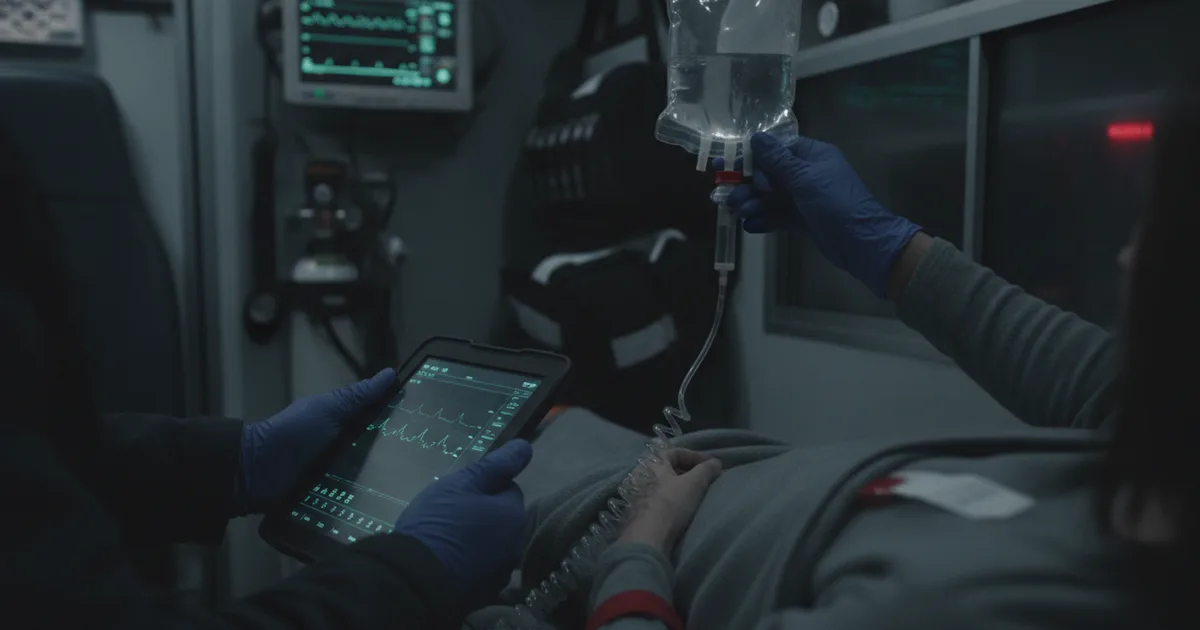
At 03:40, an older adult reports weakness and chills. The family says the patient “just is not right.” Blood pressure is 92/58, respiratory rate is 26, skin is cool, and temperature is 38.6°C. No single monitor number solves the call.
Sepsis is a recognition and communication problem before it becomes a medication problem. The 2026 Surviving Sepsis Campaign adult guideline now suggests using a standard sepsis screening tool for acutely ill adults being transported by ground ambulance or flight, but it does not turn a screen into a diagnosis. (Surviving Sepsis Campaign adult guidelines, 2026)
Your field job is to notice the pattern, treat shock within your protocol, call the receiving team early, and pass on the data that lets them act. A positive screen should sharpen your assessment. A negative screen should not overrule a sick patient.
Start with the patient, not the score
The 2026 guideline describes sepsis as a clinical diagnosis that should not be ruled in or ruled out by one biomarker or one score. It suggests a standard screening tool for acutely ill adults in an ambulance or aircraft, while the strength of that recommendation is very low because the prehospital evidence is limited. (Surviving Sepsis Campaign adult guidelines, 2026)
That distinction matters at the bedside. Ask what changed, when it changed, and what infection source is plausible. Check temperature. Record respiratory rate rather than estimating it from the monitor. Reassess mental status, skin, pulse quality, capillary refill, blood pressure, oxygenation, and glucose when indicated. These findings describe perfusion; no single one proves sepsis. (Sepsis incidence, suspicion, prediction and mortality in emergency medical services, 2024)
The 2024 German EMS cohort shows why missing data are a clinical problem. Across 110,419 prehospital cases, all screening-relevant variables were documented in only 8.2% of cases. Temperature was recorded in 17.8%, and respiratory rate in 27.9%. The study gives medical directors a useful audit question: are crews collecting the inputs that their screening tool needs? (Sepsis incidence, suspicion, prediction and mortality in emergency medical services, 2024)
Use screening to trigger a second look
In that same cohort, NEWS2 had the highest sensitivity of the four evaluated tools for an eventual inpatient sepsis diagnosis, at 73.1%, while qSOFA had the highest specificity but missed more septic cases. The authors did not establish an ideal tool, and the study was observational, based on German data, and limited by missing documentation and an imperfect hospital diagnosis as the reference. (Sepsis incidence, suspicion, prediction and mortality in emergency medical services, 2024)
The operational lesson is simple: use the score your agency has approved, and use it as a prompt. Do not announce that a patient “has sepsis” because a number crossed a threshold. Say what you see: “Suspected infection with tachypnea, hypotension, cool skin, and worsening mental status.” That wording keeps the differential open while giving the receiving hospital a useful warning.
The 2026 guideline recommends NEWS, NEWS2, MEWS, or SIRS over qSOFA as a single screening tool in hospital, but does not name one universal ambulance score. Choose a tool crews can complete reliably, embed it in the patient care report, and audit false negatives and unnecessary alerts. (Surviving Sepsis Campaign adult guidelines, 2026)
Treat hypoperfusion without chasing a number
Sepsis and septic shock are medical emergencies, so treatment and resuscitation should begin immediately. For adults with sepsis-induced hypoperfusion or septic shock, the 2026 guideline suggests at least 30 mL/kg of IV crystalloid in the first three hours, but the recommendation has low certainty. It also supports balanced crystalloids over 0.9% saline during initial resuscitation. (Surviving Sepsis Campaign adult guidelines, 2026)
That is not permission to pour fluid into every patient with fever. Give fluids within protocol and reassess after each aliquot. Watch blood pressure, pulse quality, mental status, work of breathing, lung sounds, skin, and perfusion trend. Heart failure, kidney disease, pulmonary edema, or another diagnosis can change the risk of a fixed volume. The 2026 guideline suggests using dynamic measures to guide fluid resuscitation rather than relying on physical examination or static measures alone, although the evidence is low certainty. (Surviving Sepsis Campaign adult guidelines, 2026)
Persistent hypotension after appropriate fluid therapy needs early medical direction and a vasopressor plan when your system carries and authorizes one. The guideline suggests starting vasopressors peripherally rather than delaying treatment for central access, recommends norepinephrine as the first-line agent for adult septic shock, and gives an initial MAP target of 65 mm Hg. Those recommendations still require a trained crew, a safe local protocol, and close monitoring during transport. (Surviving Sepsis Campaign adult guidelines, 2026)
Do not let the fluid decision delay airway support, oxygen for hypoxemia, glucose treatment when indicated, or transport. Evidence for prehospital antibiotics, fluids, and vasopressors remains limited and inconsistent. (Sepsis management in pre-hospital care – the earlier, the better?, 2024)
Make the hospital call useful
A sepsis alert is more than the phrase “possible sepsis.” Give the receiving team the suspected source, time of change, temperature, respiratory rate, mental status, blood pressure trend, oxygen requirement, perfusion findings, glucose when relevant, screening tool and result, treatments, response, allergies, and estimated arrival time. The 2026 guideline suggests a handoff process that carries critically important information across transitions of care. (Surviving Sepsis Campaign adult guidelines, 2026)
If probable or definite sepsis with hypotension will take more than 60 minutes to reach in-hospital evaluation, the guideline suggests antimicrobial therapy in the ambulance or aircraft. For possible sepsis without shock, it suggests rapid investigation and treatment within three hours if concern persists. Follow the medical director-approved pathway. (Surviving Sepsis Campaign adult guidelines, 2026)
This applies to rural and flight operations. Long transport can create a treatment window, but it also raises the cost of a wrong diagnosis.
For EMS agencies, the target is not “more sepsis alerts.” It is a record showing that the crew measured the right variables, treated in order, and told the hospital why the patient worried them. That work supports Global MedOps Command.
Dr. Chet's Take
I have taken enough HEMS and critical care transport handoffs to know that sepsis rarely arrives with a neat label. It arrives as weakness, confusion, a fall, shortness of breath, or a family member saying the patient is different. The medic who records a real respiratory rate and repeats the blood pressure is doing more than filling a box. That medic is building the first usable picture of the illness.
That being said, I do not want a score to become tunnel vision. qSOFA, NEWS2, and every other tool are aids, not the clinician. I have seen crews worry about whether a patient “qualifies” while the patient gets colder and less responsive. State the concern, treat within protocol, and call early. “I do not know the source yet, but this patient is deteriorating” is a strong handoff.
If you are running this call, make your partner read back four things: vital-sign trend, perfusion findings, treatment response, and your concern. Then document them. A screen starts the conversation; the patient’s trajectory finishes it.
Key Takeaways
- The 2026 guideline suggests a standard screening tool for acutely ill adults transported by ambulance or flight, but sepsis remains a clinical diagnosis. (Surviving Sepsis Campaign adult guidelines, 2026)
- Record the vital signs and perfusion findings your tool requires; missing data weaken recognition and handoff. (Sepsis incidence, suspicion, prediction and mortality in emergency medical services, 2024)
- Treat hypoperfusion within local protocol, reassess, and do not replace patient response with a fixed fluid number. (Surviving Sepsis Campaign adult guidelines, 2026)
- State the vital-sign trend, perfusion findings, treatments, response, and arrival time in the handoff. (Surviving Sepsis Campaign adult guidelines, 2026)
FAQ
What sepsis screening tool should EMS use?
Use the tool approved by your medical director and system protocol. The 2026 Surviving Sepsis Campaign guideline suggests a standard screening tool for acutely ill adults in an ambulance or aircraft, but it does not name one universal ambulance score. (Surviving Sepsis Campaign adult guidelines, 2026)
Can a negative sepsis screen rule out sepsis in the field?
No. Screening tools prompt a second assessment; they do not rule out sepsis. A 2024 EMS cohort found that tools differed in sensitivity and specificity, and the study did not establish an ideal prehospital tool. (Sepsis incidence, suspicion, prediction and mortality in emergency medical services, 2024)
How much fluid should EMS give an adult with septic shock?
Follow the local protocol and reassess the patient after each aliquot. The 2026 guideline suggests at least 30 mL/kg of IV crystalloid in the first three hours for adults with sepsis-induced hypoperfusion or septic shock, but the recommendation has low certainty and does not replace patient-specific assessment. (Surviving Sepsis Campaign adult guidelines, 2026)
When should EMS give antibiotics for suspected sepsis?
The 2026 guideline suggests antimicrobial therapy in the ambulance or aircraft for adults with probable or definite sepsis with hypotension when expected time to in-hospital evaluation is more than 60 minutes. For possible sepsis without shock, it suggests rapid investigation and treatment within three hours if concern persists. Follow the agency’s approved pathway. (Surviving Sepsis Campaign adult guidelines, 2026)
If you're a EMT, paramedic, flight medic, CCTP, or EMS medical director trying to understand how AI will actually impact your clinical practice — not just the hype — I put together a free practical guide. You can download it here: AI in EM Survival Guide.
Sources
- Society of Critical Care Medicine. Surviving Sepsis Campaign Adult Guidelines, 2026
- Robra et al. Sepsis incidence, suspicion, prediction and mortality in emergency medical services: a cohort study related to the current international sepsis guideline
- Lazzarin et al. Sepsis management in pre-hospital care – the earlier, the better?
- Related simulation training: MilMedSim and EM-Sim
- Books by Dr. Shermer