Why Prehospital Stroke Care Matters More Than You Think
The paramedic's role in stroke care extends far beyond "load and go." Research consistently shows that prehospital stroke notification reduces door-to-CT time by 15–20 minutes and door-to-needle time by 20–30 minutes. In a disease where every 15-minute improvement in treatment time saves an average of 1 month of healthy life, your pre-notification call is a therapeutic intervention.
But effective pre-notification requires accurate field identification — and that means going beyond the basic FAST screen.
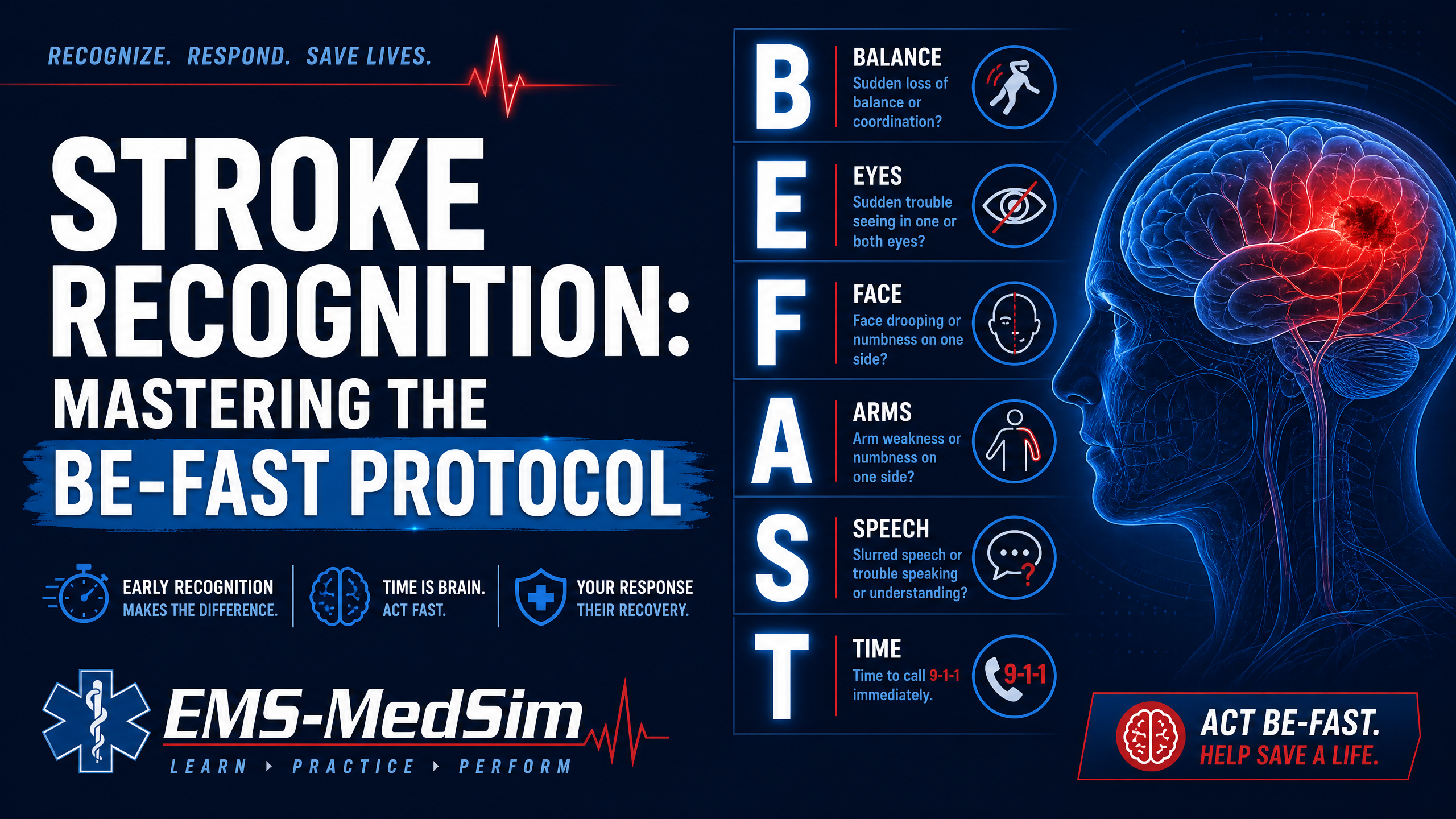
FAST vs. BE-FAST: What You're Missing
The classic FAST mnemonic (Face drooping, Arm weakness, Speech difficulty, Time to call 911) has a sensitivity of approximately 79% for ischemic stroke — meaning roughly 1 in 5 strokes is missed.
The BE-FAST expansion adds two critical anterior circulation findings:
- Balance: Sudden loss of balance or coordination
- Eyes: Sudden vision changes (double vision, loss of vision in one eye, visual field cut)
- Face: Facial droop
- Arm: Arm weakness or drift
- Speech: Slurred speech, word-finding difficulty, or inability to speak
- Time: Time of last known well
BE-FAST adds balance and eyes to catch the posterior-circulation strokes FAST misses. Pooled analyses have not shown it to be a near-perfect screen, and no prehospital scale rules out stroke — a negative screen with a concerning story is still a stroke until proven otherwise.
Always document the time of last known well (LKW) — not when symptoms were discovered, but the last time the patient was definitely at their neurological baseline. This is the critical variable for thrombolytic eligibility.
Identifying Large Vessel Occlusion (LVO)
LVO strokes — occlusion of the internal carotid artery, middle cerebral artery, or basilar artery — require mechanical thrombectomy in addition to or instead of tPA. Thrombectomy-capable centers (comprehensive stroke centers) are not the same as tPA-capable centers (primary stroke centers).
Identifying LVO in the field allows you to bypass a primary stroke center and transport directly to a comprehensive center — potentially saving hours of transfer time.
The Los Angeles Motor Scale (LAMS):
| Finding | Score |
|---|---|
| Facial palsy (absent = 0, present = 1) | 0–1 |
| Arm weakness (absent = 0, drifts = 1, falls = 2) | 0–2 |
| Grip strength (normal = 0, weak = 1, absent = 2) | 0–2 |
A LAMS of 4 or higher raises concern for large vessel occlusion. The widely quoted 81% sensitivity and 89% specificity come from the original derivation cohort (Nazliel 2008); field performance in later studies runs lower. Treat the score as triage support, not a diagnosis. A score of 4 or 5 should prompt consideration of direct transport to a thrombectomy-capable center per local protocol.
Other validated LVO screens include the Cincinnati Prehospital Stroke Severity Scale (CP-SSS) and the Field Assessment Stroke Triage for Emergency Destination (FAST-ED).
The Cincinnati Prehospital Stroke Scale (CPSS)
The CPSS is a simplified 3-item assessment:
- Facial droop: Ask the patient to show their teeth or smile. Abnormal = one side doesn't move as well.
- Arm drift: Ask the patient to close their eyes and hold both arms out for 10 seconds. Abnormal = one arm drifts down or doesn't move.
- Abnormal speech: Ask the patient to say "You can't teach an old dog new tricks." Abnormal = slurred, wrong words, or unable to speak.
Any single CPSS abnormality markedly raises the likelihood of stroke, and the more findings present, the stronger the signal. Fixed percentages depend on the population studied — do not quote one number to a receiving facility as if it were a property of the scale itself.
Stroke Mimics: What Else Looks Like a Stroke
Not every focal neurological deficit is a stroke. Common prehospital stroke mimics:
- Hypoglycemia: Always check a blood glucose. BG < 60 mg/dL can cause focal deficits indistinguishable from stroke. Treat with D50 and reassess.
- Todd's paralysis: Post-ictal focal weakness following a seizure. History of seizure activity is key.
- Hemiplegic migraine: Focal weakness with severe headache. History of similar episodes.
- Bell's palsy: Peripheral facial nerve palsy — affects the entire face including forehead (central strokes spare the forehead due to bilateral cortical representation).
- Hypertensive encephalopathy: Severe hypertension with altered mental status and diffuse neurological findings.
Key distinguishing feature: Stroke deficits are typically sudden onset and maximal at onset. Deficits that progress slowly over hours or days are less likely to be ischemic stroke.
Optimizing Your Stroke Alert
An effective prehospital stroke alert includes:
- Patient age and sex
- Time of last known well (not symptom discovery time)
- CPSS or BE-FAST findings (which deficits are present)
- LAMS score (if LVO screen was performed)
- Blood glucose
- Current medications (anticoagulants are critical for tPA eligibility)
- Estimated time of arrival
Give this information in a structured format — not a narrative. Receiving facilities use this data to activate their stroke team, prepare the CT scanner, and pre-mix tPA before you arrive.
Blood Pressure Management in Suspected Stroke
Ischemic stroke: Do not aggressively treat hypertension in the field. The elevated BP is often compensatory, maintaining perfusion to the ischemic penumbra. Target BP < 220/120 mmHg only if there is evidence of hypertensive emergency (aortic dissection, pulmonary edema, hypertensive encephalopathy).
Hemorrhagic stroke: More aggressive BP management may be appropriate per local protocol. Target systolic < 180 mmHg is a common threshold, though evidence for prehospital intervention is limited.
When in doubt, consult medical direction.
Practice stroke recognition and management with EMS-MedSim's prehospital simulation scenarios. Try a free scenario — no account required.
Frequently Asked Questions
What does BE-FAST add over FAST?
Balance and Eyes — the posterior-circulation deficits (ataxia, vertigo, visual field loss, diplopia) that FAST screening misses.
How is a large vessel occlusion suspected in the field?
With a severity scale such as the Los Angeles Motor Scale; high scores raise LVO suspicion and can justify transport to a thrombectomy-capable center under local protocol.
What are the common stroke mimics?
Hypoglycemia, seizure with Todd's paralysis, complicated migraine, sepsis, and intoxication — which is why a glucose check belongs on every suspected stroke.