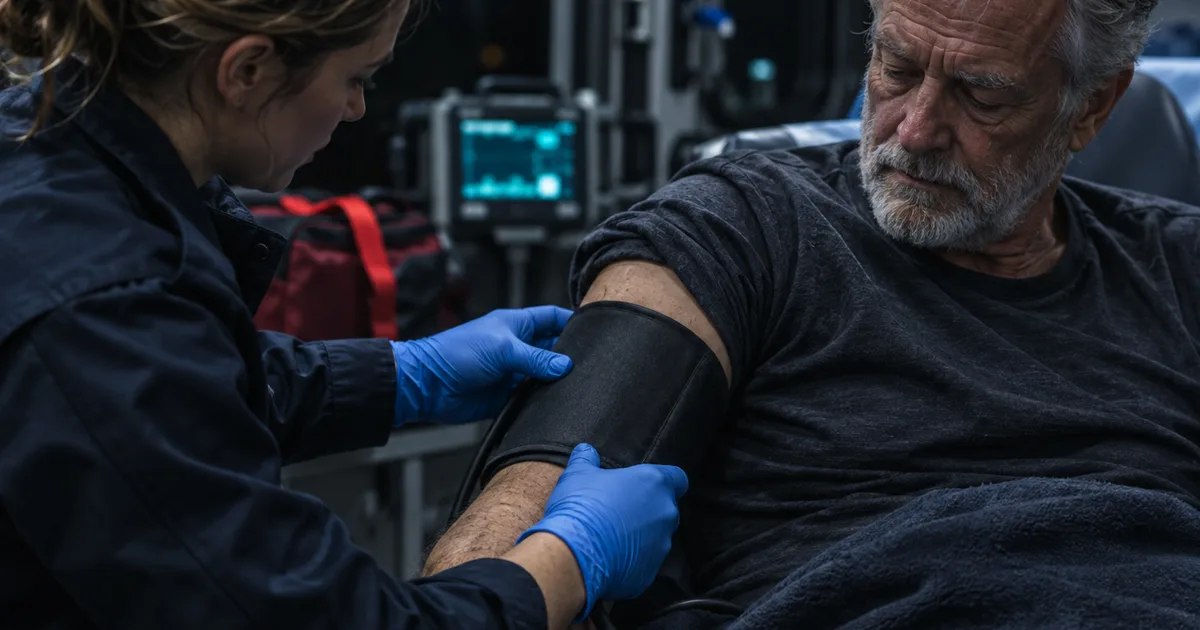
The retired welder's wife found him slumped over the kitchen table 40 minutes ago, his right arm useless and his words coming out thick. In the back of the truck his pressure reads 194/106 on the automatic cuff, his glucose is 118, and his right arm drifts to the stretcher in under ten seconds. Your partner pulls up the stroke checklist and asks the question every crew eventually asks: should we bring that pressure down before we get there? Nobody on board knows yet whether this is a clot or a bleed.
Bottom line: for undifferentiated suspected stroke, intensive blood pressure lowering in the ambulance does not improve outcomes, and the largest trial found harm in the patients whose stroke turned out to be ischemic. Leave the pressure alone in the field unless the patient has a separate indication to treat it.
What INTERACT4 Tested
INTERACT4 was a multicenter, open-label randomized trial with blinded outcome assessment, run by ambulance services in China [1]. Crews enrolled adults with suspected acute stroke, a motor deficit, and a systolic pressure of 150 mm Hg or higher, assessed within 2 hours of symptom onset. Patients in coma, with severe coexisting disease, epilepsy, recent head injury, or hypoglycemia were excluded [1].
The intervention arm received IV urapidil, an alpha-blocker, as a 25 mg bolus over 1 minute, repeatable once after 5 minutes. The target was a systolic pressure of 130 to 140 mm Hg within 30 minutes, held until hospital arrival, with treatment stopped at 130 mm Hg. In the usual-care arm, crews treated pressure in the ambulance only at a systolic of 220 mm Hg or higher or a diastolic of 110 mm Hg or higher [1].
The trial randomized 2,404 patients: 1,205 to intervention and 1,199 to usual care. Mean age was 70, median time from onset to randomization was 61 minutes, and mean pressure at randomization was 178/98 [1].
The Overall Result Was Neutral
The drug worked on the number. Mean systolic pressure at hospital arrival was 159 mm Hg in the intervention group and 170 mm Hg in the usual-care group [1].
The patients did not do better. The primary outcome, the distribution of modified Rankin Scale scores at 90 days, was identical between groups (common odds ratio 1.00, 95% CI 0.87 to 1.15). Serious adverse events were similar: 331 patients (27.5%) in the intervention group and 344 (28.7%) in the usual-care group had at least one [1].
An 11 mm Hg separation at the door bought nothing overall, and the field population is the whole population.
Bleeds and Clots Pulled in Opposite Directions
Imaging confirmed stroke in 2,240 patients, and 1,041 of them (46.5%) had a hemorrhagic stroke [1]. That share is far higher than in RIGHT-2 (13%) or MR ASAP (17%), and it matters for interpreting what came next [3][4].
In the hemorrhagic group, early lowering was associated with lower odds of a poor functional outcome (common OR 0.75, 95% CI 0.60 to 0.92). In patients with cerebral ischemia, it was associated with higher odds of a poor outcome (common OR 1.30, 95% CI 1.06 to 1.60) [1]. The investigators state that these subgroup analyses were not part of the hierarchical statistical plan and that no causal inference can be drawn from them [1].
Read that split from the stretcher. The ICH benefit depends on a population where nearly half the strokes were bleeds. In a system where ischemic stroke dominates the case mix, the same protocol pushes more patients toward the arm that did worse. No prehospital scale, cuff reading, or headache history reliably tells you which stroke you are carrying, and the guideline lists better field tools for stroke subtype as an open research need [7].
The ICH signal also has company. A 2025 individual-patient pooled analysis of the four INTERACT trials (11,312 patients with ICH) compared intensive lowering, a systolic target below 140 mm Hg within 1 hour, against guideline treatment with a target below 180 mm Hg. Intensive lowering reduced the odds of a poor functional outcome (OR 0.85, 95% CI 0.78 to 0.91), neurological deterioration within 7 days (OR 0.76), and death (OR 0.83). In the CT substudy, the benefit faded with time from onset and crossed unity at about 3 hours [6]. That supports fast lowering once a bleed is confirmed on a scan, which is a hospital decision.
The Nitroglycerin Patch Trials
Two European trials tested transdermal glyceryl trinitrate (GTN) given by paramedics.
RIGHT-2 was a sham-controlled, blinded-endpoint trial across eight UK ambulance services. It enrolled 1,149 adults with presumed stroke within 4 hours of onset, a FAST score of 2 or 3, and a systolic pressure of 120 mm Hg or higher, and gave GTN 5 mg daily for 4 days or a sham patch. GTN lowered systolic pressure by 5.8 mm Hg at admission. In patients with confirmed stroke or TIA, the adjusted common OR for poor outcome was 1.25 (95% CI 0.97 to 1.60), a nonsignificant lean toward harm. Serious adverse events were 188 with GTN and 170 with sham [4].
MR ASAP, run in the Netherlands, enrolled adults with a paramedic-diagnosed probable stroke, a FAST score of 2 or 3, a systolic of 140 mm Hg or higher, and treatment possible within 3 hours. It compared a GTN 5 mg/day patch for 24 hours plus standard care against standard care alone. The trial stopped early, at 325 analyzed patients, for safety concerns in ICH. Overall 90-day function did not differ (adjusted common OR 0.97, 95% CI 0.65 to 1.47). Among patients with ICH, 7-day death occurred in 12 of 35 (34%) with GTN versus 2 of 21 (10%) with standard care, while 90-day death was 46% versus 55% [3]. The authors concluded GTN should be avoided in this setting.
A 2026 meta-analysis of four randomized trials of prehospital lowering in hemorrhagic stroke (642 treated, 617 usual care) found no improvement in good functional outcome (RR 1.07, 95% CI 0.52 to 2.19) or 3-month mortality (RR 0.90, 95% CI 0.60 to 1.35). Urapidil outperformed GTN on serious adverse events and hematoma expansion [5].
What the 2026 Guideline Says
The 2026 AHA/ASA acute ischemic stroke guideline addresses both strategies directly in its prehospital section [7]:
- Intensive field control to a systolic target of 130 to 140 mm Hg in suspected stroke does not improve functional outcome (Class 3: No Benefit, Level B-R).
- Prehospital transdermal GTN does not improve functional outcome and is potentially harmful (Class 3: Harm, Level A).
The guideline does keep early treatment of hypertension when a comorbid condition requires it, such as an acute coronary event, acute heart failure, aortic dissection, or preeclampsia/eclampsia [7]. Those are the field exceptions. The pressure thresholds for thrombolysis, below 185/110 before the drug and below 180/105 for 24 hours after, belong to the receiving team [7].
Implementation is its own problem. A process evaluation of INTERACT4 found that nearly 90% of eligible patients received the first urapidil dose, yet only 31.7% reached the prehospital systolic target below 140 mm Hg. Systems with very short transport times and frequent handovers had more protocol deviations [2]. Even a trial built around this intervention struggled to deliver it on a short urban run.
Key Takeaways
- INTERACT4 lowered arrival systolic pressure by 11 mm Hg with urapidil and produced no functional benefit (common OR 1.00) in 2,404 patients with suspected stroke.
- The subgroup split ran both ways: OR 0.75 for poor outcome in hemorrhagic stroke, OR 1.30 in cerebral ischemia, with nearly half the cohort hemorrhagic.
- The 2026 AHA/ASA guideline rates field intensive BP control as Class 3: No Benefit and prehospital GTN as Class 3: Harm, the latter driven by early ICH deaths in MR ASAP (34% vs 10% at 7 days).
- Treat field hypertension only for a separate indication such as ACS, acute heart failure, aortic dissection, or eclampsia, and spend the saved minutes on a stroke-severity screen, last known well, glucose, and an early prenotification.
FAQ
Should EMS lower blood pressure in a suspected stroke patient?
Not for the stroke itself. In patients with undifferentiated suspected stroke, intensive field lowering to a systolic of 130 to 140 mm Hg did not improve 90-day function, and the 2026 AHA/ASA guideline rates it Class 3: No Benefit [1][7]. Treat hypertension in the field only when another condition requires it, such as an acute coronary event, acute heart failure, aortic dissection, or preeclampsia/eclampsia [7].
What did the INTERACT4 trial find?
INTERACT4 randomized 2,404 ambulance patients in China with suspected stroke, a motor deficit, and a systolic of 150 mm Hg or higher within 2 hours of onset to urapidil targeting 130 to 140 mm Hg or usual care [1]. Function at 90 days was the same in both groups (common OR 1.00), and serious adverse events were similar. Subgroup results pointed toward benefit in hemorrhagic stroke and harm in cerebral ischemia, which the investigators said cannot be read as causal [1].
Is nitroglycerin safe for stroke patients in the ambulance?
Transdermal nitroglycerin did not improve outcomes in RIGHT-2 or MR ASAP, and MR ASAP stopped early after more early deaths in patients with intracerebral hemorrhage [3][4]. The 2026 AHA/ASA guideline classifies prehospital GTN for suspected stroke as Class 3: Harm [7]. A patient with chest pain and a possible stroke needs a physician conversation before any nitrate goes on.
Dr. Chet's Take
I have spent years as a HEMS and critical care transport medical director, and I know the pull a big number has on a crew. A systolic near 200 feels like a problem you can fix, and fixing things is why most of us got into this work. This article lands where the evidence lands: for the undifferentiated patient, the pressure is not the emergency. The diagnosis is, and the diagnosis lives in the scanner. A protocol that asks a paramedic to pick a drug based on a guess about clot versus bleed is a protocol written for the wrong half of the patients, every time. The core argument holds, and it holds more firmly in a US system than in the trial that produced it, because our case mix tilts toward ischemia. That is the population the subgroup data put on the wrong side of the line.
That being said, the article treats the field as one setting, and it is two. The scene call is undifferentiated. The interfacility transfer after a CT is not. When a sending ED has already read a hemorrhage and started a drip, the crew is carrying a confirmed diagnosis with a physician target, and the logic of leaving pressure alone no longer applies. The honest answer is that the pooled hemorrhage data are what make me want that drip running during transport, not paused because the stroke protocol says hands off. I also worry about the automated cuff in a moving aircraft or rig, which reads high and low at the worst times. One wild number should prompt a repeat and a manual check, not a medication. Trend matters more than any single reading, and the receiving team needs that trend handed off clearly.
If you are the medical director, pull your stroke protocol tonight and look for any line that lowers pressure in an undifferentiated scene patient; strike it and replace it with the short list of conditions that do justify treatment. Then write a separate interfacility pathway for confirmed hemorrhage that carries the sending physician's target, the drug, and a reassessment interval. If you are running this call, your job is recognition, last known well, a clean set of serial pressures, and the right destination. If you are flying a confirmed bleed, confirm the target, the stop point, and the backup plan for overshoot with the sending physician before you lift. Pressure management for the stroke itself begins after imaging, and that call belongs to the receiving team.
— Chester Shermer, MD, FACEP | Emergency Medicine, 25+ Years Clinical Experience | State Surgeon
Continue Your Training
If you're an EMT, paramedic, flight medic, or CCTP (or any clinician treating patients daily) trying to understand how AI will actually impact your clinical practice — not just the hype — I put together a free practical guide. You can download the AI in EM Survival Guide here.
Browse All Courses at Global MedOps Command
Relevant Reading on Global MedOps Command:
How to Avoid Becoming an AI Casualty — Dr. Shermer's guide to navigating AI tools in clinical and operational settings without compromising judgment or patient outcomes.
Emergency Department Efficiency Playbook — Practical systems for throughput, triage optimization, and operational efficiency.
Read more from Dr. Shermer on Medium
Connect with Dr. Shermer: LinkedIn — Chester "Chet" Shermer, MD, FACEP.
References
- Li G, Lin Y, Yang J, et al. Intensive ambulance-delivered blood-pressure reduction in hyperacute stroke. N Engl J Med. 2024;390(20):1862-1872. PubMed 38752650
- Gao X, Chen C, Lin Y, et al. Feasibility and challenges of ambulance-delivered blood pressure lowering in hyperacute stroke. Cerebrovasc Dis. 2026:1-11. PubMed 42081391
- van den Berg SA, Uniken Venema SM, Reinink H, et al. Prehospital transdermal glyceryl trinitrate in patients with presumed acute stroke (MR ASAP): an ambulance-based, multicentre, randomised, open-label, blinded endpoint, phase 3 trial. Lancet Neurol. 2022;21(11):971-981. PubMed 36058230
- Bath PM, Scutt P, Anderson CS, et al. Prehospital transdermal glyceryl trinitrate in patients with ultra-acute presumed stroke (RIGHT-2): an ambulance-based, randomised, sham-controlled, blinded, phase 3 trial. Lancet. 2019;393(10175):1009-1020. PubMed 30738649
- Theodorou A, Melanis K, Palaiodimou L, et al. Prehospital blood pressure lowering in acute hemorrhagic stroke: a systematic review and meta-analysis of randomized controlled clinical trials. Eur Stroke J. 2026;11(1):aakaf023. PubMed 41614481
- Wang X, Ren X, Li Q, et al. Effects of blood pressure lowering in relation to time in acute intracerebral haemorrhage: a pooled analysis of the four INTERACT trials. Lancet Neurol. 2025;24(7):571-579. PubMed 40541207
- Prabhakaran S, Gonzalez NR, Zachrison KS, et al. 2026 Guideline for the early management of patients with acute ischemic stroke: a guideline from the American Heart Association/American Stroke Association. Stroke. 2026;57(8):e316-e436. PubMed 41582814
Related simulation training: EM-Sim · Books by Dr. Shermer