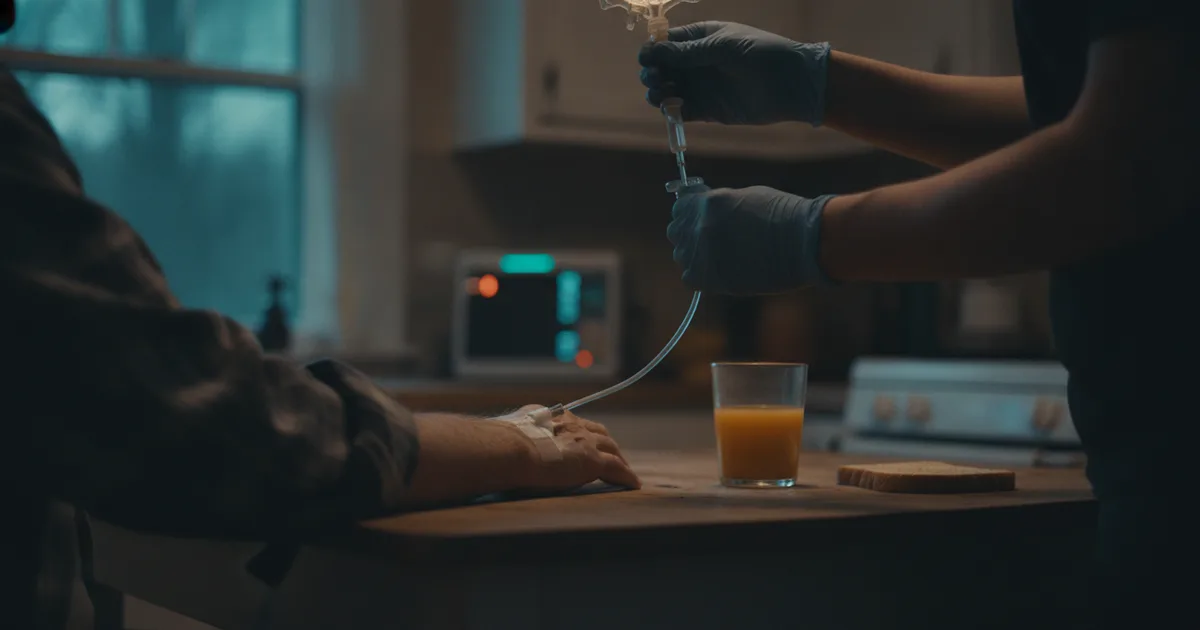
At 0600 a wife calls because her husband will not wake up properly. He is 68, a retired long-haul trucker with type 2 diabetes who takes glipizide, a sulfonylurea. He is sweating and confused, GCS 9, and the fingerstick reads 31 mg/dL. Your partner gets an IV in the back of his hand, and you give 5 g of 10% dextrose (D10), recheck (48 mg/dL), and give a second 5 g. Eight minutes after the first step he is talking, the recheck reads 104 mg/dL, and he wants to stay home and eat breakfast.
Bottom line: in the only field trial, D10 given in measured steps woke adults with no significant difference in time from 50% dextrose (D50), with less total dextrose and lower glucose afterward. Pooled data add a few minutes to wake-up with D10 and report fewer adverse events. Waking up is the start of the disposition decision, and a patient on a sulfonylurea has a strong case for transport.
What the Trials Compared
The only randomized trial in the field is small. In a UK ambulance service, 51 unresponsive adults with glucose of 4 mmol/L (72 mg/dL) or less received 5 g aliquots of either D10 (50 mL) or D50 (10 mL), up to 25 g [1]. Time to recovery did not differ significantly between the groups (median 8 minutes) [1]. The D10 group needed a median of 10 g against 25 g for D50, and its post-treatment glucose was lower (6.2 versus 9.4 mmol/L, about 112 versus 169 mg/dL) [1]. Four patients in each group had another hypoglycemic episode within 24 hours, and neither group had an extravasation injury [1].
Two cohorts from the same California system tested a 100 mL bag of D10 (10 g) as the first dose. In Contra Costa County, California, 164 patients with complete data rose from a median 38 to 98 mg/dL, rechecked at a median of 8 minutes, and 18% needed a second dose [2]. In a later 104-week cohort, 1,323 patients were treated with D10, and the 871 with complete data rose from a median 37 to 91 mg/dL, 23.0% needed a second dose, 0.8% needed a third, and no adverse events from D10 were reported [3].
A retrospective comparison of 161 D10 patients and 150 D50 patients transported to one academic center found no significant difference in retreatment before arrival (0.6% versus 2.0%) [4]. Glucose was lower with D10 at the field recheck (124.6 versus 151.9 mg/dL) and at hospital arrival, and admission, length of stay and in-hospital mortality did not differ [4].
The Trade-Off in the Pooled Data
A 2021 systematic review pooled 11 studies: 3 randomized trials, only one of which compared D10 with D50, and 8 observational studies [5]. Symptoms resolved in 95.9% of D10 patients and 88.8% of D50 patients [5]. Resolution took about four minutes longer with D10 (8.0 versus 4.1 minutes), and more D10 patients needed another dose (19.5% versus 8.1%) [5]. Post-treatment glucose was 6.2 mmol/L with D10 and 8.5 mmol/L with D50 [5]. The review found no adverse events in 1,057 D10 patients and 13 in 310 D50 patients [5]. Most of that pooled evidence is observational, so the authors concluded that D10 "may be as effective" as D50 [5].
The newest comparison comes from the emergency department. In a 2026 single-center retrospective study of 375 adults, D50 reached euglycemia sooner than D10 (38 versus 51 minutes), a difference that was not statistically significant (p = 0.053) [6]. Rebound hypoglycemia within 6 hours was more common after D50 (43.4% versus 27.2%) [6]. In patients who started below 40 mg/dL, time to euglycemia was the same, 34.5 minutes in each group [6]. The setting differs. D50 was again faster, but here rebound lows were more common after D50, while the pooled field data found more repeat doses after D10.
How to Give D10 Without a Dosing Error
A 100 mL bag of D10 holds 10 g of dextrose. The studies that support D10 gave a fixed amount, 5 g steps or one 100 mL bag, and checked glucose before giving more [1,2]. A bag that holds more than the intended dose, or any bag connected to a child, has no built-in limit.
That risk is not theoretical in children. In a 2026 Michigan simulation study of pediatric dosing, an infant seizure case with hypoglycemia produced three D10 overdoses of 540%, 557% and 830% of the intended dose [7]. All three happened when crews connected the D10 bag line to the patient's IV instead of drawing the needed volume into a syringe [7]. The authors called it a potentially fatal latent safety threat [7]. The same mechanism applies to adults: the dose is whatever leaves the bag. Our post on prehospital drug errors covers how these errors get built into a system.
For the responsive adult who can swallow, guidelines generally recommend 15 g to 20 g of oral glucose, repeated after 10 to 15 minutes [8].
Where Glucagon Fits
For the unresponsive adult, the guidelines name 10% IV dextrose or 1 mg of intramuscular glucagon [8]. A 2017 review of those guidelines found the evidence limited, often low grade, and mostly older than current diabetes care [8]. In the field, glucagon is the usual choice when vascular access fails [9].
Intranasal glucagon has little field data. One US EMS system reviewed 44 cases from 2015 to 2020 in which paramedics gave intranasal glucagon and no other hypoglycemia treatment [9]. Mental status improved substantially in 32%, slightly in 30%, and not at all in 38% [9]. In the patients who did not improve, mean glucose went from 30.1 to 33.1 mg/dL [9]. The series is small, retrospective, and excluded every patient who also received another treatment, so the 38% figure is not a failure rate for the route. It is a reason to keep the IV or IO plan moving and to recheck glucose.
Glucagon given on scene also turns up as a predictor of admission in the disposition data below. That is most likely a marker of sicker patients, and it belongs in the disposition decision.
Deciding on Non-Transport
The best data on non-transport come from a 12-month Ontario health record review of 791 adults with field glucose below 72 mg/dL [10]. At the time Ontario had no prehospital treat-and-release protocol, and 69.4% accepted transport [10]. Overall, 43 patients (5.4%) came back to EMS or an emergency department within 72 hours, and 8 of those returns were for hypoglycemia [10]. Refusing transport did not predict a return (aOR 1.1, 95% CI 0.5 to 2.4), and patients on insulin were less likely to return (aOR 0.4) [10].
The same research group then analyzed which of 791 patients ended up admitted [11]. Admission was more likely with no documented diabetes (aOR 2.35), cardiovascular disease (aOR 1.81), corticosteroid use (aOR 4.63), oral hypoglycemic agents (aOR 1.92), or glucagon on scene (aOR 1.77) [11]. It was less likely in patients on insulin (aOR 0.49), patients who tolerated complex carbohydrates and protein by mouth (aOR 0.22), and patients with a final GCS of 15 (aOR 0.53) [11].
Sulfonylureas deserve their own line. In an Auckland review of 185 adults with type 2 diabetes on a sulfonylurea who came to hospital with severe hypoglycemia, more than a third had recurrent hypoglycemia in hospital, and 15% were readmitted within 28 days, 13 of them for further hypoglycemia [12]. Those were hospital patients, so the figures are not a field recurrence rate, but they explain why the trucker in the opening is a poor candidate to stay home.
A 2026 southwestern Ontario study of 1,596 patients potentially eligible under treat-and-discharge directives for resolved hypoglycemia, seizure or SVT found 2.2% discharged by paramedics, 29.7% refusing transport, and 68.0% transported [13]. Among hypoglycemia patients, 58.9% refused [13]. The authors state that safety still needs study [13]. Treat-and-release is a medical director decision written into protocol, and a refusal still needs a capacity assessment; see our refusal checklist.
Key Takeaways
- Give D10 in 5 g to 10 g steps and recheck glucose before each additional step; in the field trial, D10 patients needed a median 10 g against 25 g for D50, with no significant difference in time to recovery.
- Expect about 1 in 5 adults to need a second D10 dose (18% to 23% in field cohorts), and plan for it.
- Never connect a D10 bag to a child's IV without a measured limit; in a 2026 pediatric simulation, that caused overdoses of 540% to 830%.
- Before a non-transport, weigh the admission predictors: no diabetes history, corticosteroids, oral glucose-lowering agents, cardiovascular disease, or glucagon on scene. A sulfonylurea is a strong reason to transport.
FAQ
Is D10 as effective as D50 for prehospital hypoglycemia?
In the one randomized field trial, time to recovery did not differ significantly (median 8 minutes), and D10 used less total dextrose [1]. Pooled data show symptom resolution of 95.9% with D10 and 88.8% with D50, but resolution took about four minutes longer with D10 and more patients needed a repeat dose [5]. Most of the pooled evidence is observational.
How much D10 do you give an adult with low blood sugar?
Field cohorts gave 100 mL of D10 (10 g) as the first dose and rechecked at a median of 8 minutes; 18% to 23% needed a second dose [2,3]. The randomized trial used 5 g steps to a maximum of 25 g [1]. Your agency protocol sets the exact dose.
Can a hypoglycemic patient refuse transport after treatment?
Yes, if they have decision-making capacity, and some systems authorize paramedic discharge by protocol. In an Ontario cohort, refusing transport did not predict a return to care within 72 hours [10]. Admission was more likely in patients without a diabetes history, on corticosteroids or oral agents, or given glucagon [11].
Dr. Chet's Take
I have practiced emergency medicine for more than 25 years, I work at a Level I academic trauma center, and I serve as medical director for a HEMS and critical care ground transport service. This article gets the main argument right, and the core of it holds. Dextrose you have already pushed cannot be taken back. Dextrose you give in steps lets you stop the moment the patient is awake and the number is safe. The trial data are thin, and the authors of the pooled review say so plainly. Nothing in them argues for the full 25 g push as the default. There is also a practical point the article leaves out. The California system in the first D10 cohort switched partly because D50 was often short and cost more. A drug you reliably have on the truck is worth more than one that may work a few minutes faster but that you sometimes do not have.
That being said, the article treats the patient who wakes up as a disposition question, and I would push it one step further. The question I care about is why he was low this morning. A skipped meal after a normal dinner is one story. A new antibiotic, a recent dose increase, a stomach bug, or kidneys that are slowly failing is a different story, and it does not end when the glucose reads 104. The honest answer is that a fingerstick cannot tell you which story you are in. The history can. Ask about the last meal, every medicine started or changed in the past two weeks, any vomiting or diarrhea, and who will be in the house tonight. Then look at the pill bottles yourself, because the family's list and the bottles do not always agree.
If you are the medical director, audit your D10 calls for two things: whether the crew rechecked glucose before giving more, and whether any patient received a second bag with no documented reading in between. If you are running the call and the patient wants to stay, write down what he ate in front of you, the medicine list you reviewed, and the name of the adult who is staying with him. Tell that adult the last reading, when he must eat again, and exactly which signs mean they call 911 back, then document that you did. If anything in the history does not add up, transport. For the patient on a sulfonylurea, my default is transport, and if he declines, the chart should say why. A good refusal is one you can defend from the chart alone.
— Chester Shermer, MD, FACEP | Emergency Medicine, 25+ Years Clinical Experience | State Surgeon
Continue Your Training
If you're an EMT, paramedic, flight medic, or CCTP (or any clinician treating patients daily) trying to understand how AI will actually impact your clinical practice — not just the hype — I put together a free practical guide. You can download the AI in EM Survival Guide here.
Browse All Courses at Global MedOps Command
Relevant Reading on Global MedOps Command:
How to Avoid Becoming an AI Casualty — Dr. Shermer's guide to navigating AI tools in clinical and operational settings without compromising judgment or patient outcomes.
Emergency Department Efficiency Playbook — Practical systems for throughput, triage optimization, and operational efficiency.
Read more from Dr. Shermer on Medium
Connect with Dr. Shermer: LinkedIn — Chester "Chet" Shermer, MD, FACEP.
References
- Moore C, Woollard M. Dextrose 10% or 50% in the treatment of hypoglycaemia out of hospital? A randomised controlled trial. Emerg Med J. 2005;22(7):512-515. PubMed 15983093
- Kiefer MV, Gene Hern H, Alter HJ, Barger JB. Dextrose 10% in the treatment of out-of-hospital hypoglycemia. Prehosp Disaster Med. 2014;29(2):190-194. PubMed 24735872
- Hern HG, Kiefer M, Louie D, et al. D10 in the treatment of prehospital hypoglycemia: a 24 month observational cohort study. Prehosp Emerg Care. 2017;21(1):63-67. PubMed 27918858
- Weant KA, Deloney L, Elsey G, et al. A comparison of 10% dextrose and 50% dextrose for the treatment of hypoglycemia in the prehospital setting. J Pharm Pract. 2021;34(4):606-611. PubMed 31769338
- Hurtubise M, Stirling J, Greene J, et al. Dextrose 50% versus dextrose 10% or dextrose titration for the treatment of out-of-hospital hypoglycemia: a systematic review. Prehosp Disaster Med. 2021;36(6):730-738. PubMed 34605385
- Fischer D, Lutz G. D10 vs. D50 for the treatment of hypoglycemia in the emergency department. J Emerg Med. 2026;89:100-108. PubMed 42731515
- Hoyle JD, Ekblad G, Dunwoody S, et al. Effect of a drug dosing safety bundle initiative to improve pediatric drug dosing by paramedics: results of the Michigan Pediatric EMS Error Reduction Study (MI-PEERS). Prehosp Emerg Care. 2026;30(6):865-874. PubMed 41563894
- Villani M, de Courten B, Zoungas S. Emergency treatment of hypoglycaemia: a guideline and evidence review. Diabet Med. 2017;34(9):1205-1211. PubMed 28477413
- Haamid A, Christian E, Tataris K, et al. Prehospital intranasal glucagon for hypoglycemia. Prehosp Emerg Care. 2023;27(3):356-359. PubMed 35200091
- Sinclair JE, Austin M, Froats M, et al. Characteristics, prehospital management, and outcomes in patients assessed for hypoglycemia: repeat access to prehospital or emergency care. Prehosp Emerg Care. 2019;23(3):364-376. PubMed 30111210
- Sinclair JE, Austin MA, Leduc S, et al. Patient and prehospital predictors of hospital admission for patients with and without histories of diabetes treated by paramedics for hypoglycemia: a health record review study. Prehosp Emerg Care. 2023;27(7):955-966. PubMed 36264569
- Braatvedt GD, Sykes AJ, Panossian Z, McNeill D. The clinical course of patients with type 2 diabetes presenting to the hospital with sulfonylurea-induced hypoglycemia. Diabetes Technol Ther. 2014;16(10):661-666. PubMed 25010949
- Strum RP, Mondoux S, Dodd T, et al. Utilization and metrics associated with paramedic treat and discharge medical directives for paramedic services and emergency departments: a retrospective cohort study. Prehosp Emerg Care. 2026:1-9. PubMed 42066243
Related simulation training: EMS-MedSim · EM-Sim · Books by Dr. Shermer